WORLD SPORT HISTORY.
Looking Back: WFF-WBBF Searched for New Paths in the Development of International Sport.
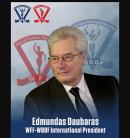
The years 2003–2005 were an important turning point in the history of WFF-WBBF. After German Klaus P. J. Hoffmann withdrew from active international sports activities within the part of the WFF-WBBF federation he had led, Dr. Edmundas Daubaras became the sole leader of the organization continuing to oversee the federation’s international activities and its directions for sports development.
At that time, the federation faced not only organizational challenges but also much broader strategic questions: How should international sport continue to develop? What direction should fitness take? And how could a sports model be created that would not simply reproduce the traditional principles of bodybuilding?
Tradition Does Not Always Mean Progress
For decades, established models had become deeply rooted in the world of bodybuilding. Yet tradition in itself does not necessarily mean progress.
The WFF-WBBF leadership understood that moving forward required more than organizing another competition in the same format or mechanically repeating solutions that were already familiar. It was necessary to look for innovations, experiment, observe the results and not be afraid to change what had long been considered self-evident.
This approach had already been visible in the federation’s activities before 2003. In 1999, WFF-WBBF introduced children’s “Fit-Kid” and disabled athletes’ categories into its activities. This was an important step that broadened the very concept of sport – sport was no longer viewed solely as competition among elite athletes, but also as an activity in which children and people with disabilities should have their place.
Beginning in 2004, the federation also started organizing fitness model competitions. These decisions were not accidental. They reflected a broader effort to search for new forms of sport and to expand the very concept of fitness as a sporting discipline.
2004 – A Year of Experimentation
The year 2004 became a particularly significant period. Numerous national and international competitions were held in Lithuania, a major international “Amber Prix” tournament was organized in Riga, and an important European Championship took place in Moscow.
However, the significance of these events went beyond the sporting results themselves. At that time, WFF-WBBF was actively experimenting with different categories, judging criteria and competition formats.
The federation was searching for an answer to a fundamental question: What should the direction of modern international fitness sport be?
In many respects, this was an experimental period. Rather than simply adapting to an existing model, the federation was looking for ways to change it itself. What mattered was not only how an athlete looked on stage, but also how competitions could be organized, how athletes could be evaluated and how the sport could be perceived by spectators.
The goal was to find an optimal balance between athletic preparation, aesthetics, the attractiveness of competitions and the organization of international sport.
Vilnius – A Center of International Sport
One of the most important events of 2004 was the WFF-WBBF World Championship held at the Vilnius Congress Palace.
The event also received state-level attention. The championship was supported by the Government of the Republic of Lithuania, while an extensive report on the competition was broadcast by Lithuanian national television.
The championship brought together 378 athletes from 28 countries around the world. These figures clearly demonstrate the scale and international character of the event.
Almost all participating athletes were provided with free accommodation and meals in Vilnius hotels. Behind these figures was an enormous amount of organizational work. Hundreds of foreign athletes had to be welcomed, accommodated and provided with meals, while the organizers also had to manage the competition program, judging and countless other details involved in staging a major international event.
The 2004 World Championship therefore became not only a sporting challenge but also a major organizational test for WFF-WBBF.
The Creation of a Professional League
That same year, the federation took another significant step – it established a professional league and incorporated professional competitions into its official competition program.
This was important because the goal was not merely to create a system of individual championships, but a broader sports structure in which elite professional athletes could also have their place.
In this way, WFF-WBBF sought to connect different stages of an athlete’s sporting career – from children’s and amateur sport to the professional level.
State Attention to International Sport
The chairman of the organizing committee of the 2004 World Championship was Gediminas Kirkilas, at the time, a member of the Parliament of the Republic of Lithuania and Minister of National Defence, and later, from 2006, Prime Minister of Lithuania.
He personally signed the diplomas presented to the competition winners and participated in the international WFF-WBBF press conference held at the ELTA news agency.
These facts are also an important part of the history of that period. They demonstrate that WFF-WBBF international events in Lithuania attracted attention not only within the sporting community but also in broader public and governmental circles.
The 2004 World Championship – A Test of the Chosen Direction
The 2004 World Championship became, in a sense, a test of the direction WFF-WBBF had chosen.
The new categories, judging principles, competition formats and the concept of professional sport that had been tested previously were brought together within a major international event.
This is where one of the most important characteristics of that period can be seen: WFF-WBBF did not limit itself to declarations about sports development. It attempted to put its ideas into practice.
2005 – Continuation of the Direction
This work continued in 2005.
Another major WFF-WBBF World Championship was held over two days at the Vilnius Congress Palace. The chairman of its organizing committee was Algirdas Butkevičius, who at the time was a member of the Parliament of the Republic of Lithuania and Minister of Finance.
The fact that another major international event was organized following the 2004 World Championship demonstrated the continuity of the direction that had been chosen.
More Than Competitions – Searching for the Future of Sport
Looking back at these events from a broader historical perspective, the period of 2003–2005 should not be regarded simply as another stage in the organization of international competitions.
It was a period in which the federation was searching for an answer to a much more complex question:
What direction should sport itself take?
At that time, WFF-WBBF attempted to move beyond the traditional boundaries of bodybuilding. Children’s “Fit-Kid,” sport for people with disabilities, fitness model competitions, new categories, experiments with judging criteria and the creation of a professional league were different expressions of one broader direction.
The aim was to create a sports system that would be broader, more diverse and more open to different groups of athletes.
Therefore, the history of this period should not be measured solely by the number of medals won or competitions organized. Much more important was the attempt to change the very approach to sports development.
A simple truth was recognized – a truth that is not always implemented by sports organizations:
If sport wants to remain alive and attractive, it cannot stand still forever.
History Is Also About What People Dared to Search For
In 2003–2005, WFF-WBBF chose the path of exploration.
The federation experimented, searched for solutions, made decisions and tested whether those decisions worked in practice. Some of the decisions may have been controversial, and some later changed, but the underlying principle was clear:
Sport must evolve.
That is why this period can be regarded as one of the more important stages in WFF-WBBF history. It was a time when the federation sought not only to organize international competitions but also to develop its own vision of what the future of fitness sport could be.
More than two decades later, the decisions made at that time can be viewed from a different historical perspective. What may then have appeared to be an experiment or a bold attempt can today help us better understand the logic of sporting evolution.
New categories, children’s sport, the inclusion of people with disabilities, a system for professional athletes and large-scale international competitions were all attempts to create a broader world of sport.
History is not only about what was achieved at the time. It is also about what people dared to search for.
The activities of WFF-WBBF during 2003–2005 tell precisely this story: a period when tradition was no longer regarded as a sufficient answer, when new solutions were being sought and when there was an attempt to demonstrate that international sport could be not merely inherited, but created.
Therefore, the main conclusion of this period is simple:
WFF-WBBF was not looking for yet another way to organize competitions – it was searching for a new path for sport itself.
World Sport History.
Klaipėda Welcomed a European Generation of Fitness and Bodybuilding Athletes.
From May 18 to 20, 2007, Klaipėda hosted the WFF and WBBF European Amateur Championships, bringing together fitness and bodybuilding athletes from numerous European countries. The competition featured a wide range of categories, from Classic Fitness and Athletic Fitness to bodybuilding, as well as dedicated events for juniors and children.
For three days in May 2007, Klaipėda became an international meeting point for athletes representing different generations, countries and disciplines within the rapidly developing world of fitness and bodybuilding.
The 2007 European Amateur Championships, organised by the World Fitness Federation (WFF) and the World Bodybuilding Federation (WBBF), offered a broad competition programme. Separate championships were held for women and men, with categories covering Classic Fitness, Performance, Athletic and Super Athletic divisions, alongside traditional bodybuilding competitions.
The official results provide more than a list of winners. They offer a snapshot of the European fitness and bodybuilding scene of the time – a sporting environment in which athletes from Eastern, Central and Northern Europe competed alongside representatives of countries farther afield.
A championship built around different disciplines
One of the defining features of the event was the variety of disciplines.
Rather than concentrating exclusively on traditional bodybuilding, the programme included several fitness categories designed to highlight different aspects of physical development, athletic ability and stage presentation.
The Women’s Classic Fitness category was one of the largest competitions of the championship. Its final included 24 competitors representing countries including Lithuania, Ukraine, Russia, Poland, Latvia, Belarus, Bulgaria and Hungary. The first three places were taken by athletes representing Lithuania, Ukraine and Russia.
The size and international composition of the category demonstrate how competitive fitness had already become by the middle of the 2000s. Reaching the final meant competing against athletes from a wide range of national sporting backgrounds.
The final ranking also included competitors from Poland, Belarus, Latvia, Bulgaria and Hungary, creating a particularly diverse European field.
An increasingly international fitness scene
The Performance category provided an even broader picture of the championship's international character.
Competitors included athletes from Israel, Lithuania, Poland, Latvia, England, Russia, Ukraine, Moldova and Belarus. The title went to Israel's Jelena Frenkel, while Lithuania's Inga Naslėnaitė finished second and Poland's Karolina Strzyżewska took third place.
The category also featured more than twenty athletes in the final results. Such participation indicates that fitness competitions were no longer limited to a small circle of specialists. They had developed into a competitive international discipline attracting athletes from many different countries.
Athletic categories bring together different European schools
The Athletic divisions formed another important part of the women's programme.
The first Athletic category included competitors from Lithuania, Ukraine, Russia, Belarus, Latvia, Poland and other countries. The second division was particularly strong for Russian athletes: Irina Stavitskaya and Irina Simonova took first and second place respectively. Lithuania's Kristina Serksnaitė finished third, followed by Latvia's Marija Deksne, Poland's Joanna Kwiatkowska and Germany's Anke Babel.
The results also included competitors from Ukraine, Belarus and other European countries. The international composition of these divisions illustrates the increasingly broad reach of the sport across the continent.
The highest-level women's category
The Super Athletic category represented one of the most advanced levels of the women's competition.
Nine athletes from Russia, Poland, Lithuania, Ukraine and Belarus took part. Russia's Tatjana Bojciuk won the title, followed by compatriot Olesia Siomina in second place and Poland's Agata Czerkawska in third. Athletes from Lithuania, Russia and Ukraine also completed the top six.
The results demonstrate the strength of several national fitness traditions, particularly those from Eastern and Central Europe. At the same time, the presence of athletes from several countries made the category a genuinely international contest.
Bodybuilding remains at the heart of the programme
Alongside the fitness divisions, traditional women's bodybuilding remained one of the championship's central competitions.
Ukraine's Maria Akizanova won the title. Russia's Darja Morozova finished second, while Ukraine's Halina Macykur took third. Belarusian athlete Irina Lebedeva finished fourth.
The result reflects the strong presence of Ukrainian, Russian and Belarusian athletes on the women's bodybuilding stage at the time. These countries repeatedly appeared among the leading positions throughout the championship.
A broad men's programme
The men's championship was similarly diverse.
Its programme included Wheel-Chair, Junior, Classic Fitness, Performance, Athletic, Super Athletic and bodybuilding categories. The structure allowed athletes with different physical abilities, ages and competitive backgrounds to participate within their respective divisions.
The inclusion of a dedicated Wheel-Chair category was an important feature of the programme. The category was won by Lithuania's Artūras Krutulis.
The Junior Bodybuilding competition for athletes under 21 also demonstrated the organisers' emphasis on developing the next generation of competitors. Lithuania's Mantas Lukošius won the category, ahead of athletes representing Ukraine, Russia, Germany, Russia and Slovakia.
Classic Fitness – a meeting of different traditions
The men's Classic Fitness category provides another particularly clear example of the championship's international character.
Latvia's Viktor Sarko won the title, followed by Lithuania's Vytautas Brazaitis and Russia's Dmitry Krivchikov. The final results also included athletes from Turkey, Belarus, Germany and Moldova, among others.
The category brought together athletes from across the Baltic region and Eastern Europe with competitors from farther south and west. It reflected the growing geographical reach of fitness as a competitive discipline.
Youth competition – starting at an early age
The championship was notable not only for its senior competitions. A separate Fit-Kid European Championship was also held, with competitors divided into age groups.
The youngest athletes competed in an under-eight category. The under-ten division included representatives of Poland, Lithuania and Latvia, while the under-twelve competition featured athletes from Poland, Lithuania and Russia.
In the under-twelve category, Polish athletes took the first two places, followed by a Lithuanian competitor, with additional representatives from Lithuania and Russia appearing in the final results.
The inclusion of children in the European championship programme shows that the organisers viewed the development of the sport as a long-term process. The event was not simply a competition for established athletes; it also provided a platform for younger generations entering the world of fitness.
A map of European fitness in 2007
Taken as a whole, the results of the Klaipėda championship provide an interesting map of the European fitness and bodybuilding scene in 2007.
Names from Russia, Ukraine, Belarus, Poland, Latvia and Lithuania appear repeatedly throughout the results. At the same time, the championship attracted athletes from a much wider geographical area, including Estonia, Germany, Slovakia, Turkey, Bulgaria, Hungary, Moldova, Israel, England, Cyprus, Kazakhstan, Australia and other countries.
The distribution of medals also shows that there was no single dominant nation across every discipline. Different countries produced winners in different categories. Israel claimed the Performance title, Russia was particularly strong in the higher-level women's categories, Ukraine produced winners in bodybuilding, Latvia topped the men's Classic Fitness division, while athletes from several other countries reached the podium.
This variety is perhaps one of the most interesting features of the championship. Instead of presenting a single national hierarchy, the results reveal a competitive landscape in which different sporting traditions excelled in different disciplines.
More than a list of results
Today, the official results of the 2007 European Amateur Championships provide a valuable record of a period when fitness and bodybuilding were developing into increasingly diverse and international sports.
The Klaipėda event brought together several generations of athletes and a wide range of disciplines – from Classic Fitness and Athletic Fitness to traditional bodybuilding, junior competitions and children's Fit-Kid events.
The results also demonstrate the scale of international participation. Athletes from numerous European countries, together with competitors from countries beyond Europe, appeared across the different categories. Their presence turned the championship into a meeting point for different approaches to training, physique development and competitive presentation.
For that reason, the Klaipėda championship is significant not simply because of who won individual titles. It offers a broader picture of the sporting culture of the period – the growing popularity of fitness, the continuing importance of bodybuilding and the emergence of new competitive categories designed for different ages and athletic profiles.
Nearly two decades later, the official results allow us to reconstruct that sporting moment: a European championship in which established athletes, emerging juniors and children shared the same event, while competitors from different countries met on the same stage in Klaipėda.
World Sport History.
PALANGA, 1998: WHEN THE WORLD OF FITNESS CAME TOGETHER ON THE BALTIC SEA.
186 athletes, 15 countries, and the first official WFF World Fitness Championship held in the Republic of Lithuania. At the time, the federation was still experimenting with categories and judging criteria, searching for its own direction. Nearly three decades ago, Palanga became the setting for a chapter that has since become part of fitness history.
The event was supported by the Government of the Republic of Lithuania. The chairman of the Organizing Committee was Kęstutis Skrebys, Minister of Public Administration Reforms and Municipal Affairs of the Republic of Lithuania. One of the main sponsors was the daily newspaper “Respublika”. The championship in Palanga was filmed by Eurosport television, which prepared an approximately one-hour report for European audiences. A report for Lithuanian national television was prepared by journalist Laima Janušonytė.
JUNE 6, 1998. PALANGA
A seaside resort, the eve of the summer season, and athletes arriving in Lithuania from across Europe.
But on that day, the most important thing happening in Palanga was neither the beach nor the summer entertainment. The city was hosting a World Fitness Championship.
186 athletes from 15 countries came together: Germany, Switzerland, Austria, Belarus, Russia, Lithuania, Latvia, Estonia, Ukraine, France, Slovenia, Greece, the United Kingdom, Uruguay and Italy.
This was more than just another international competition. In historical WFF sources, the Palanga event is described as the first official World Fitness Championship held in Lithuania.
Today, looking back at the championship protocols, we can see more than just names and rankings. They reflect the entire European fitness scene of that era.
FITNESS SEARCHING FOR ITS OWN IDENTITY
In the late 1990s, fitness was not yet what we know it as today.
Gym culture was growing rapidly, while attitudes toward the body, physical conditioning, and athletic aesthetics were changing. Alongside traditional bodybuilding, a new discipline was becoming increasingly visible – fitness.
The championship program included Classic Fitness and Aerobic Fitness categories.
It was an important development.
Athletes were not expected to demonstrate muscle mass alone. Body proportions, physical conditioning, aesthetics, athleticism, and overall presentation were becoming increasingly important.
Palanga in 1998 became a place where these emerging ideas of fitness were tested on an international stage.
15 COUNTRIES – ONE STAGE
The geographical diversity of the championship was impressive.
Athletes from Western, Central, and Eastern Europe met on the same stage.
Germany arrived in Palanga with a particularly strong team. Switzerland was also among the leading nations. They were challenged by athletes from Belarus, Russia, Austria, Slovenia, the United Kingdom, Greece, Ukraine, and the Baltic states.
It was a period when the European sporting landscape was changing rapidly, and new international connections were allowing athletes to meet more frequently on the same stage.
The Palanga championship became one of those meeting points.
THE MEN'S STAGE – TWO DIFFERENT STORIES
The men's Classic Fitness program consisted of two categories, and each produced a different championship story.
In the first category, Valdas Slimanavičius took the victory, ahead of Belarusian athlete Sergej Kalmykov and Germany's Andreas Müller.
Behind them came athletes from Switzerland, Austria, Germany, and other countries.
The second category had a different winner – Germany.
Jürgen Koch won the category, and his name would later appear in the most important line of the championship results.
JÜRGEN KOCH – ABSOLUTE CHAMPION
Koch did not win only his category.
He was also named the 1998 men's absolute fitness champion.
This was the highest possible recognition.
Winning an individual category made him a category champion; winning the overall title made him the champion of the entire men's fitness competition.
That is why Jürgen Koch remains one of the most important names in the history of the 1998 Palanga championship.
WOMEN'S FITNESS: A GERMAN DOUBLE
While the men's victories were shared between athletes from different countries, the women's competition produced a different picture.
German athletes won both women's Classic Fitness categories.
In the first category, Mandy Kietzke took first place, with her compatriot Janine Raschka finishing second.
The second category was won by Claudia Machmor.
Germany therefore claimed both women's Classic Fitness gold medals.
But the story did not end there.
CLAUDIA MACHMOR – ABSOLUTE CHAMPION
Claudia Machmor became more than just the winner of her category.
She was named the women's absolute fitness champion.
As a result, German athletes claimed both absolute fitness titles – men's and women's – at the 1998 Palanga championship.
It remains one of the most striking statistical facts of the event.
AEROBIC FITNESS – ANOTHER SIDE OF THE SPORT
The Palanga championship was not limited to Classic Fitness.
In the separate Aerobic Fitness category, female athletes demonstrated a different type of conditioning – with greater emphasis on movement, dynamics, and elements of aerobic sport.
The winner was Tanja Baumann of Switzerland.
Second and third places went to German athletes Pia Luttenberger and Diana Partheymüller.
The result once again demonstrated the strength of German female athletes, although this time the highest step on the podium belonged to Switzerland.
Interestingly, Tanja Baumann later became one of the notable figures in aerobic fitness. Historical WFF results list her as a champion in subsequent years as well.
WHAT DO THE NUMBERS TELL US?
Looking at the championship protocol as a whole, several clear points stand out:
186 participants.
15 countries.
Two men's Classic Fitness categories.
Two women's Classic Fitness categories.
A separate Aerobic Fitness program.
Absolute men's and women's fitness champions.
It was a sufficiently broad program for a one-day event to become a genuine international fitness gathering.
GERMANY – THE CHAMPIONSHIP'S STRONGEST FORCE
When we look specifically at the highest-placed athletes, one country stands out particularly clearly.
Germany.
A German athlete won the men's Classic Fitness II category.
German women won both women's Classic Fitness categories.
Germany claimed both absolute fitness titles.
In addition, German athletes took second and third places in the Aerobic Fitness category.
Therefore, even without attempting to create an official team ranking, the results allow us to draw a clear conclusion:
At the 1998 Palanga championship, Germany was one of the most prominent and successful fitness nations.
THE EUROPEAN FITNESS MAP
Yet the story of the championship is not only a German story.
Switzerland won the Aerobic Fitness gold medal.
Belarus had high-level athletes in the men's competition.
A Slovenian athlete became runner-up in one of the men's categories.
Representatives of Greece, Russia, Ukraine, the United Kingdom, Austria, Latvia, Estonia, France, and Italy also contributed to the international competition.
This was not a celebration belonging to one country alone.
It was a snapshot of the European fitness scene of that period.
PALANGA, A CITY THAT BECAME PART OF HISTORY
Today, the results of the 1998 championship may look like a simple archival table.
A name. A country. A placing.
But behind those numbers lies much more.
At the time, fitness was still developing its international identity. Athletes from different countries were learning to compete according to common criteria. Organizations were establishing championship traditions. New champions were emerging.
And for one day, all of this moved to Palanga.
186 athletes from 15 countries took part in what historical WFF sources describe as the first official World Fitness Championship.
Many years later, this fact allows us to look at the event differently.
Not simply as one of many sporting events held in 1998.
But as an important moment in the early history of international fitness, when athletes from different European countries met in Lithuania and new traditions within the sport were being formed.
KEY NAMES OF THE 1998 PALANGA CHAMPIONSHIP
Jürgen Koch – Germany
Absolute men's fitness champion.
Claudia Machmor – Germany
Absolute women's fitness champion.
Mandy Kietzke – Germany
Winner of Women's Classic Fitness Category I.
Valdas Slimanavičius – Lithuania
Winner of Men's Classic Fitness Category I.
Tanja Baumann – Switzerland
Aerobic Fitness winner.
EPILOGUE
The 1998 Palanga championship took place at a time when the modern fitness industry was only beginning to take the shape we recognize today.
There were no social media platforms, athlete personal brands, livestreams, or audiences of millions online.
But there was what matters most in sport – people, a stage, competition, and the desire to be the best.
On June 6, 1998, 186 athletes from 14 countries met in Palanga.
Some of their names remained in history.
Others disappeared into the pages of archives.
But the event itself endured.
In 1998, Palanga became a place where the world of fitness came together on the Baltic Sea.
Let us look at the 2025.
W.F.F. – W.B.B.F. Continues to Move Forward.
For W.F.F. – W.B.B.F., 2025 was not a year of promises, but a year of concrete work.
While part of the international bodybuilding movement is losing mass participation, influence and prospects, we continue to develop.
We do not hide the crisis.
We see it. And we are confronting it.
Bodybuilding Is in Crisis
Today, too many organizations are trying to present crisis as success.
But reality is determined not by statements, but by results.
When the number of athletes declines, young people disappear from the sport, and competitions become closed events for a narrow circle of professionals — this is not development.
It is a crisis.
W.F.F. – W.B.B.F. has chosen a different path.
We expand the sports programme.
We create new disciplines.
We develop children’s and mass sport.
We open competitions to veterans and athletes with disabilities.
We strengthen international cooperation.
We do not cling to old models.
We create new ones.
2025: The Facts
In 2025, W.F.F. – W.B.B.F. organized major international competitions:
• the 58th Amber Prix International;
• the 36th World Championship;
• the 30th European Championship;
• the 26th Universe.
This is not a museum of the past.
It is an active international sports system.
In 2025, an international judges’ seminar was also held in Klaipėda, together with numerous national and international competitions.
The geographical reach of athletes and specialists continues to expand.
We Are Not an Organization of the Past
W.F.F. – W.B.B.F. moved beyond the boundaries of traditional bodybuilding a long time ago.
As early as 1995, we began systematically separating bodybuilding and fitness.
Today, that decision has become even more obvious.
Fitness must exist as an independent official sport.
It has its own disciplines.
Its own athletes.
Its own judges.
Its own competitions.
Its own international future.
In 2025, the Lithuania Sport Fitness Federation was registered in Lithuania and announced its adherence to the World Anti-Doping Code of WADA.
We support a direction in which national fitness championships are organized separately, with full sporting and anti-doping control.
Lithuania: 60 Years of Bodybuilding
2025 was a historic year for Lithuania.
It marked 60 years of bodybuilding in Lithuania — 1965–2025.
The anniversary event was held in Gargždai.
We honoured the athletes and veterans who built Lithuanian bodybuilding at a time when the sport was only beginning to develop.
Sports history does not belong to one generation.
But forgotten history ceases to be history.
That is why we preserve it.
50 Years of Lithuania Cup Open
In 2025, the Lithuania Cup Open celebrated its 50th anniversary.
It also marked 50 years since the historic participation of Czechoslovak athletes, led by Vojtech Fiala, in an IFBB European Championship during the period of socialist restrictions.
At that championship, Petr Stach became the overall European champion.
This is not merely a sporting result.
It is part of the history of European bodybuilding.
In 2027, the Amber Prix International will celebrate its 60th anniversary.
We are already preparing for this important date.
We Preserve the Memory
In 2025, Valerij Koreškov (1940–2025) passed away — a journalist, writer, poet, artistic photography specialist and one of the early figures of European bodybuilding.
He was a member of Vilnius “Victoria” bodybuilding club and a laureate of the international UNESCO Award.
People like him must not disappear from the history of our sport.
We do not forget our own.
Information and Influence
For several months, WFF.lt received around 400,000 visits per month.
Our materials are published in different languages.
Our articles are read.
Our ideas are discussed.
Our formats are used by others.
This demonstrates one thing:
W.F.F. – W.B.B.F. cannot be ignored.
The International System Is Developing
In 2025, an international judges’ seminar was held in Klaipėda, with specialists from Germany, Latvia, Estonia, Lithuania and Ukraine.
We consider professional judges’ education to be one of the foundations of international sport.
Without objective judging, there is no trust.
Without trust, there is no future.
We Are Moving Forward
W.F.F. – W.B.B.F. continues to pursue international recognition.
We seek associated membership in the United Nations and the International Olympic Committee.
We continue to pursue international recognition of fitness as an independent official sport and its development in the Olympic direction.
We understand the scale of this objective.
But we are not interested in easy tasks.
2025 Is Only Another Stage
We do not intend to justify ourselves to those who do not believe in our development.
The results speak for themselves.
While some discuss the past, we are creating the future.
While some reduce their activities, we expand ours.
While some fear change, we experiment.
While some forget history, we preserve it.
W.F.F. – W.B.B.F. continues moving forward.
And we have no intention of stopping.
History continues.
Dr. Edmundas Daubaras
President of W.F.F. – W.B.B.F.
BRUSNO 2012 – WORLD SPORTING ELITE IN THE SLOVAK MOUNTAINS.
From October 11–13, 2012, the small Slovak mountain resort of Brusno Kupele became a true capital of world fitness and bodybuilding. Athletes from different generations, representing different sporting traditions and countries, gathered here, turning the three-day event into a major international celebration of sport.
The stage welcomed young Fit-Kid competitors, aerobics athletes, Model Fitness representatives, juniors, adults, veterans and athletes with disabilities. From the first steps of young competitors to the performances of world champions, Brusno 2012 embraced virtually the entire spectrum of sporting life.
This was more than a competition for medals. It was a meeting where sport became a common language, bringing together athletes of different ages, backgrounds and nationalities.
BRUSNO – WHERE SPORT BECAME A TRADITION
Brusno Kupele did not become a venue for WFF–WBBF international events by chance.
Beginning in 2009, on the initiative of Slovak patron Štefan Hrčka, various international events of the World WFF–WBBF Federation were held annually at this mountain resort. The events received the patronage of prominent Slovak public and political figures.
Among those who supported the events were Slovak Prime Ministers Vladimír Mečiar and Robert Fico, Speaker of Parliament Ján Figeľ, and Chairman of the National Council of Slovakia Andrej Hrnčiar.
Therefore, the 2012 championship was not an isolated event, but part of an already established international sporting tradition.
FROM THE YOUNGEST CHAMPIONS TO THE WORLD ELITE
One of the most impressive features of the Brusno event was its remarkably wide age range.
Very young athletes stepped onto the stage alongside competitors in their forties and fifties. This created a unique atmosphere: the same championship brought together the first steps of young athletes and the results of decades of sporting experience.
FIT-KID – SMALL ATHLETES, BIG AMBITIONS
The first competitors to step onto the world championship stage were the Fit-Kid athletes.
Girls competed in the under-8, under-10, under-12 and under-14 categories, with young athletes representing Belarus, Serbia, Poland, Slovakia and other countries.
The boys' under-10 and under-14 categories were equally international, bringing together competitors from Belarus, Latvia, Ukraine, Russia and Moldova.
They were the youngest participants of the championship, but their determination and desire to perform on the world stage were anything but childish.
The Fit-Kid competitions were a reminder that great sporting stories often begin with very small steps.
AEROBICS – ENERGY, TEMPERAMENT AND PRECISION
After the young athletes, the aerobics competitors took over the stage.
Women competed in the 16, 18, 21 and over-21 age categories. The different age groups demonstrated how technique, artistry, stage confidence and experience develop through sport.
In the under-16 category, the winner was Klaudia Korpan. The under-18 title went to Viktoriya Lebedynska, while the under-21 category was won by Miriama Žigalová.
In the over-21 category, victory went to Renata Kaladzinskaya.
But the real climax came with the announcement of the overall winners.
Klaudia Korpan was named the Overall Winner of Women's Aerobics, while Vitaliy Lebedynskyi became the Overall Winner among the men.
It was a discipline in which strength met music, while physical preparation was combined with stage performance and artistry.
MODEL FITNESS – SPORT, AESTHETICS AND THE STAGE
The Brusno stage also welcomed athletes competing in Model Fitness.
The junior categories for competitors up to 16, 18 and 21 years of age brought together some of the future representatives of this sporting discipline. Here, physical shape alone is not enough. Athletes must also be able to present themselves on stage, demonstrate proportion, posture, elegance and confidence.
The women's senior competition was divided into four categories.
Eva Martinková became the Overall Winner of Model Fitness.
In the men's category, first place went to Dzianis Kazlou.
These competitions once again demonstrated one of the distinctive features of WFF–WBBF: sport is understood not only as physical strength or muscle mass, but also as aesthetics, discipline and stage presence.
THE MAIN BATTLE OF THE CHAMPIONSHIP – BODYBUILDING
October 13 became the key day of the championship at Brusno Kupele.
The athletes of the WBBF World Amateur Bodybuilding Championship took to the stage.
The women's programme included Classic, Performance, Athletic and Super Athletic Bodybuilding categories.
In Classic Bodybuilding, the world title went to Yamila Vanessa Toledo of Argentina.
The Performance Bodybuilding title was won by Valiantsina Kazlouskaya of Belarus, while Svetlana Pugacheva of Russia took first place in Athletic Bodybuilding.
But particular attention was drawn to the Super Athletic category.
The title went to Brazil's Dalvaniza Aquino. She also became the Overall Winner across all women's bodybuilding categories.
The triumph of a South American athlete on the European stage was a striking example of the international reach of WFF–WBBF competition.
ON THE MEN'S STAGE – STRENGTH AND COMPETITION
The men's bodybuilding competition was no less intense.
The four Classic Bodybuilding categories produced winners from several different countries, while Sergey Grigoryev of Russia became the Overall Winner of Classic Bodybuilding.
The Performance categories also featured a strong field of competitors. The first category was won by Viacheslav Rokashkov, while Aleksandr Sobolev took first place in the second.
In Athletic Bodybuilding, the top two places went to Polish athletes Andrzej Rak and Andrzej Brzezinski.
Then came the most extreme category.
EXTREME BODYBUILDING
Nikolay Vorobyev won the Extreme Bodybuilding category.
He also became the Overall Winner across all men's bodybuilding categories.
It was one of the most memorable moments of the 2012 championship in Brusno.
YOUTH AND EXPERIENCE – TOGETHER ON ONE STAGE
The championship programme placed considerable emphasis on both young athletes and veterans.
At the Junior Championship, athletes up to 21 years of age had the opportunity to experience the atmosphere of a genuine world championship.
The women's category was won by Erika Kandracova, while Ilya Lukavets took the men's title.
But the sporting journey on the Brusno stage did not end at the age of 21.
Athletes over 40 had their own category, while competitors over 50 also stepped onto the stage to fight for world championship titles.
Andrzej Rak became the Overall Winner among the senior categories.
The result was another reminder that a high level of sporting excellence has no specific age limit.
SPORT WHERE THE HUMAN BEING TRIUMPHS
A particularly meaningful part of the championship was the competition for athletes with disabilities.
The Wheelchair category was won by Oleksandr Golub of Ukraine.
In the other Disabled category, first place went to Niias Izmailov, followed by Brazil's Gustavo Rodrigues in second place and Oleksandr Rossomakin of Ukraine in third.
These performances carried a special emotional significance.
Here, victory meant more than a medal. It symbolized determination, perseverance and the ability of the human spirit to overcome circumstances.
THE WORLD MEETS IN BRUSNO
Looking back at the results of the 2012 championship, the first thing that stands out is its international character.
Athletes from Europe, South America and other parts of the world came together on the Brusno stage. Winners and medallists represented countries including Argentina, Brazil, Belarus, Russia, Ukraine, Poland, Slovakia, Serbia, Latvia, Romania, Bulgaria, Switzerland and others.
It was a true sporting map of the world.
Different languages, different sporting traditions and different personal stories met on one stage. Yet they were united by one thing – the desire to be the best.
BRUSNO 2012 – MORE THAN A CHAMPIONSHIP
The 2012 WFF–WBBF World Championship in Brusno Kupele was more than an ordinary international competition.
It was a three-day sporting story that brought together childhood dreams, youthful ambition, the mastery of adult athletes and the experience of veterans.
There was music and stage performance, aesthetics and strength, discipline and tension. There were victories and defeats, emotions and medals.
But above all, there were people who stepped onto the stage to demonstrate the result of their hard work and to prove what can be achieved through discipline and perseverance.
For three days in October, the Slovak mountain resort became a meeting place for world sport.
The results of the 2012 championship are not only a record of titles and medals. They also tell the story of an era when the WFF–WBBF international stage brought together an ever-growing number of countries, generations and sporting disciplines.
And that is why Brusno 2012 remains one of the memorable chapters in WFF–WBBF history.
World sport history.
VILNIUS AT THE HEART OF WORLD FITNESS: THE 2004 WFF WORLD CHAMPIONSHIP THAT BECAME A HISTORIC EVENT.
September 2004. Vilnius. Athletes from Europe and other parts of the world arrive in Lithuania's capital. For several days, the Vilnius Congress Palace becomes the center of the international fitness world.
This was not an ordinary international competition.
It was the WFF – World Fitness Federation – World Amateur Championship, an event that went far beyond the usual boundaries of sport. The competition involved not only athletes and coaches. High-ranking Lithuanian state officials took part in its organization, the event received support and funding from the Government of the Republic of Lithuania, and the championship attracted national media attention.
Today, more than two decades later, the 2004 WFF World Championship in Vilnius can be regarded as one of the most significant episodes in the early history of international fitness sport in Lithuania.
From 1995: The Emergence of a New International Fitness Federation
The World Fitness Federation (WFF) was established in 1995.
It was a period when international fitness sport was still searching for its organizational identity. Different countries had different sports structures, while athletes competed in various forms of physical culture, fitness, aerobics and bodybuilding.
WFF sought to bring these disciplines together within a single international system.
An important feature of the federation's history was cooperation between the sporting worlds of East and West. The federation was led by two presidents: Dr. Edmundas Daubaras, representing the Eastern countries, and German representative Klaus Hofman, representing the Western side.
This structure reflected the realities of Europe at the time – sports organizations were attempting to bring together countries that, only a short time earlier, had belonged to very different political and sporting systems.
In 2003, Klaus Hofman withdrew from active involvement in WFF, and leadership of the federation effectively became concentrated in the hands of Dr. Edmundas Daubaras.
Following the 2003 World Championship in Moscow, the next major chapter in WFF history unfolded in Vilnius.
And it was an important one.
VILNIUS 2004: WHEN A WORLD CHAMPIONSHIP BECAME A MATTER OF NATIONAL IMPORTANCE
The World Championship held in Vilnius on September 24–27, 2004, stood out because its organization and scale went well beyond the usual format of an international sporting competition.
The chairman of the organizing committee was Gediminas Kirkilas, a member of the Lithuanian Parliament and, at the time, Minister of National Defence, who would later become Prime Minister of Lithuania.
His signatures on the championship diplomas became an official symbol accompanying the victories of the winners.
Other representatives of Lithuanian state institutions, including Dr. Rišardas Krinickis and Kęstutis Virketis, were also involved in the organizing committee.
But the most important point was not simply the names of the officials.
The championship received support and funding from the Government of the Republic of Lithuania.
Foreign athletes were provided with free accommodation and meals in Vilnius hotels.
This demonstrated that Lithuania regarded the event as an international sporting occasion of significance.
THE VILNIUS CONGRESS PALACE – A WORLD STAGE FOR ATHLETES
The championship events were held at the prestigious Vilnius Congress Palace.
Athletes arriving in Vilnius competed for world championship titles in a wide range of fitness disciplines.
This was not simply a display of muscular development.
The WFF competition system included Classic Fitness, Performance Fitness, Athletic Fitness, Super Athletic Fitness, Extreme Fitness, as well as other categories. Separate competitions were held for women and in aerobics.
Another important feature was the inclusion of wheelchair fitness categories in the championship program.
This reflected one of the fundamental characteristics of the WFF approach: fitness was viewed as a broad sporting phenomenon encompassing aesthetics, athleticism, physical conditioning and athletes with different physical abilities.
THE WORLD IN VILNIUS
The 2004 championship results reveal an impressive international geographic reach.
Athletes represented:
Lithuania, Latvia, Estonia, Russia, Ukraine, Belarus, Denmark, France, Italy, Germany, Cyprus, Slovenia, the Czech Republic, Kazakhstan, Norway, England, Moldova, the Netherlands, Australia and Guadeloupe.
It was a genuine international sporting gathering.
The Baltic and Eastern European countries were particularly strongly represented, while Western European and other international athletes also took part.
The championship results therefore provide more than a simple list of rankings.
They represent a snapshot of the geography of world fitness sport in 2004.
LITHUANIA – NOT A SPECTATOR, BUT ONE OF THE CHAMPIONSHIP'S LEADING FORCES
One of the most striking features of the 2004 Vilnius championship is immediately apparent when examining the results:
Lithuanian athletes were everywhere.
Their names appear throughout almost every major category.
And, more importantly, this was not simply a matter of participation.
Lithuanian athletes won world championship titles and secured numerous podium finishes.
In the men's Classic Fitness Category 2, Ramūnas Sendrius became World Champion, while Olegas Gusarovas took second place.
In the Mr. Super Athletic Fitness category, Mindaugas Kvasys won the bronze medal.
In the Mr. Athletic Fitness category, Marikas Stefanovich finished seventh, while other Lithuanian athletes also achieved strong results.
In the Wheel-Chair Athletic Fitness category, Sergej Beglik became World Champion.
This is significant: Lithuania's name appeared in the championship record not merely as the host nation, but repeatedly among the winners and leading competitors.
LITHUANIAN WOMEN AMONG THE WORLD'S BEST
The achievements of Lithuanian women were equally impressive.
Jolanta Mileriūtė became World Champion in the Miss Aerobic Fitness category.
She also won second place in Miss Classic Fitness Category 1.
Aleksandra Kukreš became World Champion in Miss Aerobic Athletic.
In Miss Classic Fitness Category 2, Lithuania's Edita Diržinikaitė won silver, while Simona Šakinytė took bronze.
In Miss Performance Fitness, Laura Romeraitė won the silver medal.
In Miss Super Body Fitness, Marta Alesiūnaitė finished third, while Eglė Stasiukaitė won bronze in Miss Extreme Fitness.
Lithuanian women were therefore not merely participants in the championship.
They were among its leading international competitors.
THE OVERALL CHAMPIONS
The ultimate prize at any world championship is the overall title.
In Vilnius, the men's overall winner was Konstantin Zacharov of Russia.
He won Mr. Classic Fitness Category 1 and was declared the Men's Overall Winner.
The women's overall title went to Marina Burinskaja of Latvia, winner of Miss Extreme Fitness.
The Aerobics Overall Winner was Marija Deksne of Latvia.
Thus, in the overall standings, the strongest presence came from Russia and the Baltic region.
RESULTS THAT TELL A STORY BEYOND THE MEDALS
The results of this championship can be read as much more than a ranking table.
They tell the story of an entire sporting era.
They show that at the time:
• Lithuania had a large and active fitness community;
• the Baltic countries were an important region within international WFF sport;
• Russian and Ukrainian fitness schools were particularly strong;
• Western European athletes were also actively involved;
• the WFF competition program extended well beyond traditional bodybuilding;
• wheelchair athletes were included in the international championship;
• women's fitness and aerobics were integral parts of the world championship program.
The Vilnius results can therefore be regarded as a map of world fitness sport in 2004.
THE LITHUANIAN STATE AND INTERNATIONAL SPORT
A particularly important feature of the event was the involvement of Lithuanian state institutions.
Today, international sporting events are often assessed according to sporting results, attendance figures, media coverage or television audiences.
The 2004 Vilnius championship presents a broader picture.
Representatives of state institutions participated in the organizing committee.
The event received government support.
Foreign athletes were provided with accommodation and meals.
The championship was held in a prestigious venue in the capital.
National television prepared a report on the event.
Following the championship, a press conference was held at the Lithuanian news agency ELTA, attended by Lithuanian Minister of Sports Vytas Nėnius.
This demonstrated that international fitness sport was being taken seriously in Lithuania at the time.
WHY DOES THIS CHAMPIONSHIP MATTER TODAY?
More than twenty years later, an important question remains:
Why should we remember the 2004 WFF World Championship in Vilnius?
The answer is simple.
Because it is a historical document of a period when Lithuania itself hosted a world-level fitness championship, while Lithuanian athletes were among its most active and competitive participants.
It is not merely the story of one competition.
It is the story of the people who helped build international fitness sport.
It is the story of a federation seeking to unite different sporting traditions.
It reflects the period following the Cold War, when the sporting worlds of East and West were increasingly seeking common ground.
And it is the story of Lithuania, a country that was by then capable of welcoming athletes from around the world to its capital.
THE LESSON OF VILNIUS 2004
Today, the championship protocol may appear to show nothing more than a name, a country and a ranking.
But behind every number lies a story.
First place represented years of preparation.
Second or third place represented international competition at the highest level.
And the presence of dozens of Lithuanian athletes in the results tells us something that a medal table alone cannot show: at that time, Lithuania possessed a strong and substantial fitness community.
The 2004 championship should therefore not be judged solely by who became World Champion.
A broader question should be asked:
What did this championship mean for Lithuanian sport and for international fitness?
The answer is – a great deal.
CONCLUSION: VILNIUS BECAME PART OF HISTORY
The 2004 WFF World Championship in Vilnius was more than a sporting competition.
It was an international event where athletes from different countries, different fitness schools and different sporting traditions came together.
It represented a period when WFF, established in 1995, had already developed an international competition system and was presenting fitness as a broad and diverse sporting discipline.
It was also an important chapter in Lithuanian sporting history, when state institutions, sports organizers and athletes joined forces to host a world championship in Vilnius.
And most importantly, Lithuania was not merely the host nation.
Lithuania was one of the championship's leading sporting forces.
Lithuanian athletes won world titles, earned podium places and formed a significant part of the championship's field.
Meanwhile, the overall winners from Russia and the Baltic region once again demonstrated the important role that this part of Europe played in WFF international sport at the time.
The message of 2004 was clear:
Vilnius was ready to host the world of sport.
Lithuanian athletes were ready to compete with it.
And WFF was, at that time, one of the important centers of the international fitness movement, bringing together countries, sporting disciplines and people.
For this reason, the results of the 2004 WFF World Championship in Vilnius are not merely an old competition protocol.
They are a historical record of Lithuania's place in the history of world fitness sport.
World sport history.
2001 WFF World Championship in Zwickau: The International Fitness Scene in One Place.
From November 23–25, 2001, the WFF World Championship was held in the German city of Zwickau. It was one of the important international fitness events of that period, bringing together athletes from various countries. In the same year, the WFF European Championship was held in Tallinn, Estonia, while the World Championships moved to Germany.
This championship was also significant in the broader history of the WFF. The World Fitness Federation was established in 1995. At that time, it was led by two presidents: Dr. Edmundas Daubaras represented the “Eastern” countries, while Klaus P. J. Hoffmann represented the “Western” countries. After Hoffmann withdrew from WFF activities in 2003, Dr. Edmundas Daubaras remained the sole head of the international federation.
A Broad Competition Programme
The championship programme covered more than one specific fitness discipline. The official results include categories such as “Mr. Fitness Juniors,” “Mr. Junior Performance,” “Mr. Fitness,” “Mr. Extreme Fitness,” “Mr. Athletic Fitness Over 30 Years,” as well as the women’s “Miss Fitness,” “Miss Athletic Fitness,” and “Miss Performance Fitness Over 30 Years” categories. In addition to individual events, pairs competitions were also organised.
This structure shows that the championship sought to accommodate different groups of athletes. Younger participants had their own categories, separate events were intended for athletes over 30, while in some categories the emphasis was placed not only on an athlete’s individual physique and preparation but also on the overall stage performance.
As a result, the championship in Zwickau was more than a single standard individual fitness competition. It was a multi-discipline event in which athletes could compete according to different criteria and in different age or performance groups.
Junior Competitions
One part of the championship was dedicated to younger athletes. The official list for the “Mr. Fitness Juniors” category contains seven participants. First place went to Germany’s Patryk Wieczorek, second place to Lithuania’s Vladimir Petrov, and third place to Tobias Schasten of Germany. The results table also lists the points awarded by the judges and the final rankings.
The presence of junior categories at the World Championship was significant because the WFF competition system was not limited to experienced adult athletes. Younger competitors could also participate in an international championship and compete against athletes from other countries in their age group.
International competition was also evident in the women’s junior events. In the “Miss Junior Fitness” category, the first two places were taken by Lithuanian representatives Jelena Marchenko and Eglė Barisevičiūtė, while third place went to Latvia’s Anita Nitecka.
Thus, the junior section formed a separate and important part of the overall championship programme, aiming to showcase not only the current leaders of the sport but also the younger generation of athletes.
Diversity of Adult Categories
Competition among adult athletes was even broader. The men’s programme included various categories, among them “Mr. Fitness,” “Mr. Extreme Fitness,” and “Mr. Athletic Fitness Over 30 Years.”
In the “Mr. Extreme Fitness” category, first place went to Greece’s Vasilis Zachilis, while second place was taken by Lithuania’s Julijus Grishajev.
A separate category was designated for athletes over 30. In the “Mr. Athletic Fitness Over 30 Years” group, the winner was Germany’s Andreas Wilms. Second place went to Danish athlete Henning Kristensen, while third place was taken by Germany’s Udo Walther.
The women’s programme also featured several different events. For example, in the “Miss Performance Fitness Over 30 Years” category, first place went to Germany’s Corina Mayer. She was followed by fellow German athlete Silvia Schor, while third place went to France’s Marie Piere Ripert.
In another women’s event, “Miss Athletic Fitness,” the winner was Russia’s Svetlana Pugachova, while second place went to Germany’s Susan Malekpur-Shirazi.
These results show that the championship sought to distinguish between different types of athletic preparation and performance, giving participants the opportunity to compete in categories suited to their particular strengths.
Pairs Performances
Pairs competitions held a special place in the championship programme. They offered a different perspective on fitness competition, as the focus was not only on an individual athlete’s physical preparation but also on the joint performance of two people.
In the “Fitness Pairs” category, first place went to the German pair Cornelia Trost and Thomas Riedel. Second place was awarded to the Dutch pair Chantelle Tanke and Raymond Punter, while third place went to Germany’s Tanja-Leona Meyer and Philip Magenheimer. Latvian pairs were also listed further down the results.
Another event was “Fitness Performance Pairs.” First place went to the German pair Lucie and Udo Walther, second place to Russia’s Svetlana Pugachova and Artiom Ovsojan, and third place to Germany’s Corina Mayer and Andreas Trienbacher. Other participants included representatives from Latvia, Estonia and Croatia.
The pairs events added further variety to the championship and allowed athletes to compete not only individually. They were also one of the areas in which cooperation between athletes from different countries and the importance of stage performance were particularly evident.
An International Judging Panel
The international judging panel was an important part of the championship. Official documents list judges from Greece, Lithuania, the United States, Russia, Belarus, Austria, Germany, France and other countries.
Among the judges were Anargiros Tsopouridis of Greece, Dr. Edmundas Daubaras and Edita Sendrienė of Lithuania, Bob Gruskin of the United States, Andrej Basov of Russia, Fidel Sedych and Tatjana Kovalco of Belarus, Markus Schlager of Austria, Tamara Konz and Wolfgang Iben of Germany, and Oliver Ripeir of France.
Such a judging panel emphasised the international character of the championship. The evaluation was not carried out solely by representatives of the host country; the geographical composition of the judging team was considerably broader.
Overall Championship Winners
In addition to the winners of the individual categories, the culmination of the championship was the selection of the overall winners. According to the official results, the “Mr. Over-All Winner” title was awarded to Lithuania’s Mindaugas Kvasys, while Germany’s Corina Mayer became the “Miss Over-All Winner.”
The overall winner title was distinctive because it was not tied exclusively to one particular category. It represented an overall assessment of the championship and gave additional significance to the entire competition programme. Following the individual category contests, these two athletes were listed as the overall winners of the 2001 WFF World Championship.
The Geographical Diversity of the Championship
The results of the championship in Zwickau reflect a broad geographical representation of participants. The official lists include representatives from Germany, Lithuania, Latvia, Russia, Greece, Austria, the Netherlands, France, Italy, Croatia, Estonia, Denmark, Sweden, the United States, Israel and other countries.
This is particularly evident in the pairs categories and in the men’s and women’s individual events, where representatives of other European countries regularly appear alongside German athletes in the results tables. Such distribution of participants allows the championship to be viewed as an international sporting platform where athletes from different countries could compare their preparation and competitive experience.
The Significance of the 2001 Championship
The 2001 WFF World Championship in Zwickau was an event in which several different areas of fitness came together. Individual men’s and women’s events, junior categories, groups for athletes over 30, an extreme fitness category and pairs competitions formed a diverse programme.
The championship results also reveal the geographical character of the international fitness scene of that period. Athletes from many European countries participated, as well as representatives from the United States and Israel. Not only the athletes but also the judging panel had an international composition.
The Zwickau World Championship can therefore be regarded as one of the WFF events of that period in which an effort was made to bring different forms of fitness competition together on a single stage. From juniors to veterans, and from individual performances to pairs events, the entire programme reflected the broad approach to fitness sport adopted by the WFF at the time.
The competition held in Zwickau from November 23–25, 2001, remains an interesting historical record that provides an insight into the international fitness competition system taking shape at the time, its categories, judging structure and the geographical diversity of its athletes.
More information is on international site www.wff.lt