2026 News International.
Lithuania Strengthens International Sports Cooperation: Focus on Taiwan and Upcoming WFF-WBBF Events.
On August 27, 2026, an official meeting took place in Vilnius between the leadership of the World WFF-WBBF Federation and representatives of the Taiwan Embassy. The meeting focused on the possibility of Taiwan’s official delegation participating in major international sporting events in Lithuania, as well as prospects for further cooperation between Lithuania and Taiwan in the field of sport.
The World WFF-WBBF Federation is currently preparing for two major international events in Lithuania: the 37th World Championship in Neringa, scheduled for October 24–26, 2026, and the 60th edition of the historic international “Amber Prix” Tournament in Klaipėda, planned for May 2027.
The international significance of these events was further highlighted by the meeting held in Vilnius on August 27 with representatives of the Taiwan Embassy. The meeting was attended by Mr. Elvie Wu, Deputy Head of the Taiwan Embassy, and Ms. Lee Chun-Chih, First Secretary of the Embassy.
The meeting was held with the official support of the Ministry of Foreign Affairs of the Republic of Lithuania, providing an important broader context for the international cooperation being developed by the Federation.
Taiwan’s Participation – One of the Key Issues Discussed
One of the main topics of discussion was the possibility of an official Taiwan delegation participating in upcoming WFF-WBBF international events.
The participation of Taiwanese athletes and an official delegation in the World Championship in Neringa and the “Amber Prix” Tournament in Klaipėda could represent an important step toward strengthening international sporting relations.
In this context, sport serves not only as a field of competition but also as a platform for international dialogue, people-to-people contacts and institutional cooperation. International championships and tournaments with long-standing traditions provide opportunities for representatives of different countries to meet, establish contacts and develop long-term partnerships.
Looking Ahead to 2027
The discussions were not limited to upcoming events in Lithuania. The parties also discussed the possibility of organizing a major international WFF-WBBF event in Taiwan in 2027 – the 52nd International “World Grand Prix” Tournament.
This demonstrates that the potential cooperation is not being considered merely as a one-time participation of a Taiwanese delegation in events held in Lithuania. Rather, the discussions point toward a broader partnership in the organization of international sporting events, potentially involving sports organizations and athletes from both Lithuania and Taiwan.
Lithuania as a Meeting Point for International Sport
As the 37th World Championship in Neringa approaches, Lithuania is once again emerging as a country where sports communities from different parts of the world can meet.
The World Championship in Neringa in October 2026 and the 60th “Amber Prix” Tournament in Klaipėda in May 2027 are more than events on the international sporting calendar. They provide a platform for international cooperation, bringing together countries, federations, athletes and sports organizations.
The possibility of developing new event destinations – from Lithuania to Taiwan – adds another important dimension to this process.
A New Stage in International Cooperation
The August 27 meeting in Vilnius may mark a new stage in Lithuania–Taiwan sports cooperation. The immediate practical step is to continue coordinating the possible participation of a Taiwanese delegation in WFF-WBBF events in Lithuania. The longer-term perspective is the possible organization of the 52nd International “World Grand Prix” Tournament in Taiwan in 2027.
In this way, sport becomes a concrete and practical instrument for strengthening international relations.
The key conclusion of the meeting is that the potential cooperation extends beyond a single event. A broader international sports cooperation framework is taking shape, bringing together Lithuania, Taiwan and the international WFF-WBBF event network.
The coming months will show how the discussed opportunities and arrangements develop in practice. Meanwhile, the WFF-WBBF Federation continues preparations for one of its major events of 2026 – the 37th World Championship in Neringa.
More information is on international site www.wff.lt
NIDA TO WELCOME THE WORLD OF SPORT: 37th WORLD CHAMPIONSHIPS.
An exceptional international sporting event will take place in Neringa on October 24–26.
Nida will become an international sports hub. From October 24 to 26, the prestigious “Agila” Cultural Centre in Nida will host the 37th World Championships for amateurs and professionals, the 51st International “World Grand Prix” Tournament, and the 3rd Neringa Mayor’s Cup Championships.
For three days, amateurs and professionals from various countries around the world will compete in Nida.
ALMOST 40 YEARS OF WORLD CHAMPIONSHIP TRADITION
WFF-WBBF World Championships have been held for almost four decades. Throughout this long history, the championships have faced many challenges, yet the tradition has never been interrupted – competitions were held even during difficult periods, including the COVID-19 pandemic.
Athletes representing all continents have taken part in the championships.
The 2026 event in Neringa will continue this long-standing tradition of international sport.
742 ATHLETES FROM 32 COUNTRIES
One of the most impressive chapters in the history of the championships was 2005, when a record 742 athletes from 32 countries took part in the competition.
That year, the overall champions received exceptional prizes – original valuable diamonds.
The championship was broadcast live on the Internet to audiences around the world. AB “Lietuvos telekomas” supported the live broadcast, providing more than 144,000 Lithuanian litas, equivalent to more than EUR 40,000 at the time.
It was one of the signs that WFF-WBBF international events had already gone far beyond the boundaries of conventional sporting competitions.
THE EVENTS RECEIVED SUPPORT FROM THE LITHUANIAN STATE
The history of WFF-WBBF World Championships also includes significant attention and support from the Lithuanian state.
The 1998, 2004, 2005, 2006 and 2007 World Championships received support from the Lithuanian state budget.
The organizing committees have been chaired by senior Lithuanian public officials, including ministers and even two Prime Ministers.
Lithuanian Ministers of Sport Vytas Nėnius and Algirdas Raslanas attended championship opening ceremonies.
Following several championships, international press conferences were held at the ELTA news agency, while the heads of foreign delegations were received at the Seimas of the Republic of Lithuania.
NIDA – AN IMPORTANT DESTINATION ON THE 2026 SPORTS MAP
The 2026 World Championships in Neringa are more than a sporting competition. They represent the continuation of a long-standing international tradition and provide Neringa with another opportunity to become a meeting place for the international sports community.
The organizers hope that this year’s championship will leave a lasting mark both on sports history and on Neringa’s international profile.
Registration for participants is already open.
The full event programme, competition schedule and registration are available at www.worldfitness.lt
A STEP TOWARDS THE 60th “AMBER PRIX”
The Nida championships will also serve as a kind of rehearsal for another major event in 2027 – the 60th International “Amber Prix” Tournament in Klaipėda.
Preparations for this anniversary event began as early as 2025. A unique historical book, to be published in several languages, is planned to mark the occasion and preserve the long history of the “Amber Prix” tournament.
The year 2026 promises to be an exceptional one in the WFF-WBBF sporting calendar – with the World Championships in Nida, the International “World Grand Prix” Tournament and in 2027 the upcoming 60th “Amber Prix” in Klaipėda forming an impressive chain of international sporting events.
More information: www.wff.lt
World Sport History.
PALANGA, 1998: WHEN THE WORLD OF FITNESS CAME TOGETHER ON THE BALTIC SEA.
186 athletes, 15 countries, and the first official WFF World Fitness Championship held in the Republic of Lithuania. At the time, the federation was still experimenting with categories and judging criteria, searching for its own direction. Nearly three decades ago, Palanga became the setting for a chapter that has since become part of fitness history.
The event was supported by the Government of the Republic of Lithuania. The chairman of the Organizing Committee was Kęstutis Skrebys, Minister of Public Administration Reforms and Municipal Affairs of the Republic of Lithuania. One of the main sponsors was the daily newspaper “Respublika”. The championship in Palanga was filmed by Eurosport television, which prepared an approximately one-hour report for European audiences. A report for Lithuanian national television was prepared by journalist Laima Janušonytė.
JUNE 6, 1998. PALANGA
A seaside resort, the eve of the summer season, and athletes arriving in Lithuania from across Europe.
But on that day, the most important thing happening in Palanga was neither the beach nor the summer entertainment. The city was hosting a World Fitness Championship.
186 athletes from 15 countries came together: Germany, Switzerland, Austria, Belarus, Russia, Lithuania, Latvia, Estonia, Ukraine, France, Slovenia, Greece, the United Kingdom, Uruguay and Italy.
This was more than just another international competition. In historical WFF sources, the Palanga event is described as the first official World Fitness Championship held in Lithuania.
Today, looking back at the championship protocols, we can see more than just names and rankings. They reflect the entire European fitness scene of that era.
FITNESS SEARCHING FOR ITS OWN IDENTITY
In the late 1990s, fitness was not yet what we know it as today.
Gym culture was growing rapidly, while attitudes toward the body, physical conditioning, and athletic aesthetics were changing. Alongside traditional bodybuilding, a new discipline was becoming increasingly visible – fitness.
The championship program included Classic Fitness and Aerobic Fitness categories.
It was an important development.
Athletes were not expected to demonstrate muscle mass alone. Body proportions, physical conditioning, aesthetics, athleticism, and overall presentation were becoming increasingly important.
Palanga in 1998 became a place where these emerging ideas of fitness were tested on an international stage.
15 COUNTRIES – ONE STAGE
The geographical diversity of the championship was impressive.
Athletes from Western, Central, and Eastern Europe met on the same stage.
Germany arrived in Palanga with a particularly strong team. Switzerland was also among the leading nations. They were challenged by athletes from Belarus, Russia, Austria, Slovenia, the United Kingdom, Greece, Ukraine, and the Baltic states.
It was a period when the European sporting landscape was changing rapidly, and new international connections were allowing athletes to meet more frequently on the same stage.
The Palanga championship became one of those meeting points.
THE MEN'S STAGE – TWO DIFFERENT STORIES
The men's Classic Fitness program consisted of two categories, and each produced a different championship story.
In the first category, Valdas Slimanavičius took the victory, ahead of Belarusian athlete Sergej Kalmykov and Germany's Andreas Müller.
Behind them came athletes from Switzerland, Austria, Germany, and other countries.
The second category had a different winner – Germany.
Jürgen Koch won the category, and his name would later appear in the most important line of the championship results.
JÜRGEN KOCH – ABSOLUTE CHAMPION
Koch did not win only his category.
He was also named the 1998 men's absolute fitness champion.
This was the highest possible recognition.
Winning an individual category made him a category champion; winning the overall title made him the champion of the entire men's fitness competition.
That is why Jürgen Koch remains one of the most important names in the history of the 1998 Palanga championship.
WOMEN'S FITNESS: A GERMAN DOUBLE
While the men's victories were shared between athletes from different countries, the women's competition produced a different picture.
German athletes won both women's Classic Fitness categories.
In the first category, Mandy Kietzke took first place, with her compatriot Janine Raschka finishing second.
The second category was won by Claudia Machmor.
Germany therefore claimed both women's Classic Fitness gold medals.
But the story did not end there.
CLAUDIA MACHMOR – ABSOLUTE CHAMPION
Claudia Machmor became more than just the winner of her category.
She was named the women's absolute fitness champion.
As a result, German athletes claimed both absolute fitness titles – men's and women's – at the 1998 Palanga championship.
It remains one of the most striking statistical facts of the event.
AEROBIC FITNESS – ANOTHER SIDE OF THE SPORT
The Palanga championship was not limited to Classic Fitness.
In the separate Aerobic Fitness category, female athletes demonstrated a different type of conditioning – with greater emphasis on movement, dynamics, and elements of aerobic sport.
The winner was Tanja Baumann of Switzerland.
Second and third places went to German athletes Pia Luttenberger and Diana Partheymüller.
The result once again demonstrated the strength of German female athletes, although this time the highest step on the podium belonged to Switzerland.
Interestingly, Tanja Baumann later became one of the notable figures in aerobic fitness. Historical WFF results list her as a champion in subsequent years as well.
WHAT DO THE NUMBERS TELL US?
Looking at the championship protocol as a whole, several clear points stand out:
186 participants.
15 countries.
Two men's Classic Fitness categories.
Two women's Classic Fitness categories.
A separate Aerobic Fitness program.
Absolute men's and women's fitness champions.
It was a sufficiently broad program for a one-day event to become a genuine international fitness gathering.
GERMANY – THE CHAMPIONSHIP'S STRONGEST FORCE
When we look specifically at the highest-placed athletes, one country stands out particularly clearly.
Germany.
A German athlete won the men's Classic Fitness II category.
German women won both women's Classic Fitness categories.
Germany claimed both absolute fitness titles.
In addition, German athletes took second and third places in the Aerobic Fitness category.
Therefore, even without attempting to create an official team ranking, the results allow us to draw a clear conclusion:
At the 1998 Palanga championship, Germany was one of the most prominent and successful fitness nations.
THE EUROPEAN FITNESS MAP
Yet the story of the championship is not only a German story.
Switzerland won the Aerobic Fitness gold medal.
Belarus had high-level athletes in the men's competition.
A Slovenian athlete became runner-up in one of the men's categories.
Representatives of Greece, Russia, Ukraine, the United Kingdom, Austria, Latvia, Estonia, France, and Italy also contributed to the international competition.
This was not a celebration belonging to one country alone.
It was a snapshot of the European fitness scene of that period.
PALANGA, A CITY THAT BECAME PART OF HISTORY
Today, the results of the 1998 championship may look like a simple archival table.
A name. A country. A placing.
But behind those numbers lies much more.
At the time, fitness was still developing its international identity. Athletes from different countries were learning to compete according to common criteria. Organizations were establishing championship traditions. New champions were emerging.
And for one day, all of this moved to Palanga.
186 athletes from 15 countries took part in what historical WFF sources describe as the first official World Fitness Championship.
Many years later, this fact allows us to look at the event differently.
Not simply as one of many sporting events held in 1998.
But as an important moment in the early history of international fitness, when athletes from different European countries met in Lithuania and new traditions within the sport were being formed.
KEY NAMES OF THE 1998 PALANGA CHAMPIONSHIP
Jürgen Koch – Germany
Absolute men's fitness champion.
Claudia Machmor – Germany
Absolute women's fitness champion.
Mandy Kietzke – Germany
Winner of Women's Classic Fitness Category I.
Valdas Slimanavičius – Lithuania
Winner of Men's Classic Fitness Category I.
Tanja Baumann – Switzerland
Aerobic Fitness winner.
EPILOGUE
The 1998 Palanga championship took place at a time when the modern fitness industry was only beginning to take the shape we recognize today.
There were no social media platforms, athlete personal brands, livestreams, or audiences of millions online.
But there was what matters most in sport – people, a stage, competition, and the desire to be the best.
On June 6, 1998, 186 athletes from 14 countries met in Palanga.
Some of their names remained in history.
Others disappeared into the pages of archives.
But the event itself endured.
In 1998, Palanga became a place where the world of fitness came together on the Baltic Sea.
Let us look at the 2025.
W.F.F. – W.B.B.F. Continues to Move Forward.
For W.F.F. – W.B.B.F., 2025 was not a year of promises, but a year of concrete work.
While part of the international bodybuilding movement is losing mass participation, influence and prospects, we continue to develop.
We do not hide the crisis.
We see it. And we are confronting it.
Bodybuilding Is in Crisis
Today, too many organizations are trying to present crisis as success.
But reality is determined not by statements, but by results.
When the number of athletes declines, young people disappear from the sport, and competitions become closed events for a narrow circle of professionals — this is not development.
It is a crisis.
W.F.F. – W.B.B.F. has chosen a different path.
We expand the sports programme.
We create new disciplines.
We develop children’s and mass sport.
We open competitions to veterans and athletes with disabilities.
We strengthen international cooperation.
We do not cling to old models.
We create new ones.
2025: The Facts
In 2025, W.F.F. – W.B.B.F. organized major international competitions:
• the 58th Amber Prix International;
• the 36th World Championship;
• the 30th European Championship;
• the 26th Universe.
This is not a museum of the past.
It is an active international sports system.
In 2025, an international judges’ seminar was also held in Klaipėda, together with numerous national and international competitions.
The geographical reach of athletes and specialists continues to expand.
We Are Not an Organization of the Past
W.F.F. – W.B.B.F. moved beyond the boundaries of traditional bodybuilding a long time ago.
As early as 1995, we began systematically separating bodybuilding and fitness.
Today, that decision has become even more obvious.
Fitness must exist as an independent official sport.
It has its own disciplines.
Its own athletes.
Its own judges.
Its own competitions.
Its own international future.
In 2025, the Lithuania Sport Fitness Federation was registered in Lithuania and announced its adherence to the World Anti-Doping Code of WADA.
We support a direction in which national fitness championships are organized separately, with full sporting and anti-doping control.
Lithuania: 60 Years of Bodybuilding
2025 was a historic year for Lithuania.
It marked 60 years of bodybuilding in Lithuania — 1965–2025.
The anniversary event was held in Gargždai.
We honoured the athletes and veterans who built Lithuanian bodybuilding at a time when the sport was only beginning to develop.
Sports history does not belong to one generation.
But forgotten history ceases to be history.
That is why we preserve it.
50 Years of Lithuania Cup Open
In 2025, the Lithuania Cup Open celebrated its 50th anniversary.
It also marked 50 years since the historic participation of Czechoslovak athletes, led by Vojtech Fiala, in an IFBB European Championship during the period of socialist restrictions.
At that championship, Petr Stach became the overall European champion.
This is not merely a sporting result.
It is part of the history of European bodybuilding.
In 2027, the Amber Prix International will celebrate its 60th anniversary.
We are already preparing for this important date.
We Preserve the Memory
In 2025, Valerij Koreškov (1940–2025) passed away — a journalist, writer, poet, artistic photography specialist and one of the early figures of European bodybuilding.
He was a member of Vilnius “Victoria” bodybuilding club and a laureate of the international UNESCO Award.
People like him must not disappear from the history of our sport.
We do not forget our own.
Information and Influence
For several months, WFF.lt received around 400,000 visits per month.
Our materials are published in different languages.
Our articles are read.
Our ideas are discussed.
Our formats are used by others.
This demonstrates one thing:
W.F.F. – W.B.B.F. cannot be ignored.
The International System Is Developing
In 2025, an international judges’ seminar was held in Klaipėda, with specialists from Germany, Latvia, Estonia, Lithuania and Ukraine.
We consider professional judges’ education to be one of the foundations of international sport.
Without objective judging, there is no trust.
Without trust, there is no future.
We Are Moving Forward
W.F.F. – W.B.B.F. continues to pursue international recognition.
We seek associated membership in the United Nations and the International Olympic Committee.
We continue to pursue international recognition of fitness as an independent official sport and its development in the Olympic direction.
We understand the scale of this objective.
But we are not interested in easy tasks.
2025 Is Only Another Stage
We do not intend to justify ourselves to those who do not believe in our development.
The results speak for themselves.
While some discuss the past, we are creating the future.
While some reduce their activities, we expand ours.
While some fear change, we experiment.
While some forget history, we preserve it.
W.F.F. – W.B.B.F. continues moving forward.
And we have no intention of stopping.
History continues.
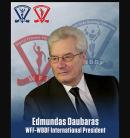
Dr. Edmundas Daubaras
President of W.F.F. – W.B.B.F.
WFF-WBBF – New Times, New People, New Opportunities.
The World WFF-WBBF Federation is constantly moving forward. Sport is changing, and so are the people who are shaping its future.
We have written more than once about the innovations introduced by the WFF-WBBF Federation and its continuous commitment to progress. For three decades, the Federation has been searching for new solutions, experimenting with new ideas and improving its competitions in order to make international events increasingly attractive to both athletes and spectators.
Today, the results are clearly visible. In recent years, between 200 and 300 athletes from different countries around the world have taken part in WFF-WBBF international events. At the same time, a new generation of talented organizers, coaches and judges has become increasingly involved in the Federation's activities.
One of them is Alina Pelepko.
From Athlete to International Federation Official
Alina Pelepko, a coach from a sports club in Gargždai, joined the activities of the World WFF-WBBF Federation several years ago. She did not enter the international sports scene as a newcomer – she had already gained valuable experience as an athlete.
Her sporting career began under the guidance of coach Aleksas Stankus. Alina competed in numerous events and soon achieved significant results. In 2003, she became the Champion of the Republic of Lithuania and the winner of the WFF-WBBF World Amateur Championship in the Bikini category.
Her experience as an athlete, combined with the knowledge she gained and her passion for sport, naturally developed into a career as a coach and sports organizer.
The encouragement of the Federation's Secretary General, Ugnė Raudytė-Daubarienė, played an important role in the next stage of Alina's professional development.
Since 2024, Alina Pelepko has headed the Fitness Model and Bikini divisions of the World WFF-WBBF Federation.
Today, she not only holds responsible positions within the Federation, but is also actively involved in preparing athletes for international competitions. Alina coaches athletes from Lithuania and Latvia, gives lectures at seminars, conducts practical training sessions and shares her sporting and coaching experience.
The results of her work are already visible on the international stage – her athletes have achieved high placements at World and European Championships.
Important Events Ahead
The WFF-WBBF Federation continues to move forward, with a number of important events approaching.
The 37th WFF-WBBF World Championship in Nida is just around the corner. The championship will be held together with the 3rd Neringa Mayor's Cup at the prestigious “Agila” Cultural Centre in Nida.
On September 27, in Klaipėda, an international seminar for coaches and judges will take place on the eve of the events.
In May 2027, Klaipėda will host a special anniversary celebration – the 60th anniversary of the “Amber Prix” tournament, one of the oldest competitions in our sport in the world.
This is yet another example of how the WFF-WBBF Federation continues its long-standing tradition while looking firmly toward the future.
A New Generation – The Future of the Federation
Alina Pelepko's story is a good example of how experience is passed from one generation to the next in sport. An athlete becomes a coach, a coach becomes involved in international activities, and the knowledge gained is passed on to a new generation of athletes.
These are precisely the people who are helping shape the future of the WFF-WBBF Federation today.
New times. New ideas. New talent. And the same determination to keep moving forward.
We wish Alina Pelepko continued success, strength and new victories – both on her personal journey and in developing a new generation of champions in Lithuania and on the international stage.
To move forward means not being afraid to change. The WFF-WBBF Federation has been doing exactly that for three decades.
More information is on international page www.wff.lt
BRUSNO 2012 – WORLD SPORTING ELITE IN THE SLOVAK MOUNTAINS.
From October 11–13, 2012, the small Slovak mountain resort of Brusno Kupele became a true capital of world fitness and bodybuilding. Athletes from different generations, representing different sporting traditions and countries, gathered here, turning the three-day event into a major international celebration of sport.
The stage welcomed young Fit-Kid competitors, aerobics athletes, Model Fitness representatives, juniors, adults, veterans and athletes with disabilities. From the first steps of young competitors to the performances of world champions, Brusno 2012 embraced virtually the entire spectrum of sporting life.
This was more than a competition for medals. It was a meeting where sport became a common language, bringing together athletes of different ages, backgrounds and nationalities.
BRUSNO – WHERE SPORT BECAME A TRADITION
Brusno Kupele did not become a venue for WFF–WBBF international events by chance.
Beginning in 2009, on the initiative of Slovak patron Štefan Hrčka, various international events of the World WFF–WBBF Federation were held annually at this mountain resort. The events received the patronage of prominent Slovak public and political figures.
Among those who supported the events were Slovak Prime Ministers Vladimír Mečiar and Robert Fico, Speaker of Parliament Ján Figeľ, and Chairman of the National Council of Slovakia Andrej Hrnčiar.
Therefore, the 2012 championship was not an isolated event, but part of an already established international sporting tradition.
FROM THE YOUNGEST CHAMPIONS TO THE WORLD ELITE
One of the most impressive features of the Brusno event was its remarkably wide age range.
Very young athletes stepped onto the stage alongside competitors in their forties and fifties. This created a unique atmosphere: the same championship brought together the first steps of young athletes and the results of decades of sporting experience.
FIT-KID – SMALL ATHLETES, BIG AMBITIONS
The first competitors to step onto the world championship stage were the Fit-Kid athletes.
Girls competed in the under-8, under-10, under-12 and under-14 categories, with young athletes representing Belarus, Serbia, Poland, Slovakia and other countries.
The boys' under-10 and under-14 categories were equally international, bringing together competitors from Belarus, Latvia, Ukraine, Russia and Moldova.
They were the youngest participants of the championship, but their determination and desire to perform on the world stage were anything but childish.
The Fit-Kid competitions were a reminder that great sporting stories often begin with very small steps.
AEROBICS – ENERGY, TEMPERAMENT AND PRECISION
After the young athletes, the aerobics competitors took over the stage.
Women competed in the 16, 18, 21 and over-21 age categories. The different age groups demonstrated how technique, artistry, stage confidence and experience develop through sport.
In the under-16 category, the winner was Klaudia Korpan. The under-18 title went to Viktoriya Lebedynska, while the under-21 category was won by Miriama Žigalová.
In the over-21 category, victory went to Renata Kaladzinskaya.
But the real climax came with the announcement of the overall winners.
Klaudia Korpan was named the Overall Winner of Women's Aerobics, while Vitaliy Lebedynskyi became the Overall Winner among the men.
It was a discipline in which strength met music, while physical preparation was combined with stage performance and artistry.
MODEL FITNESS – SPORT, AESTHETICS AND THE STAGE
The Brusno stage also welcomed athletes competing in Model Fitness.
The junior categories for competitors up to 16, 18 and 21 years of age brought together some of the future representatives of this sporting discipline. Here, physical shape alone is not enough. Athletes must also be able to present themselves on stage, demonstrate proportion, posture, elegance and confidence.
The women's senior competition was divided into four categories.
Eva Martinková became the Overall Winner of Model Fitness.
In the men's category, first place went to Dzianis Kazlou.
These competitions once again demonstrated one of the distinctive features of WFF–WBBF: sport is understood not only as physical strength or muscle mass, but also as aesthetics, discipline and stage presence.
THE MAIN BATTLE OF THE CHAMPIONSHIP – BODYBUILDING
October 13 became the key day of the championship at Brusno Kupele.
The athletes of the WBBF World Amateur Bodybuilding Championship took to the stage.
The women's programme included Classic, Performance, Athletic and Super Athletic Bodybuilding categories.
In Classic Bodybuilding, the world title went to Yamila Vanessa Toledo of Argentina.
The Performance Bodybuilding title was won by Valiantsina Kazlouskaya of Belarus, while Svetlana Pugacheva of Russia took first place in Athletic Bodybuilding.
But particular attention was drawn to the Super Athletic category.
The title went to Brazil's Dalvaniza Aquino. She also became the Overall Winner across all women's bodybuilding categories.
The triumph of a South American athlete on the European stage was a striking example of the international reach of WFF–WBBF competition.
ON THE MEN'S STAGE – STRENGTH AND COMPETITION
The men's bodybuilding competition was no less intense.
The four Classic Bodybuilding categories produced winners from several different countries, while Sergey Grigoryev of Russia became the Overall Winner of Classic Bodybuilding.
The Performance categories also featured a strong field of competitors. The first category was won by Viacheslav Rokashkov, while Aleksandr Sobolev took first place in the second.
In Athletic Bodybuilding, the top two places went to Polish athletes Andrzej Rak and Andrzej Brzezinski.
Then came the most extreme category.
EXTREME BODYBUILDING
Nikolay Vorobyev won the Extreme Bodybuilding category.
He also became the Overall Winner across all men's bodybuilding categories.
It was one of the most memorable moments of the 2012 championship in Brusno.
YOUTH AND EXPERIENCE – TOGETHER ON ONE STAGE
The championship programme placed considerable emphasis on both young athletes and veterans.
At the Junior Championship, athletes up to 21 years of age had the opportunity to experience the atmosphere of a genuine world championship.
The women's category was won by Erika Kandracova, while Ilya Lukavets took the men's title.
But the sporting journey on the Brusno stage did not end at the age of 21.
Athletes over 40 had their own category, while competitors over 50 also stepped onto the stage to fight for world championship titles.
Andrzej Rak became the Overall Winner among the senior categories.
The result was another reminder that a high level of sporting excellence has no specific age limit.
SPORT WHERE THE HUMAN BEING TRIUMPHS
A particularly meaningful part of the championship was the competition for athletes with disabilities.
The Wheelchair category was won by Oleksandr Golub of Ukraine.
In the other Disabled category, first place went to Niias Izmailov, followed by Brazil's Gustavo Rodrigues in second place and Oleksandr Rossomakin of Ukraine in third.
These performances carried a special emotional significance.
Here, victory meant more than a medal. It symbolized determination, perseverance and the ability of the human spirit to overcome circumstances.
THE WORLD MEETS IN BRUSNO
Looking back at the results of the 2012 championship, the first thing that stands out is its international character.
Athletes from Europe, South America and other parts of the world came together on the Brusno stage. Winners and medallists represented countries including Argentina, Brazil, Belarus, Russia, Ukraine, Poland, Slovakia, Serbia, Latvia, Romania, Bulgaria, Switzerland and others.
It was a true sporting map of the world.
Different languages, different sporting traditions and different personal stories met on one stage. Yet they were united by one thing – the desire to be the best.
BRUSNO 2012 – MORE THAN A CHAMPIONSHIP
The 2012 WFF–WBBF World Championship in Brusno Kupele was more than an ordinary international competition.
It was a three-day sporting story that brought together childhood dreams, youthful ambition, the mastery of adult athletes and the experience of veterans.
There was music and stage performance, aesthetics and strength, discipline and tension. There were victories and defeats, emotions and medals.
But above all, there were people who stepped onto the stage to demonstrate the result of their hard work and to prove what can be achieved through discipline and perseverance.
For three days in October, the Slovak mountain resort became a meeting place for world sport.
The results of the 2012 championship are not only a record of titles and medals. They also tell the story of an era when the WFF–WBBF international stage brought together an ever-growing number of countries, generations and sporting disciplines.
And that is why Brusno 2012 remains one of the memorable chapters in WFF–WBBF history.
World sport history.
VILNIUS AT THE HEART OF WORLD FITNESS: THE 2004 WFF WORLD CHAMPIONSHIP THAT BECAME A HISTORIC EVENT.
September 2004. Vilnius. Athletes from Europe and other parts of the world arrive in Lithuania's capital. For several days, the Vilnius Congress Palace becomes the center of the international fitness world.
This was not an ordinary international competition.
It was the WFF – World Fitness Federation – World Amateur Championship, an event that went far beyond the usual boundaries of sport. The competition involved not only athletes and coaches. High-ranking Lithuanian state officials took part in its organization, the event received support and funding from the Government of the Republic of Lithuania, and the championship attracted national media attention.
Today, more than two decades later, the 2004 WFF World Championship in Vilnius can be regarded as one of the most significant episodes in the early history of international fitness sport in Lithuania.
From 1995: The Emergence of a New International Fitness Federation
The World Fitness Federation (WFF) was established in 1995.
It was a period when international fitness sport was still searching for its organizational identity. Different countries had different sports structures, while athletes competed in various forms of physical culture, fitness, aerobics and bodybuilding.
WFF sought to bring these disciplines together within a single international system.
An important feature of the federation's history was cooperation between the sporting worlds of East and West. The federation was led by two presidents: Dr. Edmundas Daubaras, representing the Eastern countries, and German representative Klaus Hofman, representing the Western side.
This structure reflected the realities of Europe at the time – sports organizations were attempting to bring together countries that, only a short time earlier, had belonged to very different political and sporting systems.
In 2003, Klaus Hofman withdrew from active involvement in WFF, and leadership of the federation effectively became concentrated in the hands of Dr. Edmundas Daubaras.
Following the 2003 World Championship in Moscow, the next major chapter in WFF history unfolded in Vilnius.
And it was an important one.
VILNIUS 2004: WHEN A WORLD CHAMPIONSHIP BECAME A MATTER OF NATIONAL IMPORTANCE
The World Championship held in Vilnius on September 24–27, 2004, stood out because its organization and scale went well beyond the usual format of an international sporting competition.
The chairman of the organizing committee was Gediminas Kirkilas, a member of the Lithuanian Parliament and, at the time, Minister of National Defence, who would later become Prime Minister of Lithuania.
His signatures on the championship diplomas became an official symbol accompanying the victories of the winners.
Other representatives of Lithuanian state institutions, including Dr. Rišardas Krinickis and Kęstutis Virketis, were also involved in the organizing committee.
But the most important point was not simply the names of the officials.
The championship received support and funding from the Government of the Republic of Lithuania.
Foreign athletes were provided with free accommodation and meals in Vilnius hotels.
This demonstrated that Lithuania regarded the event as an international sporting occasion of significance.
THE VILNIUS CONGRESS PALACE – A WORLD STAGE FOR ATHLETES
The championship events were held at the prestigious Vilnius Congress Palace.
Athletes arriving in Vilnius competed for world championship titles in a wide range of fitness disciplines.
This was not simply a display of muscular development.
The WFF competition system included Classic Fitness, Performance Fitness, Athletic Fitness, Super Athletic Fitness, Extreme Fitness, as well as other categories. Separate competitions were held for women and in aerobics.
Another important feature was the inclusion of wheelchair fitness categories in the championship program.
This reflected one of the fundamental characteristics of the WFF approach: fitness was viewed as a broad sporting phenomenon encompassing aesthetics, athleticism, physical conditioning and athletes with different physical abilities.
THE WORLD IN VILNIUS
The 2004 championship results reveal an impressive international geographic reach.
Athletes represented:
Lithuania, Latvia, Estonia, Russia, Ukraine, Belarus, Denmark, France, Italy, Germany, Cyprus, Slovenia, the Czech Republic, Kazakhstan, Norway, England, Moldova, the Netherlands, Australia and Guadeloupe.
It was a genuine international sporting gathering.
The Baltic and Eastern European countries were particularly strongly represented, while Western European and other international athletes also took part.
The championship results therefore provide more than a simple list of rankings.
They represent a snapshot of the geography of world fitness sport in 2004.
LITHUANIA – NOT A SPECTATOR, BUT ONE OF THE CHAMPIONSHIP'S LEADING FORCES
One of the most striking features of the 2004 Vilnius championship is immediately apparent when examining the results:
Lithuanian athletes were everywhere.
Their names appear throughout almost every major category.
And, more importantly, this was not simply a matter of participation.
Lithuanian athletes won world championship titles and secured numerous podium finishes.
In the men's Classic Fitness Category 2, Ramūnas Sendrius became World Champion, while Olegas Gusarovas took second place.
In the Mr. Super Athletic Fitness category, Mindaugas Kvasys won the bronze medal.
In the Mr. Athletic Fitness category, Marikas Stefanovich finished seventh, while other Lithuanian athletes also achieved strong results.
In the Wheel-Chair Athletic Fitness category, Sergej Beglik became World Champion.
This is significant: Lithuania's name appeared in the championship record not merely as the host nation, but repeatedly among the winners and leading competitors.
LITHUANIAN WOMEN AMONG THE WORLD'S BEST
The achievements of Lithuanian women were equally impressive.
Jolanta Mileriūtė became World Champion in the Miss Aerobic Fitness category.
She also won second place in Miss Classic Fitness Category 1.
Aleksandra Kukreš became World Champion in Miss Aerobic Athletic.
In Miss Classic Fitness Category 2, Lithuania's Edita Diržinikaitė won silver, while Simona Šakinytė took bronze.
In Miss Performance Fitness, Laura Romeraitė won the silver medal.
In Miss Super Body Fitness, Marta Alesiūnaitė finished third, while Eglė Stasiukaitė won bronze in Miss Extreme Fitness.
Lithuanian women were therefore not merely participants in the championship.
They were among its leading international competitors.
THE OVERALL CHAMPIONS
The ultimate prize at any world championship is the overall title.
In Vilnius, the men's overall winner was Konstantin Zacharov of Russia.
He won Mr. Classic Fitness Category 1 and was declared the Men's Overall Winner.
The women's overall title went to Marina Burinskaja of Latvia, winner of Miss Extreme Fitness.
The Aerobics Overall Winner was Marija Deksne of Latvia.
Thus, in the overall standings, the strongest presence came from Russia and the Baltic region.
RESULTS THAT TELL A STORY BEYOND THE MEDALS
The results of this championship can be read as much more than a ranking table.
They tell the story of an entire sporting era.
They show that at the time:
• Lithuania had a large and active fitness community;
• the Baltic countries were an important region within international WFF sport;
• Russian and Ukrainian fitness schools were particularly strong;
• Western European athletes were also actively involved;
• the WFF competition program extended well beyond traditional bodybuilding;
• wheelchair athletes were included in the international championship;
• women's fitness and aerobics were integral parts of the world championship program.
The Vilnius results can therefore be regarded as a map of world fitness sport in 2004.
THE LITHUANIAN STATE AND INTERNATIONAL SPORT
A particularly important feature of the event was the involvement of Lithuanian state institutions.
Today, international sporting events are often assessed according to sporting results, attendance figures, media coverage or television audiences.
The 2004 Vilnius championship presents a broader picture.
Representatives of state institutions participated in the organizing committee.
The event received government support.
Foreign athletes were provided with accommodation and meals.
The championship was held in a prestigious venue in the capital.
National television prepared a report on the event.
Following the championship, a press conference was held at the Lithuanian news agency ELTA, attended by Lithuanian Minister of Sports Vytas Nėnius.
This demonstrated that international fitness sport was being taken seriously in Lithuania at the time.
WHY DOES THIS CHAMPIONSHIP MATTER TODAY?
More than twenty years later, an important question remains:
Why should we remember the 2004 WFF World Championship in Vilnius?
The answer is simple.
Because it is a historical document of a period when Lithuania itself hosted a world-level fitness championship, while Lithuanian athletes were among its most active and competitive participants.
It is not merely the story of one competition.
It is the story of the people who helped build international fitness sport.
It is the story of a federation seeking to unite different sporting traditions.
It reflects the period following the Cold War, when the sporting worlds of East and West were increasingly seeking common ground.
And it is the story of Lithuania, a country that was by then capable of welcoming athletes from around the world to its capital.
THE LESSON OF VILNIUS 2004
Today, the championship protocol may appear to show nothing more than a name, a country and a ranking.
But behind every number lies a story.
First place represented years of preparation.
Second or third place represented international competition at the highest level.
And the presence of dozens of Lithuanian athletes in the results tells us something that a medal table alone cannot show: at that time, Lithuania possessed a strong and substantial fitness community.
The 2004 championship should therefore not be judged solely by who became World Champion.
A broader question should be asked:
What did this championship mean for Lithuanian sport and for international fitness?
The answer is – a great deal.
CONCLUSION: VILNIUS BECAME PART OF HISTORY
The 2004 WFF World Championship in Vilnius was more than a sporting competition.
It was an international event where athletes from different countries, different fitness schools and different sporting traditions came together.
It represented a period when WFF, established in 1995, had already developed an international competition system and was presenting fitness as a broad and diverse sporting discipline.
It was also an important chapter in Lithuanian sporting history, when state institutions, sports organizers and athletes joined forces to host a world championship in Vilnius.
And most importantly, Lithuania was not merely the host nation.
Lithuania was one of the championship's leading sporting forces.
Lithuanian athletes won world titles, earned podium places and formed a significant part of the championship's field.
Meanwhile, the overall winners from Russia and the Baltic region once again demonstrated the important role that this part of Europe played in WFF international sport at the time.
The message of 2004 was clear:
Vilnius was ready to host the world of sport.
Lithuanian athletes were ready to compete with it.
And WFF was, at that time, one of the important centers of the international fitness movement, bringing together countries, sporting disciplines and people.
For this reason, the results of the 2004 WFF World Championship in Vilnius are not merely an old competition protocol.
They are a historical record of Lithuania's place in the history of world fitness sport.
World sport history.
2001 WFF World Championship in Zwickau: The International Fitness Scene in One Place.
From November 23–25, 2001, the WFF World Championship was held in the German city of Zwickau. It was one of the important international fitness events of that period, bringing together athletes from various countries. In the same year, the WFF European Championship was held in Tallinn, Estonia, while the World Championships moved to Germany.
This championship was also significant in the broader history of the WFF. The World Fitness Federation was established in 1995. At that time, it was led by two presidents: Dr. Edmundas Daubaras represented the “Eastern” countries, while Klaus P. J. Hoffmann represented the “Western” countries. After Hoffmann withdrew from WFF activities in 2003, Dr. Edmundas Daubaras remained the sole head of the international federation.
A Broad Competition Programme
The championship programme covered more than one specific fitness discipline. The official results include categories such as “Mr. Fitness Juniors,” “Mr. Junior Performance,” “Mr. Fitness,” “Mr. Extreme Fitness,” “Mr. Athletic Fitness Over 30 Years,” as well as the women’s “Miss Fitness,” “Miss Athletic Fitness,” and “Miss Performance Fitness Over 30 Years” categories. In addition to individual events, pairs competitions were also organised.
This structure shows that the championship sought to accommodate different groups of athletes. Younger participants had their own categories, separate events were intended for athletes over 30, while in some categories the emphasis was placed not only on an athlete’s individual physique and preparation but also on the overall stage performance.
As a result, the championship in Zwickau was more than a single standard individual fitness competition. It was a multi-discipline event in which athletes could compete according to different criteria and in different age or performance groups.
Junior Competitions
One part of the championship was dedicated to younger athletes. The official list for the “Mr. Fitness Juniors” category contains seven participants. First place went to Germany’s Patryk Wieczorek, second place to Lithuania’s Vladimir Petrov, and third place to Tobias Schasten of Germany. The results table also lists the points awarded by the judges and the final rankings.
The presence of junior categories at the World Championship was significant because the WFF competition system was not limited to experienced adult athletes. Younger competitors could also participate in an international championship and compete against athletes from other countries in their age group.
International competition was also evident in the women’s junior events. In the “Miss Junior Fitness” category, the first two places were taken by Lithuanian representatives Jelena Marchenko and Eglė Barisevičiūtė, while third place went to Latvia’s Anita Nitecka.
Thus, the junior section formed a separate and important part of the overall championship programme, aiming to showcase not only the current leaders of the sport but also the younger generation of athletes.
Diversity of Adult Categories
Competition among adult athletes was even broader. The men’s programme included various categories, among them “Mr. Fitness,” “Mr. Extreme Fitness,” and “Mr. Athletic Fitness Over 30 Years.”
In the “Mr. Extreme Fitness” category, first place went to Greece’s Vasilis Zachilis, while second place was taken by Lithuania’s Julijus Grishajev.
A separate category was designated for athletes over 30. In the “Mr. Athletic Fitness Over 30 Years” group, the winner was Germany’s Andreas Wilms. Second place went to Danish athlete Henning Kristensen, while third place was taken by Germany’s Udo Walther.
The women’s programme also featured several different events. For example, in the “Miss Performance Fitness Over 30 Years” category, first place went to Germany’s Corina Mayer. She was followed by fellow German athlete Silvia Schor, while third place went to France’s Marie Piere Ripert.
In another women’s event, “Miss Athletic Fitness,” the winner was Russia’s Svetlana Pugachova, while second place went to Germany’s Susan Malekpur-Shirazi.
These results show that the championship sought to distinguish between different types of athletic preparation and performance, giving participants the opportunity to compete in categories suited to their particular strengths.
Pairs Performances
Pairs competitions held a special place in the championship programme. They offered a different perspective on fitness competition, as the focus was not only on an individual athlete’s physical preparation but also on the joint performance of two people.
In the “Fitness Pairs” category, first place went to the German pair Cornelia Trost and Thomas Riedel. Second place was awarded to the Dutch pair Chantelle Tanke and Raymond Punter, while third place went to Germany’s Tanja-Leona Meyer and Philip Magenheimer. Latvian pairs were also listed further down the results.
Another event was “Fitness Performance Pairs.” First place went to the German pair Lucie and Udo Walther, second place to Russia’s Svetlana Pugachova and Artiom Ovsojan, and third place to Germany’s Corina Mayer and Andreas Trienbacher. Other participants included representatives from Latvia, Estonia and Croatia.
The pairs events added further variety to the championship and allowed athletes to compete not only individually. They were also one of the areas in which cooperation between athletes from different countries and the importance of stage performance were particularly evident.
An International Judging Panel
The international judging panel was an important part of the championship. Official documents list judges from Greece, Lithuania, the United States, Russia, Belarus, Austria, Germany, France and other countries.
Among the judges were Anargiros Tsopouridis of Greece, Dr. Edmundas Daubaras and Edita Sendrienė of Lithuania, Bob Gruskin of the United States, Andrej Basov of Russia, Fidel Sedych and Tatjana Kovalco of Belarus, Markus Schlager of Austria, Tamara Konz and Wolfgang Iben of Germany, and Oliver Ripeir of France.
Such a judging panel emphasised the international character of the championship. The evaluation was not carried out solely by representatives of the host country; the geographical composition of the judging team was considerably broader.
Overall Championship Winners
In addition to the winners of the individual categories, the culmination of the championship was the selection of the overall winners. According to the official results, the “Mr. Over-All Winner” title was awarded to Lithuania’s Mindaugas Kvasys, while Germany’s Corina Mayer became the “Miss Over-All Winner.”
The overall winner title was distinctive because it was not tied exclusively to one particular category. It represented an overall assessment of the championship and gave additional significance to the entire competition programme. Following the individual category contests, these two athletes were listed as the overall winners of the 2001 WFF World Championship.
The Geographical Diversity of the Championship
The results of the championship in Zwickau reflect a broad geographical representation of participants. The official lists include representatives from Germany, Lithuania, Latvia, Russia, Greece, Austria, the Netherlands, France, Italy, Croatia, Estonia, Denmark, Sweden, the United States, Israel and other countries.
This is particularly evident in the pairs categories and in the men’s and women’s individual events, where representatives of other European countries regularly appear alongside German athletes in the results tables. Such distribution of participants allows the championship to be viewed as an international sporting platform where athletes from different countries could compare their preparation and competitive experience.
The Significance of the 2001 Championship
The 2001 WFF World Championship in Zwickau was an event in which several different areas of fitness came together. Individual men’s and women’s events, junior categories, groups for athletes over 30, an extreme fitness category and pairs competitions formed a diverse programme.
The championship results also reveal the geographical character of the international fitness scene of that period. Athletes from many European countries participated, as well as representatives from the United States and Israel. Not only the athletes but also the judging panel had an international composition.
The Zwickau World Championship can therefore be regarded as one of the WFF events of that period in which an effort was made to bring different forms of fitness competition together on a single stage. From juniors to veterans, and from individual performances to pairs events, the entire programme reflected the broad approach to fitness sport adopted by the WFF at the time.
The competition held in Zwickau from November 23–25, 2001, remains an interesting historical record that provides an insight into the international fitness competition system taking shape at the time, its categories, judging structure and the geographical diversity of its athletes.
More information is on international site www.wff.lt
News International.
WFF-WBBF Executive Council Meeting Held in Klaipėda.
On September 11, 2026, members of the Executive Council of the World WFF-WBBF Federation met in Klaipėda. The meeting was attended by Federation President Dr. Edmundas Daubaras, Secretary General Ugnė Raudytė-Daubarienė, Technical Committee Chairwoman Svetlana Pugacheva, and Head of the Fitness Models and Bikini Division Alina Pelepko.
The meeting focused on upcoming international events in Lithuania. On September 27, an international seminar for coaches and judges will take place in Klaipėda, followed by the 37th World Amateur and Professional Championships in Nida on October 24–26.
Particular attention will be given to the art of posing in bodybuilding. According to the federation, posing at international competitions has become increasingly simplified and less attractive to spectators in recent years. The upcoming seminar will address ways to improve posing techniques, stage presentation, and artistic expression.
This will be the first specialized event of its kind to be organized in Eastern Europe.
THE HISTORY OF WORLD SPORT.
SIX DECADES OF INTERNATIONAL SPORT IN LITHUANIA.
THE GEOGRAPHY, TRADITIONS AND HISTORICAL SIGNIFICANCE OF WFF-WBBF EVENTS.
IS THERE ANOTHER SPORTS ORGANIZATION IN LITHUANIA THAT CAN MATCH THIS SCALE?
There are sporting events that come and go.
There are championships that become entries in official records.
There are victories that become part of statistics.
But there are also traditions that survive generations.
The history of WFF-WBBF in Lithuania can be described as precisely such a tradition.
It is a history measured not only in years, but in decades, international championships, hundreds of events, dozens of Lithuanian cities, thousands of athletes, and a truly global geographical reach.
In May 2027, Klaipėda will proudly host the celebration of a remarkable milestone – the 60th anniversary of the “Amber Prix,” one of the three oldest traditional international competitions in the world.
Sixty years.
This is far more than a symbolic number.
Over six decades, entire generations of athletes have changed. States and political systems have changed. Sports infrastructure has evolved. Communication technologies have transformed. The world itself has changed.
Yet some sporting traditions have endured.
The “Amber Prix” tradition has survived.
And it continues today.
NIDA – ANOTHER PAGE IN THE HISTORY OF WORLD SPORT
On October 24–26, 2026, Nida will host the 37th World Professional and Amateur Championships.
This is not simply another date on the international sporting calendar.
It is another chapter in a long-standing tradition that brings the international sports community together in Lithuania.
Nida will become a meeting place for sport, international cooperation and the unique atmosphere of Lithuania’s Baltic coast.
But the significance of this event must be viewed in a much broader historical context.
Behind the 37th World Championships stand decades of organizational experience.
Behind every championship stand people.
Behind every international event are athletes, coaches, judges, organizers, partners and host cities.
And behind all of this stands tradition.
60 YEARS – WHEN SPORT BECOMES HISTORY
Throughout six decades of activity, the World WFF-WBBF Federation, operating under various legal statuses, has organized and continues to organize hundreds of international and national sporting events in countries around the world.
Today, the federation brings together members from 141 countries, representing every continent.
That is the scale of a truly international sports organization.
Yet Lithuania holds a particularly significant place in this history.
During this period, WFF-WBBF has organized more than 100 sporting events of various levels in Lithuania.
World Championships.
European Championships.
“Amber Prix” tournaments.
“Universe” competitions.
International and national championships.
Hundreds of events over six decades are not merely a quantitative indicator.
They are evidence of consistent, long-term work.
LITHUANIA AS PART OF THE INTERNATIONAL SPORTING MAP
The scale of this history becomes even more impressive when we examine the geography of the events.
WFF-WBBF competitions have been held repeatedly in:
Vilnius, Kaunas, Klaipėda, Panevėžys, Telšiai, Palanga, Kretinga, Mažeikiai, Ukmergė, Kėdainiai, Kaišiadorys, Nida, Šilutė, Trakai, Vilkaviškis, Zarasai, Ignalina, Raudondvaris, Kazlų Rūda, and other cities and districts throughout Lithuania.
The capital.
The major cities.
Resort towns.
Regional centres.
Smaller Lithuanian communities.
This is not simply a random collection of points on a map.
It is the geography of six decades of sporting history.
It demonstrates that international sport in Lithuania was not developed only in the capital or in the largest cities.
It travelled throughout the country.
From city to city.
From region to region.
From generation to generation.
And together with the athletes, the world came to Lithuania.
INTERNATIONAL SPORT BEYOND THE MAJOR ARENAS
One aspect of this history deserves particular attention.
An international sporting event is much more than a sports hall or an arena.
It is also a representation of a city, a region and a country.
When athletes from different nations arrive in a Lithuanian city, cultures, sporting traditions and people come together.
For this reason, every international championship becomes not only a sporting event, but also an opportunity to present Lithuania to the world.
The geography of WFF-WBBF events demonstrates that this process has continued in Lithuania for decades.
Cooperation has taken place with Lithuania’s highest state institutions, municipal authorities, mayors and local organizations.
This is an important part of the story.
International sport did not exist in isolation.
It became part of the life of Lithuanian cities and regions.
FROM KLAIPĖDA TO NIDA – FROM LITHUANIA TO THE WORLD
Today, it is particularly symbolic to speak about Klaipėda and Nida.
In 2027, Klaipėda will celebrate the 60th anniversary of the “Amber Prix.”
In October 2026, Nida will host the 37th World Professional and Amateur Championships.
Two locations on Lithuania’s Baltic coast.
Two important milestones in international sporting history.
And between them – six decades.
This reminds us that a sporting tradition is not a museum exhibit.
It is not simply a chapter of the past locked away in archives.
A true tradition lives as long as it continues.
WHAT DO THE NUMBERS TELL US?
Sometimes a few numbers are enough to understand the scale of history.
60 years – the tradition of the “Amber Prix.”
37 World Championships – evidence of a long-standing international competitive tradition.
More than 100 events in Lithuania – the scale of international and national sporting activity.
141 countries – the federation’s current international reach.
Every continent in the world – the global dimension of the organization.
Dozens of Lithuanian cities and districts – the geographical reach of its events across the country.
But numbers are only the beginning.
Behind every number are people.
Behind every event is a story.
Behind every medal is an athlete’s dedication.
Behind every championship is the responsibility of organizers.
And behind six decades stands the continuity of generations.
IS THERE ANOTHER ORGANIZATION IN LITHUANIA THAT CAN COMPARE?
It is therefore worth asking a question that is neither a rhetorical trick nor simply a promotional statement.
Is there another sports organization in Lithuania that can demonstrate six decades of international sporting traditions, more than one hundred events of various levels in the country, a history of World and European Championships, such a broad geographical presence across Lithuanian cities, and international representation in 141 countries around the world?
The answer does not necessarily have to be found in words.
The answer can be found in history.
In archives.
In competition records.
In photographs.
In the memories of athletes.
In the cities that hosted the events.
And in the people who created and continue this tradition.
A HISTORY THAT CONTINUES
There are countless sports organizations around the world.
There are thousands of championships.
There are countless tournaments.
But not every sports organization has the opportunity to look back and say:
“We were here six decades ago. We are here today. And we intend to be here tomorrow.”
That is the essence of a genuine sporting tradition.
Not only the past.
Continuity.
Not only history.
The future.
In May 2027, Klaipėda will become the city where the 60-year history of the “Amber Prix” will be celebrated.
In October 2026, Nida will become another international meeting point for athletes from around the world.
And the entire geography of WFF-WBBF events in Lithuania reminds us of one simple but profoundly important truth:
the international sporting history of Lithuania was created not only in the capital and not only in the largest arenas. It was created throughout the country.
From Vilnius to Klaipėda.
From Kaunas to Panevėžys.
From Palanga to Nida.
From the largest cities to the smallest regions of Lithuania.
Across decades.
Across generations.
Through hundreds of events.
THIS IS MORE THAN SPORTING HISTORY
It is part of the history of sport in Lithuania.
It is a history of international cooperation.
It is the history of people who worked for sport for decades.
It is the history of Lithuanian cities that welcomed athletes from around the world.
It is a tradition that travelled from Lithuania to the world – and from the world back to Lithuania.
Therefore, the 60th anniversary of the “Amber Prize” is more than an anniversary.
It is a testament to six decades in which a sporting tradition became history.
And history becomes truly meaningful when it is not only remembered, but continued.
60 YEARS.
37TH WORLD CHAMPIONSHIPS.
MORE THAN 100 EVENTS IN LITHUANIA.
141 COUNTRIES.
EVERY CONTINENT OF THE WORLD.
DOZENS OF LITHUANIAN CITIES.
SIX DECADES OF INTERNATIONAL SPORT.
THE HISTORY OF WFF-WBBF CONTINUES.
INTERNATIONAL COACHES’ AND JUDGES’ SEMINAR IN KLAIPĖDA: THE ART OF POSING IN THE SPOTLIGHT.
An international seminar for coaches and judges will take place in Klaipėda on September 27, focusing on one of the most important, yet increasingly underestimated, elements of bodybuilding – posing.
In preparation for the 37th WFF-WBBF World Amateur and Professional Championship, which will take place on October 24–26, 2026, at the “Agila” Cultural Centre in Neringa, the WFF-WBBF World Federation, together with the International Sport University, will organize an international coaches’ and judges’ seminar in Klaipėda on September 27, 2026.
The upcoming seminar is significant not only because of its international scope, but also because of its long-standing tradition. Coaches’ seminars in Klaipėda were first organized back in 1987, meaning that this year marks another chapter in a tradition that has continued for almost four decades.
Posing – More Than Just a Required Part of Competition
The main topic of this year’s seminar will be posing in competition – posing technique, stage presentation, aesthetics, and the importance of posing in the overall evaluation of an athlete.
According to the organizers, this subject is particularly relevant today. In their view, the standard of posing has declined considerably in recent years, while stage presentation has increasingly lost some of its aesthetic and artistic qualities.
In bodybuilding, an athlete’s physique must not only be displayed – it must be presented professionally. Posing allows athletes to demonstrate their proportions, symmetry, muscular development, posture, and overall aesthetic preparation. For this reason, the art of posing remains an essential part of high-level bodybuilding.
The seminar will therefore bring together highly experienced professionals who will share their knowledge and practical experience and address the question of how to improve posing standards and restore a greater sense of professionalism and aesthetics to stage presentation.
New Fitness Categories and Current Judging Issues
The seminar will cover much more than posing. Participants will also be introduced to new fitness categories, while important issues concerning athlete evaluation criteria and current judging practices will be discussed.
Particular attention will be given to ensuring that coaches and judges share a clear understanding of judging principles and are able to evaluate athletes objectively in terms of physical development, proportions, symmetry, aesthetics, and stage presentation.
Seminar participants will also have the opportunity to obtain the appropriate international coaches’ and judges’ qualifications, making the event an important platform for professional development and qualification improvement.
A Return to the Classical Concept of Bodybuilding
The purpose of the seminar goes beyond the professional development of judges and coaches. The organizers aim to strengthen the understanding of bodybuilding as a sport in which success is determined not only by physical development, but also by aesthetics, proportions, symmetry, elegance, stage presence, and professional presentation.
It is an effort to return to the classical concept of bodybuilding – one in which an athlete’s stage performance should be engaging and appealing not only to the judges, but also to the audience.
The September 27 seminar in Klaipėda will be an important step toward improving the qualifications of coaches and judges, developing athlete evaluation standards, and strengthening posing culture within international bodybuilding and fitness.
Further information about the seminar programme, lecturers, and participation requirements will be announced soon.
More information: www.wff.lt and www.worldfitness.lt
09-16-2026, 09:09 AM (This post was last modified: 09-16-2026, 09:12 AM by WFF/WBBF Secretary.)
60 YEARS OF WORLD SPORTS HISTORY:
LITHUANIA — AN IMPORTANT PART OF THE WFF-WBBF JOURNEY.
From the “Amber Prix” to World Championships — for decades, Lithuania has been a place where international sports history has been made.
Six decades are more than simply a period of time. They represent people, generations, traditions, competitions, victories, meetings and stories that remain long after an individual sporting event has ended.
As the WFF-WBBF Federation approaches the 60th anniversary of its international activities, it can be said with confidence that Lithuania holds a special place in this history.
Over more than half a century, more than 100 international WFF-WBBF events have been held in Lithuania. Vilnius, Kaunas, Klaipėda, Panevėžys, Telšiai, Šilutė, Vilkaviškis and Nida have hosted World and European Championships, international “Amber Prix” and “Universe” tournaments, as well as numerous other high-level international competitions.
Over the decades, athletes and delegations from Europe, Asia, Africa, North and South America, and Australia have travelled to Lithuania. Today, the WFF-WBBF Federation is represented in 141 countries around the world, covering all continents.
It is particularly significant that, for many years, Lithuania has been one of the important venues for the Federation’s international events. International sporting relations were developed here, representatives of different countries met, and new chapters of world sports history were created.
Lithuania — A Meeting Place for International Sport
WFF-WBBF events in Lithuania became much more than sporting competitions. They developed into meeting places where athletes, coaches, judges, organisers and representatives of the sporting community from different countries came together.
Over the years, delegations from numerous European countries travelled to Lithuania — Latvia, Estonia, Poland, the Czech Republic, Slovakia, Hungary, Bulgaria, Romania, Serbia, Bosnia and Herzegovina, Greece, Italy, Spain, Germany, Switzerland, the Netherlands, Denmark, France, the United Kingdom, Ireland, Portugal, Belgium, Finland, Norway and many others.
However, the international geography of these events extended far beyond Europe.
Athletes from the Republic of South Africa, Algeria, Nigeria, Mozambique and Egypt came to Lithuania. South America was represented by Argentina, Brazil, Uruguay, Paraguay and Venezuela, while the United States, Canada and Mexico represented North America. Athletes from Australia also participated in events held in Lithuania.
Asia was particularly broadly represented. Lithuanian competitions welcomed athletes from Japan, Malaysia, Thailand, Iran, Israel, Syria, India, Pakistan, Uzbekistan, Turkmenistan, Kazakhstan and other countries.
Such a geographical reach allows us today to look at the history of Lithuanian sport from a broader perspective. A small country on the shores of the Baltic Sea has, for decades, served as a venue for international sporting meetings, attracting people from many different parts of the world.
Sport That Brought People Together
The sporting result was not the only important aspect of these major international events. Equally significant were personal encounters, international relationships and shared experiences.
The heads of many foreign delegations were officially received at the Seimas of the Republic of Lithuania on numerous occasions. Participants of WFF-WBBF events also took part in international press conferences held at the ELTA news agency.
Many major international events were organised with the support and financial assistance of institutions of the Republic of Lithuania. This demonstrated the country’s attention to international sport and provided an opportunity to present Lithuania more widely to the global sporting community.
Over the decades, the international relationships that were established did not disappear. On the contrary, they became the foundation for new competitions, new generations of athletes and new international cooperation projects.
The History of the “Amber Prix”
A special place in this history belongs to the “Amber Prix” tournament.
It is more than simply the name of a sporting competition. Over many years, the “Amber Prix” has become a tradition and an important part of Lithuania’s sporting history, gaining recognition in many countries around the world.
In May 2027, Klaipėda will ceremonially mark the 60th anniversary of the “Amber Prix” tournament.
This will be a symbolic opportunity to remember the people who created the history of the tournament, the athletes who competed for victory over the years, and the coaches, judges and organisers who devoted many years to developing this tradition.
Sixty years is already a legacy — one that is passed from generation to generation.
A New Chapter of History — in Nida
But history is not only about memories. It continues today.
From 24–26 October 2026, the 37th World Championship for Professionals and Amateurs will take place in Nida.
This will be another major international sporting event in Lithuania, once again bringing athletes and delegations from different countries around the world to our country.
And in 2027, the jubilee celebration of the “Amber Prix” in Klaipėda will provide another opportunity to look back at the path that has been travelled while also looking towards the future.
The History Continues
Over six decades, countries, cities, generations of athletes and the world itself have changed. Yet one thing has remained constant — the desire to compete, achieve outstanding results, meet one another and build friendships.
Today, with WFF-WBBF activities reaching 141 countries around the world, Lithuania’s role in this history is clear.
More than 100 international events held in Lithuania are more than statistics.
They represent thousands of athletes, hundreds of delegations, dozens of countries, countless competitions and six decades of accumulated experience.
This is a history created not only through results and medals. It was created by people.
And this history is far from over.
The 2026 World Championship in Nida and the 60th anniversary of the “Amber Prix” in Klaipėda in 2027 will become new chapters in this remarkable history.
After six decades, the journey continues.
Lithuania remains, and will continue to remain, a part of world sports history.
More information is on international site www.wff.lt
World Bodybuilding History.
WFF-WBBF PROFESSIONAL DIVISION FOR ATHLETES WITH DISABILITIES.
From the 1998 Palanga Congress to the International Professional Stage
The WFF-WBBF International Congress held in Palanga in 1998 became an important milestone in the history of sport for people with disabilities. Following the decisions adopted at the Congress, the World WFF-WBBF Federation (World Fitness Federation, World Body Building Federation) began systematically developing activities involving athletes with disabilities. According to the federation's historical sources, continuous work with athletes with disabilities began in 1999.
This was an important step from individual athlete appearances toward a consistent international competition system for athletes with disabilities, in which athletes could compete for World and European Championship titles and participate in international tournaments.
The First Generation of Champions
The first international WFF-WBBF champions among athletes with disabilities were Garib Jounis (Netherlands), Torsten Petersen (Denmark), Aleksandr Koroliov (Estonia), and Sergej Beglik (Lithuania).
A special place in this history belongs to Lithuanian athlete Sergej Beglik (Lithuania). The federation's historical sources emphasize that he won all the official international competitions that were possible at the time — the World and European Championships, as well as the international “Universe” tournament. Then his trainer was the best Lithuania bodybuilder of all times Natalija Murnikoviene.
The official WFF-WBBF historical list of champions shows that Torsten Petersen (Denmark) became World Champion in 1999, 2000 and 2002, Aleksandr Koroliov (Estonia) in 2001, Sergej Beglik (Lithuania) in 2003, and Garib Younis (Netherlands) in 2004.
This first generation of athletes laid the foundations for the international WFF-WBBF tradition in sport for people with disabilities.
An International Sports Movement
In subsequent years, numerous high-level international athletes from different countries emerged in the WFF-WBBF division for athletes with disabilities.
Among them were:
Mickael Louvel (France), Peter Smit (South Africa), Tolga Murat Balikci (Turkey), Dian Michailov (Bulgaria), Petar Milenkovič (Serbia), Anastasia Belkovskaja (Russia), Gustavo Rodrigues (Brazil), Karol Milewski (Poland), Mariusz Krzystof Kupczak (Poland), Grzegorz Dabrowski (Poland), Aleksandr Golub (Ukraine), Nias Izmailov (Ukraine), Oleg Abornev (Ukraine), Oleg Pileckij (Ukraine), Aleksandr Rossomakin (Ukraine), Ravinder Singh (India), Anand Arnold (India), and Aleksejs Petkevics (Latvia).
Lithuania was represented by Viktoras Topolis (Lithuania), Nikolajus Mironovas (Lithuania), Arturas Krutulis (Lithuania), Genadijus Zametaškinas (Lithuania), Karolis Stončius (Lithuania), and Artūras Bolyčevas (Lithuania).
This list of athletes demonstrates the true international character of the division: it represents countries from Europe, Asia, Africa, and South America.
The World Champions’ Chain
The historical list of World Champions published by WFF-WBBF shows a consistent succession of champions from different countries. Following the first generation, the World Champions were:
• Oleg Abornev (Ukraine) — 2014;
• Karol Milewski (Poland) — 2015;
• Anand Arnold (India) — 2016;
• Mariusz Krzystof Kupczak (Poland) — 2017 and 2019;
• Tolga Murat Balikci (Turkey) — 2018;
• Aleksejs Petkevics (Latvia) — 2020, 2021 and 2022;
• Grzegorz Piotr Dabrowski (Poland) — 2023.
This succession of champions clearly demonstrates how the geographical distribution of leading athletes in disability sport changed over more than two decades — from athletes representing Lithuania, Denmark, Estonia and the Netherlands to champions from Ukraine, Poland, India, Turkey and Latvia.
The Professional Division — A New Historical Stage
Another essential step for WFF-WBBF was the creation of a professional division for athletes with disabilities.
The Executive Council of the federation decided to establish the WFF-WBBF Professional Division for Athletes with Disabilities.
It consists of two main categories:
• general category for professional athletes with disabilities;
• category for professional athletes with disabilities competing in wheelchairs.
Athletes who meet the WFF-WBBF professional requirements may receive a WFF-WBBF Professional Card (“Pro Card”) and participate in professional competitions.
This represented a qualitatively new stage. An athlete with a disability became not only a participant in international amateur competitions, but also an athlete within the professional sports system.
In 2018, Tolga Murat Balikci (Turkey) became the first-ever WFF-WBBF World Professional Champion among athletes with disabilities. In the same year, he also won the World Amateur Championship among all participating athletes.
Professional Champions
Among the most prominent WFF-WBBF professional athletes in disability sport were:
• Anand Arnold (India);
• Aleksejs Petkevics (Latvia);
• Tolga Murat Balikci (Turkey);
• Mickael Louvel (France);
• Kamil Kowalczyk (Poland).
The international character of the professional division continued in later years.
14 Countries — One Sporting History
The historical list of WFF-WBBF athletes in disability sport represents 14 countries:
the Netherlands, Denmark, Estonia, Lithuania, South Africa, Turkey, Bulgaria, Russia, Ukraine, Brazil, Poland, France, India, and Latvia.
This is not merely a statistical fact. The geography of 14 countries demonstrates that the WFF-WBBF disability sport division has grown into an international sports system, bringing together representatives of different continents and sporting schools.
A special place in this history belongs to Lithuania. It was not only the home country of one of the first champions — Sergej Beglik (Lithuania) — but also one of the countries from which several high-level international athletes emerged. Furthermore, the international congress held in Palanga in 1998 is identified in the federation's history as an important starting point for further work with athletes with disabilities.
Conclusion
The history of WFF-WBBF disability sport is not merely a history of World Champions, medals and titles.
It is a journey of more than two decades — from the decisions of the 1998 Palanga Congress to an international professional sports system in which athletes from 14 countries competed for World Championship titles and professional status.
During this period, several generations of athletes emerged. Among them were Torsten Petersen (Denmark), Garib Jounis (Netherlands), Aleksandr Koroliov (Estonia), Sergej Beglik (Lithuania), Oleg Abornev (Ukraine), Karol Milewski (Poland), Anand Arnold (India), Tolga Murat Balikci (Turkey), Mariusz Krzystof Kupczak (Poland), Aleksejs Petkevics (Latvia), Grzegorz Piotr Dabrowski (Poland) and many other athletes who became part of WFF-WBBF disability sport history.
The most important message of this history is that disability is not an obstacle to achieving the highest level of sporting excellence. An athlete with a disability can be a World Champion, a professional, a representative of their country, and an equal member of the international sporting community.
Therefore, the history of the WFF-WBBF disability sport division can be viewed as a long-term project of sporting excellence, internationalism, professionalism and inclusion.
Its origins are linked to Lithuania, while its achievements belong to the entire international sporting community.
The History of Champions — More Than a List of Titles
WFF-WBBF historical data records a consistent succession of World Champions among athletes with disabilities. It includes athletes from different generations: from Torsten Petersen, Garib Jounis and Sergej Beglik to Tolga Murat Balikci, Karol Milewski, Mariusz Krzystof Kupczak, Anand Arnold, Aleksejs Petkevics and Grzegorz Dabrowski.
Several athletes stand out particularly. In 2018, Tolga Murat Balikci became the first-ever WFF-WBBF World Professional Champion among athletes with disabilities. Aleksejs Petkevics subsequently emerged as one of the most prominent athletes with disabilities in the world, while Mariusz Krzystof Kupczak won the World Championship title more than once.
The Professional Division — A New Historical Stage
Another important step was the creation of the WFF-WBBF Professional Division for athletes with disabilities. By decision of the federation's Executive Council, a professional system was established, providing top-level athletes with the opportunity to move from amateur to professional sport.
The professional division includes two main categories:
• general category for professional athletes with disabilities;
• category for professional athletes with disabilities competing in wheelchairs.
Athletes who meet the WFF-WBBF professional criteria may receive a WFF-WBBF Professional Card (“Pro Card”) and participate in professional competitions.
This was a fundamental change: an athlete with a disability became not only a competition participant, but also a part of the professional sports system.
Professional Champions
Among the most prominent WFF-WBBF professional athletes in disability sport are:
• Anand Arnold (India);
• Aleksejs Petkevics (Latvia);
• Tolga Murat Balikci (Turkey);
• Mickael Louvel (France);
• Kamil Kowalczyk (Poland).
The professional division remains part of the WFF-WBBF competition system today. In more recent competition data published by the federation, the “Disabled Bodybuilding” category is listed among the professional categories.
The Main Conclusion of WFF-WBBF Disability Sport History
The history of WFF-WBBF disability sport is more than the history of individual champions and medals.
From the decisions adopted in Palanga in 1998 to the creation of the professional division, a journey was made from individual international appearances to an organized and international sports system.
During this period, several generations of champions emerged, while athletes from Lithuania, Europe, Asia, Africa and South America demonstrated that disability is not an obstacle to achieving the highest sporting results, becoming a World Champion, or attaining professional status.
The most important message of this history is that an athlete with a disability is not an exception here. They are an athlete striving for the highest level of sporting excellence, with the right to international recognition, professional status, and a place on the world sporting stage.
Therefore, the history of the WFF-WBBF disability sport division can be regarded as a long-term project of inclusion, sporting professionalism and international competition, whose origins are associated with Lithuania and, in particular, with the 1998 international congress in Palanga
The Contribution of WFF–WBBF to the Development of Global Fit-Kid:
27 Years of International Sporting Tradition.
The history of Fit-Kid Championships from 1999 to 2025 represents 27 years of the development of international children’s and youth sport. An analysis of the results from this period shows not only the changing geography of championship victories, but above all the continuity of the international competition system developed within the framework of the W.F.F. – World Fitness Federation and W.B.B.F. – World Bodybuilding Federation.
Fit-Kid is a children’s fitness discipline that combines elements of gymnastics, aerobics, acrobatics, physical preparation and stage presentation. Its significance, however, extends beyond sporting competition itself. For children and young people, participation in competitions involves systematic training, physical development, discipline, cooperation with coaches and the opportunity to represent their country on the international stage.
WFF–WBBF as an International Platform
One of the most important elements in the history of Fit-Kid is the operation of the WFF–WBBF international competition system. Regular international championships make it possible to establish a long-term sporting tradition involving athletes, coaches, clubs, national teams and sports organizers from different countries.
Within this system, the international federation plays an organizational and integrating role. International competitions create a common environment for sporting competition, enable comparisons of athletic performance and provide continuity for the development of successive generations of participants.
From this perspective, Fit-Kid is not a separate, one-time project. It is part of a broader international fitness system in which, over decades, a structure of competitions, age categories, judging procedures and cooperation between clubs and national teams has been developed.
27 Years and Eight Countries
The results of the absolute Fit-Kid Championships for 1999–2025 show that titles were won by representatives of eight European countries: Lithuania, Poland, Slovakia, Serbia, Russia, Belarus, Ukraine and Hungary.
The geography of the championship victories changed over the years. During different periods, particular countries were more frequently represented among the champions, while new national representatives subsequently joined the competition. This demonstrates that the championship system was not limited to one country or one region, but developed across a broader European sporting environment.
Over the 27-year period, 27 championship titles were awarded. Some athletes won the title more than once, demonstrating the possibility of maintaining a high level of preparation and continuing competitive development. At the same time, new names regularly appeared, reflecting generational change and continuity within the system.
Continuity Between Generations
One of the most important characteristics of the Fit-Kid history is continuity. With each successive period, new participants, coaches and teams appear, while the international competition structure continues to operate.
This model is particularly important in children’s sport. A child who begins training can gradually progress through different stages of sporting development, participate in national and international competitions, gain experience and eventually become part of the next generation that continues the sporting tradition.
In this way, the history of Fit-Kid is not simply a list of champions. It represents a long-term sporting tradition developed across generations.
The International Character of the System
The results also demonstrate the distinctly international character of Fit-Kid. Championship victories have been distributed among several countries, while the geographical composition of the participants has changed over the years.
This is important for the development of children’s fitness because international competition provides additional motivation for training and development. Participants have the opportunity to meet athletes from other countries, experience different approaches to preparation and gain valuable experience in an international competitive environment.
Coaches and clubs also play an important role in this process. The development of an athlete is not based solely on individual talent, but also on long-term coaching, organizational support and the involvement of families.
The Social Significance of Fit-Kid
The 27-year history of the championships also has a broader social dimension. Children’s sport helps develop habits associated with physical activity, consistency and responsibility.
Participation in international competitions allows young athletes to gain experience, manage the pressure associated with performing and function within a sporting environment where rules, preparation and mutual respect are important.
For this reason, the development of Fit-Kid can be assessed not only through the number of championship titles, but also through the sustainability of the wider sporting environment that has developed around the discipline.
2025 – A Continuation of the Tradition
The year 2025 represents another stage in this history. According to the results provided, the absolute champion was Elzbieta Matoga of Poland.
However, the significance of this result should be viewed within the context of the entire 27-year period. One championship title is part of a much broader history involving many generations of athletes, coaches, clubs and national teams.
Conclusion
Twenty-seven years of Fit-Kid Championships demonstrate, above all, the continuity of an international sporting tradition. Between 1999 and 2025, 27 championship titles were awarded to athletes representing eight countries, with both returning champions and new generations of participants becoming part of the history of the competition.
From the perspective of WFF–WBBF, one of the most important achievements of this process is the creation and maintenance of an international platform for the development of children’s fitness. The competition system brings together athletes, coaches, clubs, national teams and organizers within a shared international sporting tradition.
The history of Fit-Kid is therefore not only a history of individual victories. It is above all 27 years of international children’s fitness development within the WFF–WBBF system, reflecting continuity, international cooperation and the emergence of successive generations of young athletes.
2009 WFF-WBBF WORLD CHAMPIONSHIP.
In 2009, Lithuania Was Among the Leaders in Tallinn: 263 Athletes, 28 Countries and 11 Lithuanian Podium Finishes
November 21, 2009, became an important day for the global fitness and bodybuilding community. A total of 263 athletes from 28 countries gathered in Estonia’s capital, Tallinn. Among them were representatives of Lithuania, who returned home with as many as 11 podium finishes, including five category victories.
The sports hall in Tallinn was filled that day with both tension and a wide variety of sporting cultures. The championship programme was exceptionally broad — ranging from children’s “Fit-Kid” and aerobic fitness to model fitness, strength fitness and various bodybuilding categories.
Yet when looking at the official results today, more than fifteen years later, a more interesting picture emerges: Lithuania was considerably more visible on the international fitness and bodybuilding scene at the time than one might expect simply by looking at the country’s size.
263 Athletes, 28 Countries and One Results Table
The 2009 championship was a true international sporting map. The results recorded athletes from almost fifty countries.
However, a relatively clear group dominated the podiums. The analysed results show a total of 108 podium finishes, with Poland leading the way with 24. Russia was close behind with 22.
They were followed by South Africa with 13 podium finishes, Lithuania with 11, Ukraine with 9, while Slovakia and Estonia recorded 8 each.
The figures may appear dry at first glance. Yet it is precisely the relationship between them that reveals an important point: the country with the most podium finishes did not necessarily have the most champions.
Five Champions for Lithuania
From this perspective, Lithuania’s result is particularly interesting.
Of Lithuania’s 11 podium finishes, 5 were first places, 4 were second places and 2 were third places.
That means that almost every second Lithuanian podium finish was a victory.
Poland, meanwhile, had the highest total number of podium finishes — 24 — and won 6 categories. Russia, with 22 podium finishes, recorded 8 first-place finishes.
Thus, the strength of the Lithuanian delegation lay not in quantity, but in the concentration of top-level results.
Lithuanian Names Appeared Across Different Categories
It is also interesting that Lithuania’s victories were not concentrated in a single discipline.
Aušra Tasiukevičiūtė and Eglė Girtavičiūtė took first place in the “Model Fitness” category.
In strength fitness, Nikita Butylkinas won the junior category, while Vytautas Juknevičius took first place in the senior division.
Another top result in the older athletes’ category was achieved by Vidmantas Malakauskas.
This is an important detail: Lithuanian representatives competed successfully across different sporting disciplines rather than in just one specific bodybuilding category.
Poland Led in Podium Finishes, Russia in First-Place Results
If the championship results table were turned into a kind of sporting map, two countries would clearly stand out at the top — Poland and Russia.
Poland recorded the highest number of podium finishes — 24. Its athletes were particularly visible across various age groups and disciplines.
Russian representatives reached the podium 22 times, but on 8 occasions they took first place.
This was especially evident in the WBBF bodybuilding categories. Russian athletes’ names appear repeatedly throughout the results protocol in various bodybuilding divisions, ranging from classic categories to more extreme disciplines.
At the same time, the Polish athletes’ performance was broader, covering different age groups and disciplines.
The Youngest Championship Participants — Another Important Signal
The Tallinn competition was not simply a celebration of adult bodybuilding.
The programme devoted considerable attention to children and young athletes. In the “Fit-Kid” categories, athletes aged 8, 10, 12 and 14 competed.
Poland was particularly prominent in these events. Its representatives won several of the youngest categories, while in some age groups Polish athletes occupied both first and second place.
In the junior categories, Lithuania, Slovakia, Ukraine and Estonia also joined the leading group.
This allows us to look at the 2009 championship as more than just a competition from a single season. The results also reveal how, at the time, federation sports systems were being developed across different age groups — from children to veterans.
One Athlete — Several Stages
The results protocol also includes athletes who successfully competed in more than one category.
For example, Slovak representative Miriama Zigalova won two different categories. Eva Martinkova also appeared on the winners’ list in more than one event.
This is an important consideration when evaluating the statistics: 108 podium finishes do not mean 108 different athletes. Some athletes may have been awarded in multiple categories.
Therefore, the results table tells us not only about the strength of national delegations, but also about the versatility of individual athletes.
WFF and WBBF — Two Different Faces of the Championship
Another interesting trend emerges when the WFF and WBBF programmes are analysed separately.
In the WFF section, Poland was the most prominent nation, with its representatives collecting 18 podium finishes. Lithuania had 7, while Slovakia recorded 6.
In the WBBF section, the situation changed. Russia stood out most clearly, with its athletes taking 21 of the analysed podium places.
Thus, the Tallinn championship essentially had two different faces in terms of results: Poland and Lithuania were particularly prominent in fitness, model and related disciplines, while Russian representatives were much more dominant in bodybuilding.
Where Does Lithuania Fit Into This Story?
More than 15 years later, the 2009 results can be viewed as one of the notable moments in the history of Lithuanian fitness and bodybuilding.
Lithuania did not arrive in Tallinn with the largest delegation. Yet its name appears eleven times in the results table — and five of those appearances are at the very top.
It was a performance in which Lithuanian athletes were not merely competing for places in the finals. They were winning.
11 Lithuanian podium finishes. 5 first places. 28 countries. 263 athletes.
Today, these figures allow us to look at the 2009 Tallinn championship as more than an old competition results sheet. It is a snapshot of a period when Central and Eastern European countries were actively shaping the international fitness and bodybuilding competition landscape, and Lithuania was clearly visible on that map.
In Tallinn in 2009, there were fewer Lithuanian athletes than representatives of some of the larger nations, but their results in the official record were more than enough to keep Lithuania among the championship’s leading countries.
Nida Welcomes Young Sports Talents from Around the World – 27th Fit-Kid World Championship.
From October 24 to 26, Nida will become an international center of children’s sport. The 27th Fit-Kid World Championship will take place in this Lithuanian seaside resort, bringing together young athletes from various countries. For three days, the stage of the Agila Cultural Centre in Nida will belong to children who will showcase their physical fitness, sporting skills and stage performance in an international competition.
This year’s championship is being held as part of the 37th World Amateur and Professional Championships of the WFF-WBBF Federation. It is one of the federation’s major annual events, bringing together athletes, coaches and sports professionals from different countries. For young Fit-Kid participants, the championship is an opportunity to demonstrate their abilities on an international stage and compete for World Championship titles.
Sport, Discipline and Stage Performance
Fit-Kid is a children’s sports discipline in which success is based on more than just one physical quality. Competitors demonstrate strength, flexibility, coordination, posture, movement technique, physical fitness and the ability to perform confidently on stage.
Every performance is therefore not only a sporting challenge, but also a carefully prepared presentation. Young athletes have the opportunity to demonstrate what they have achieved through training, how well they can control their bodies and how they perform under the pressure of competition.
Behind every performance lies a long journey – regular training, the work of coaches, family support and the athlete’s own determination. International competitions give children valuable experience, teach them to pursue their goals and help them understand that both victories and defeats are an important part of the sporting journey.
27 Years of Fit-Kid World Championship Tradition
This year marks the 27th Fit-Kid World Championship. Over more than two decades, this children’s sports discipline has developed into an international event bringing together young athletes from different countries and sporting backgrounds.
The World Championship is about more than competing for medals. It is also an international meeting place for young athletes, where new friendships are formed, experience is exchanged and the next generation takes its first steps onto the international sporting stage.
The World Championship Comes to Nida
This year, Nida will host the championship. Usually associated with the Baltic Sea, dunes and summer holidays, the Lithuanian resort will become an international meeting point for young athletes for several days in October.
From October 24 to 26, the Agila Cultural Centre in Nida will welcome athletes representing different countries as they compete for the highest honours. Spectators will have the opportunity to witness first-hand how much dedication, determination and preparation stand behind every young athlete’s performance.
The 27th Fit-Kid World Championship is an event where results are only part of the story. It is an opportunity for children to experience the atmosphere of international competition, test themselves against some of the strongest athletes in their age groups and take another important step in their sporting development.
Nida is ready to welcome young sports talents from around the world.
More information about the 27th Fit-Kid World Championship, the competition programme and WFF-WBBF Federation events is available on the international websites www.wff.lt and www.worldfitness.lt.
WFF-WBBF International – More Than Five Decades of International Sport Leadership.
World Fitness Federation (WFF – International) and World Bodybuilding Federation (WBBF – International) represent a long-standing international sports movement whose history dates back to 1968. For more than five decades, the federations have worked to develop, organize and promote fitness, bodybuilding and related disciplines on the international stage.
Today, WFF-WBBF International brings together 141 member countries, representing a broad international network of athletes, national organizations, sports professionals and enthusiasts. This extensive geographical presence reflects the federation’s long-term commitment to international cooperation and the development of organized sport.
Throughout its history, WFF-WBBF International has continuously expanded its competition system and introduced new sporting disciplines in response to the development of modern fitness and bodybuilding. One of the important examples of this approach is Model Fitness, which became part of the federation’s international competition program in 2004.
The introduction of Model Fitness was another step in the continuing development of the WFF-WBBF International competition system. The federation created an international platform for athletes whose preparation combines physical conditioning, harmonious proportions, aesthetics, stage presentation, elegance and professional performance.
For WFF-WBBF International, the development of Model Fitness has been part of a broader mission: to provide athletes from different countries with an established international competition environment and opportunities to represent their national organizations at the highest level.
Since the first Model Fitness World Championship in 2004, the discipline has developed within the WFF-WBBF International system for more than two decades. The World Championship has brought together athletes representing countries from different regions of Europe and beyond, creating a continuous international sporting tradition.
The history of the WFF-WBBF Model Fitness World Championship demonstrates the geographical reach of the federation. Absolute World Champions have represented Russia, Latvia, Lithuania, Slovakia, the Czech Republic, Belarus, Uzbekistan and Poland.
Behind these names and titles stands the long-term organizational work of WFF-WBBF International: international championships, cooperation with national organizations, development of competition structures and the creation of opportunities for athletes to compete on an international stage.
A particularly notable chapter in the championship's history belongs to Eva Martinkova of Slovakia, who became Overall World Champion four times – in 2008, 2009, 2011 and 2012. Her achievements form an important part of the historical record of the WFF-WBBF Model Fitness World Championship.
The Baltic region has also played a significant role in the federation's Model Fitness history. Lithuanian athletes became World Champions in 2007, 2013, 2014, 2017 and 2020, while Latvian athletes achieved a particularly notable sequence of victories between 2021 and 2024.
These results illustrate the international character of WFF-WBBF competitions. Athletes representing different national organizations meet within one federation, compete according to an established international competition system and contribute to a common sporting history.
The 2025 championship added another chapter to this history, with Olga Bogacz of Poland becoming the Overall World Champion.
However, the history of WFF-WBBF International cannot be measured only by the names of individual champions. The broader significance lies in the federation’s continuity, international structure and long-term development of sport.
Since its foundation in 1968, WFF-WBBF International has continued to build an international platform where athletes can develop their careers, national organizations can participate in international competition and new disciplines can become part of an established global sporting system.
Model Fitness is one example of this long-term development. By introducing the discipline to its international championship program in 2004 and maintaining the World Championship tradition through 2025, WFF-WBBF International established a distinct chapter in the history of this discipline.
The federation’s history is therefore a history not only of champions, medals and championships, but also of international organization, sporting development and cooperation between countries.
With 141 member countries and a history extending back to 1968, WFF-WBBF International continues to represent an international sporting structure built on decades of experience.
The WFF-WBBF International Model Fitness World Championship, established in 2004, is one part of this much broader legacy. It reflects the federation’s continuing role in developing new competition formats, providing international opportunities for athletes and bringing national organizations together through sport.
More than five decades after its establishment, the WFF-WBBF International story continues to be written through its athletes, national organizations, championships and international sporting community.
More information is on international site www.wff.lt
22 YEARS OF THE WORLD PROFESSIONAL CHAMPIONSHIP: FROM RUSSIAN DOMINANCE TO LITHUANIA’S AMBITIONS IN NIDA.
What really lies behind the list of champions from 2004 to 2025?
The history of the World Professional Championship is not simply a list of names and medals. It is a map of more than two decades of changing international power in professional bodybuilding.
The results from 2004 to 2025 reveal a clear pattern: new national leaders have emerged in different periods, while only a select number of athletes have been able to maintain their position at the top for several consecutive years.
At different times, Russia, Brazil, Iran, Finland and other countries have dominated particular periods, while in recent years athletes from Central and Northern Europe have increasingly moved into the spotlight.
And the 2026 edition could be particularly significant: the World Professional Championship is scheduled to take place in Nida, Lithuania, on October 24–26.
NOT JUST A HISTORY OF NAMES — A HISTORY OF CHANGING POWER
The 2004–2025 results can be divided into several distinct periods.
The first was a period of Russian dominance.
The second saw the rise of Brazil and Iran.
The third was characterized by individual super-champions, when one athlete was able to maintain the title for many consecutive years.
The fourth is the multi-polar era, in which championships are increasingly being shared among athletes from different countries.
This latest stage is particularly interesting because it suggests that predicting a single favorite for the 2026 championship will be extremely difficult.
WOMEN: FROM THE RUSSIAN SCHOOL TO THE HANNA KRISTINA SKYTTA PHENOMENON
The women's championship history provides one of the clearest examples of how the geography of professional bodybuilding has changed.
Between 2004 and 2010, Russian athletes appeared repeatedly at the top of the championship standings.
In 2006 and 2007, Irina Riabova won the heavyweight title. In 2008, Irina Stavickaja became champion, followed by Liudmila Kolesnikova in 2009 and 2010.
This was not simply a series of isolated victories.
It represented the strength of a particular national bodybuilding school.
But eventually the balance changed.
THE BRAZILIAN TRIUMPH
Between 2011 and 2014, Brazil emerged very strongly at the top of the women's championship.
In 2011, Crecky Chaves won the title.
Then, in 2012, 2013 and 2014, Dalvaniza Aquino captured the championship three consecutive times.
This was one of the strongest periods of national dominance in the history of the competition.
Four consecutive championships for Brazilian athletes demonstrated that the center of professional bodybuilding could move rapidly from one region of the world to another.
More importantly, this was not the achievement of a single isolated victory, but part of a broader period of Brazilian success.
SKYTTA — FIVE CONSECUTIVE CHAMPIONSHIPS THAT CHANGED THE STATISTICS
If one athlete has to be singled out as the most remarkable phenomenon in the women's history of the championship, it is Hanna Kristina Skytta.
In 2018, 2019, 2020, 2021 and 2022, the Finnish athlete won the heavyweight championship five consecutive times.
This is more than a statistical achievement.
Five consecutive years constitute an era.
During such a period, competitors change, sporting form changes, preparation methods evolve and the international competitive environment itself develops.
Skytta's five-year winning streak from 2018 through 2022 stands as one of the most remarkable individual achievements in the championship's history.
It demonstrates an important principle: at the highest professional level, long-term individual consistency can be more decisive than the strength of an entire national team.
LITHUANIA: NOT AN OBSERVER, BUT PART OF THE CHAMPIONSHIP'S HISTORY
It would be a mistake to view 2026 as the moment when Lithuania suddenly appears on the world professional bodybuilding map.
Lithuania has much deeper roots in this championship history.
One of the most important names is Jolanta Mileriute.
She won the women's lightweight category three consecutive times, in 2006, 2007 and 2008.
This remains one of the strongest periods of dominance by a Lithuanian athlete in the championship's history.
Lithuania subsequently continued to produce athletes capable of competing at the highest international level.
The country's role has therefore not been limited to hosting international competitions. Lithuanian athletes have themselves been active participants in the battle for professional titles.
THE MEN'S CHAMPIONSHIP: AN EVEN BROADER INTERNATIONAL LANDSCAPE
The men's history reveals an even greater diversity of countries.
Between 2004 and 2010, Russian athletes were particularly prominent.
But later, champions emerged from Iran, Brazil, South Africa, Turkey, Poland, Lithuania, Estonia, India and Slovakia.
This is an important development.
The World Professional Championship is no longer the arena of a single bodybuilding school.
It has become a meeting point for different bodybuilding traditions and sporting cultures.
THE IRANIAN TRIO
The period from 2011 to 2013 stands out in the men's championship.
In 2011, Ali Imani won.
In 2012, Reza Rezaei took the title.
In 2013, Reza Bagherzadeh became champion.
Three consecutive years.
Three Iranian champions.
Once again, the same pattern appears: national dominance in professional sport often comes in waves.
BRAZIL'S RESPONSE
In 2016 and 2017, Brazil's Glayson Souto Ferreira won the men's heavyweight championship two years in succession.
His victories represented another powerful period for Brazilian bodybuilding on the international professional stage.
However, the championship history also reveals another important aspect of the story: the emergence of athletes who would become major figures in later years.
Among them was Slovakia's Maros Kanasz.
THE NEW EUROPEAN WAVE
The results from 2018 to 2025 reveal a different trend.
Turkey.
Poland.
Lithuania.
Estonia.
Slovakia.
India.
The championship is no longer dominated by one country.
It has become a multi-polar professional championship.
In 2020, Lithuania's Dainius Dzikevicius reached the top of the men's championship.
In 2021 and 2022, Estonia's Roman Polshin won the men's lightweight category.
In 2023 and 2025, Slovakia's Maros Kanasz captured the heavyweight title, while in 2024 India's Rahul Joshi won the lightweight category.
This period is particularly significant because the geographical distribution of champions has become increasingly diverse.
MAROS KANASZ: THE RETURNING CHAMPION
The career of Maros Kanasz deserves special attention.
He is not an athlete who won once and disappeared from the international stage.
His name has appeared in the professional championship history over a long period.
His victories in 2023 and 2025 therefore cannot be viewed as isolated achievements.
They represent the continuation of a long international career.
Kanasz's story is a good example of another important principle in professional bodybuilding: long-term competitiveness is often more difficult to achieve than a single championship victory.
AND THIS BRINGS US TO THE BIG QUESTION OF 2026
This history makes the 2026 championship particularly difficult to predict.
If the last two decades are viewed as a series of competitive cycles, the pattern looks something like this:
Russia → Brazil → Iran → Finland → increasingly diverse European competition.
But history has not yet answered the question of who will become the next dominant force.
Will Slovakia continue its momentum?
Will athletes from Russia, Brazil or Finland return to the top?
Will a new country emerge?
Or could Lithuania produce another world champion on home soil?
LITHUANIA ENTERS 2026 WITH A SIGNIFICANT PSYCHOLOGICAL ADVANTAGE
Recent results give Lithuania a particularly strong foundation.
In 2024, Vilma Povilioniene won the women's lightweight championship.
In 2025, according to the championship results provided, Svetlana Pugacheva became the women's heavyweight champion representing Lithuania.
This means that Lithuania enters the 2026 championship not merely as the host nation.
Lithuania enters as a country with fresh world-champion success.
That is a very different position from simply organizing an international event.
NIDA — MORE THAN JUST A COMPETITION VENUE
The World Professional Championship scheduled for October 24–26, 2026, in Nida could become an important event for Lithuanian sport.
Nida will not simply be a geographical location on the competition calendar.
It will become a meeting point for different bodybuilding schools, sporting traditions and international champions.
And this creates the central question of the 2026 championship:
Can Lithuania turn the home advantage into championship success?
History shows that hosting a major competition does not automatically guarantee medals.
But competing on home soil can provide additional motivation, a familiar environment and strong support from the local audience.
Lithuanian athletes will have all of these advantages — together with the experience of recent championship victories.
THE BIGGEST PARADOX OF THE HISTORY
The most interesting conclusion from this 22-year history is simple:
The championship is not dominated by countries — it is dominated by eras.
Russia had its period.
Brazil had its period.
Iran had its period.
Hanna Kristina Skytta created her own individual era.
Today we are witnessing an increasingly multi-national competition.
And this is precisely why the 2026 championship is so difficult to predict.
History shows that whenever one bodybuilding school appears to be establishing long-term dominance, a new athlete or a new country eventually emerges.
2026: WHO WILL TAKE THE CROWN?
The 2025 champions are already part of history.
The 2026 titles, however, still have no owners.
That is what makes the Nida championship so intriguing.
Can Maros Kanasz once again demonstrate his consistency at the highest level?
Will a new female champion emerge and end the recent cycle of changing champions?
Can Lithuanian athletes, competing in front of their home crowd, raise the national flag above the highest step of the podium?
Or will 2026 become another historic moment when a new country and a new name enter the world professional bodybuilding elite?
CONCLUSION: NIDA 2026 COULD BECOME A NEW STARTING POINT
The history of the World Professional Championship from 2004 to 2025 demonstrates one fundamental truth:
nothing in professional bodybuilding remains permanent.
Champions change.
Countries change.
The geography of the sport changes.
But one principle remains constant: at the highest level, champions are those who can not only achieve exceptional physical condition, but maintain it when the world's strongest competitors step onto the same stage.
That is why the 2026 World Professional Championship in Nida will be more than another competition.
It will be a new chapter in the history of the championship.
After more than two decades of international competition, one conclusion is clear: the World Professional Championship is moving away from the dominance of individual nations toward an increasingly broad and unpredictable international field.
And Lithuania now has a special role to play.
This time, the world professional stage is coming to Lithuania.
And the question is no longer who won in the past.
The question is: who will be worthy of the crown in Nida in October 2026?
Nida Becomes the World Center of Fitness: The Best Model Fitness Athletes to Meet in Lithuania.
The 22nd World Championship in Lithuania continues a more than two-decade international Model Fitness tradition.
This autumn, Nida will become a place where the history, present and future of world fitness come together. From October 24–26, 2026, the stage of the “Agila” Cultural Centre in Nida will host the 22nd Model Fitness World Championship, one of the major events within the programme of the 37th WFF-WBBF World Amateur and Professional Championships.
For three days, Lithuania’s seaside resort will welcome leading representatives of international fitness. Athletes will step onto the Nida stage after a long and demanding journey based not only on physical preparation, but also on discipline, dedication and professionalism.
This is more than just another sporting competition. It is the continuation of more than two decades of international Model Fitness history, with Lithuania hosting this year’s championship.
A History That Began in 2004
The history of the Model Fitness World Championships began in 2004, when the World Fitness Federation (WFF – International) introduced the discipline into its international competition programme.
It was an important step towards a broader understanding of fitness sport. In Model Fitness, success is not determined by muscularity or physical strength alone. The discipline combines athletic conditioning, harmonious body shape, proportions, aesthetics, posture, stage presence and the ability to present oneself professionally.
Over more than two decades, the discipline has developed into an international competitive tradition, with the World Championship serving as its annual culmination.
And this year, that stage will be in Lithuania.
From Lithuania to 141 Countries Worldwide
The history of WFF-WBBF International dates back to 1968. Over more than five decades, the organisations have developed an extensive international competition system encompassing various disciplines of physical culture, fitness and bodybuilding.
Today, WFF-WBBF International represents 141 member countries within its international network.
A World Championship of such international scale taking place in Nida is a notable event for Lithuania and its sporting community. While world-class championships are often associated with the largest international sporting centres, this year the global fitness stage will move to one of Lithuania’s most distinctive locations – Nida.
When Sport Becomes a Stage
Model Fitness is unique because athletes are expected to demonstrate much more than the results of their training.
On stage, athletic conditioning, body aesthetics, proportions, elegance, posture and professional presentation come together. Behind a few minutes in the spotlight are months and years of training, disciplined nutrition, preparation and commitment.
The World Championship stage therefore becomes a true test of an athlete’s journey.
Outstanding physical condition alone is not enough. An athlete must also know how to present it.
Three Days When Nida Will Live to the Rhythm of World Fitness.
The 22nd Model Fitness World Championship, taking place at the “Agila” Cultural Centre in Nida on October 24–26, will be one of the major events within the 37th WFF-WBBF World Amateur and Professional Championships.
The three-day event will bring together athletes, coaches, judges and fitness representatives from different countries and generations. For some athletes, it will be an opportunity to step onto the World Championship stage for the first time. For others, it will mark a return to the international arena. For champions, it will be another opportunity to demonstrate their highest level of achievement.
But they will all share one goal – the World Championship stage and the highest possible sporting result.
A New Chapter in World Fitness History Will Be Written in Nida
Since 2004, the Model Fitness World Championships have travelled a long road. The 22nd Championship will become another chapter in this history.
And this chapter will be written in Lithuania.
From October 24–26, 2026, Nida will become the international capital of Model Fitness for three days. Athletes, coaches, judges and fitness professionals from around the world will meet here, while the stage of the “Agila” Cultural Centre will become the setting for the continuation of a World Championship tradition spanning more than two decades.
The world fitness stage is coming to Nida.
For more information about WFF-WBBF International, the World Championship and the event programme: www.wff.lt www.worldfitness.lt
WFF-WBBF PRO HISTORY.
202 W.F.F.–W.B.B.F. PROFESSIONALS.
Not Just a List of Names.
At first glance, the list of W.F.F.–W.B.B.F. International professional card holders from 2004 to 2026 may look like nothing more than a collection of names, certificate numbers, and countries.
But when the list is examined as a whole, a much larger picture emerges.
It tells the story of the development of professional bodybuilding and fitness across more than two decades. It reveals how the sport expanded geographically, how new countries entered the professional arena, how entire generations of athletes emerged — and, perhaps most importantly, how consistently Lithuania has been represented throughout this history.
The list contains 202 professional records.
Among them are 27 Lithuanian professionals.
That means that approximately 13.4% of all professional records in the entire list are associated with Lithuania.
For a relatively small country, this is a remarkable figure.
And it is even more significant when we look not only at the number, but at the continuity.
27 Lithuanian Names — A Number That Cannot Be Ignored
Lithuania does not appear in this history as a temporary or accidental participant.
The Lithuanian names are spread across many different years. Different generations of athletes appear in the records, demonstrating that professional-level bodybuilding and fitness in Lithuania was not built around one athlete, one club, or one particular period.
This is a long-term phenomenon.
Among the Lithuanian professionals are athletes such as Jolanta Mileriutė, Mindaugas Kvasys, Ramūnas Sendrius, and many others who represent different stages of the development of the sport.
Later generations include names such as Evelina Pranauskė, Piotras Sevcenko, Rūta Karpaitė, and others.
This continuity is perhaps the most important feature of the Lithuanian contribution.
One generation does not simply disappear.
Another generation follows.
And that is how a sporting tradition is created.
2004: A Beginning That Today Looks Symbolic
The earliest records in the list date back to 2004.
At that time, professional bodybuilding and fitness were developing in a very different international environment. Global communication was more limited, international competition was less accessible, and athletes from smaller countries faced considerably greater obstacles when trying to establish themselves on the world stage.
Yet Lithuania was already present.
Looking back from 2026, that early presence acquires a different meaning.
It demonstrates that Lithuania entered the professional history of W.F.F.–W.B.B.F. not yesterday and not as a result of a recent trend.
The foundations were established more than twenty years ago.
2026: A Particularly Powerful Signal
The most recent year in the list, 2026, provides an especially interesting indication of where this story may be heading.
There are five new professional records in 2026.
Three of them are Lithuanian.
That means that Lithuania accounts for 60% of the new professional entries listed for 2026.
This is not merely a historical achievement.
It is a current one.
The Lithuanian presence is not simply something that belongs to the past. It remains visible in the newest generation of professional athletes.
And that makes the historical statistics even more significant.
The Strongest Wave of Professionalization: 2018
Another striking feature of the list is 2018, which stands out as the peak year, with 26 professional records.
That year reflects a particularly strong expansion of professional bodybuilding and fitness.
It also demonstrates that professionalization did not occur gradually at exactly the same pace every year.
There were periods of acceleration, when many athletes from different countries entered the professional ranks.
2018 was clearly one of those moments.
Placed within the broader timeline, it becomes one of the most important years in the development of the professional division represented by this list.
The Baltic States: A Small Region With a Large Footprint
One of the most interesting geographical observations is the presence of the Baltic states — Lithuania, Latvia, and Estonia.
The region is small in terms of population and territory.
Yet its representation in the professional records is highly visible.
This raises an important question:
Why does such a relatively small region produce such a noticeable number of professional athletes?
The answer is probably not a single factor.
It may include sporting culture, strong personal discipline, established coaching traditions, competitive ambition, and the willingness of athletes to participate internationally.
But there is another factor that should not be underestimated:
tradition.
Once professional athletes emerge from a country, they create examples for younger athletes.
Success becomes visible.
The professional path becomes imaginable.
And a new generation begins to understand that reaching the international level is not an abstract dream, but a realistic possibility.
The Russian Factor
The earlier part of the list also reveals a particularly strong presence of athletes from Russia.
This is important in understanding the historical geography of the organization.
Russia represented one of the major sources of professional athletes during the earlier stages of the period covered by the list.
This demonstrates that the development of professional bodybuilding and fitness was not concentrated in Western Europe or North America.
Eastern Europe and the broader post-Soviet sporting space played a major role as well.
Lithuania therefore belongs to a much larger regional sporting story.
Professional Sport Has Expanded Far Beyond Europe
Another important conclusion comes from the increasing geographical diversity of the professional records.
The list includes athletes from Europe, Asia, South America, Africa, and other parts of the world.
This is a clear sign that professional bodybuilding and fitness have become genuinely international disciplines.
The professional stage is no longer dominated by a small number of traditional countries.
New countries continue to enter.
New sporting cultures develop.
And athletes from regions that once had little visibility in international bodybuilding are increasingly becoming part of the professional landscape.
Iran, India, Brazil — New Centers of Influence
The presence of athletes from countries such as Iran, India, and Brazil is particularly interesting.
These countries possess enormous populations and strong sporting cultures, creating a vast potential pool of athletes.
Their growing presence in professional bodybuilding and fitness illustrates the globalization of the sport.
The professional map is becoming broader.
The center of gravity is no longer located in just a few traditional bodybuilding nations.
This is one of the most important trends visible in the 2004–2026 records.
The History of Female Professionals Deserves a Separate Chapter
Another important aspect of the list is the significant representation of women professionals.
Their presence demonstrates that the professional division has never been exclusively a men's story.
Female athletes have contributed to the development and visibility of the sport, representing different countries and generations.
Their careers form a separate and highly valuable part of the history.
In fact, the evolution of women's professional bodybuilding and fitness deserves to be studied independently, because it reflects broader changes in women's participation in strength sports, fitness culture, and professional competition.
Lithuania's Strength Is Not Only in Numbers — It Is in Continuity
This may be the most important conclusion of all.
If Lithuania had produced 27 professionals within only one or two years, the statistic would certainly be impressive.
But that is not what happened.
The names are distributed across a much longer period.
Different generations appear.
Different athletes emerge at different times.
This means that Lithuania has not simply produced individual successes.
It has developed a continuing professional tradition.
That distinction is crucial.
A champion can be an exception.
A generation can be a wave.
But continuity means that the sport has established roots.
What Does 13.4% Really Mean?
The figure of 13.4% should not be interpreted as a direct measure of sporting quality or superiority.
Statistics alone cannot determine which country has produced the “best” athletes.
But the figure does demonstrate something very important:
Lithuania has had a disproportionately visible presence within this particular professional history.
For a country of its size, 27 professional records out of 202 is a substantial contribution.
It means that when the history of W.F.F.–W.B.B.F. professional athletes is examined as a whole, Lithuania cannot be treated as a marginal participant.
It is part of the central narrative.
A Small Country — But a Large History
Lithuania is a relatively small country.
Its population is tiny compared with countries such as India, Brazil, Russia, or the United States.
Yet its name repeatedly appears among professional athletes.
That creates an interesting paradox:
small country, significant professional footprint.
And this is precisely why the Lithuanian story is worth examining.
The significance is not only in the number 27.
It is in what those 27 names represent.
They represent years of training.
Coaches.
Gyms.
Competitions.
Athletes who served as examples for younger generations.
Families and communities supporting sport.
And, above all, a belief that athletes from a small country can compete on an international professional stage.
And This Is Where the Main Conclusion Lies
The real story behind the 202 records is not simply the number of countries or the number of athletes.
It is the evolution of a global sporting community.
From the early 2000s to 2026, the professional division represented in this list has become increasingly international.
New countries have appeared.
Different continents have become more visible.
Women have strengthened their representation.
And smaller nations have demonstrated that they can leave a substantial mark on international professional sport.
Lithuania is one of the clearest examples.
Its 27 professional records show that geographical size does not necessarily determine sporting influence.
2026 Leaves an Open Question
The most interesting question is therefore not what happened between 2004 and 2026.
We already know the answer.
The more interesting question is:
What comes next?
If 2026 already shows three Lithuanian professional entries out of five, the story is clearly not finished.
A new generation is emerging.
And if the tradition of professional sport continues, the number of Lithuanian professionals may continue to grow.
Perhaps future lists will contain not 27 Lithuanian names, but 40, 50, or even more.
The next chapter has not yet been written.
FROM NAMES TO A PHENOMENON
A list of 202 professional records can easily be treated as an archive.
But it can also be read as a map.
A map of sporting ambition.
A map of globalization.
A map of generations.
And, in the case of Lithuania, a map of continuity.
The 27 Lithuanian professionals are not simply 27 isolated names.
Together, they form a story.
A story that began more than two decades ago and continues into 2026.
That is why the Lithuanian contribution to W.F.F.–W.B.B.F. professional history deserves to be recognized not as a footnote, but as an important part of the organization's international sporting legacy.
THE HISTORY OF LITHUANIAN PROFESSIONALS IS NOT OVER
World Sport History.
PALANGA, 1998: WHEN THE WORLD OF FITNESS CAME TOGETHER ON THE BALTIC SEA.
186 athletes, 15 countries, and the first official WFF World Fitness Championship held in the Republic of Lithuania. At the time, the federation was still experimenting with categories and judging criteria, searching for its own direction. Nearly three decades ago, Palanga became the setting for a chapter that has since become part of fitness history.
The event was supported by the Government of the Republic of Lithuania. The chairman of the Organizing Committee was Kęstutis Skrebys, Minister of Public Administration Reforms and Municipal Affairs of the Republic of Lithuania. One of the main sponsors was the daily newspaper “Respublika”. The championship in Palanga was filmed by Eurosport television, which prepared an approximately one-hour report for European audiences. A report for Lithuanian national television was prepared by journalist Laima Janušonytė.
JUNE 6, 1998. PALANGA
A seaside resort, the eve of the summer season, and athletes arriving in Lithuania from across Europe.
But on that day, the most important thing happening in Palanga was neither the beach nor the summer entertainment. The city was hosting a World Fitness Championship.
186 athletes from 15 countries came together: Germany, Switzerland, Austria, Belarus, Russia, Lithuania, Latvia, Estonia, Ukraine, France, Slovenia, Greece, the United Kingdom, Uruguay and Italy.
This was more than just another international competition. In historical WFF sources, the Palanga event is described as the first official World Fitness Championship held in Lithuania.
Today, looking back at the championship protocols, we can see more than just names and rankings. They reflect the entire European fitness scene of that era.
FITNESS SEARCHING FOR ITS OWN IDENTITY
In the late 1990s, fitness was not yet what we know it as today.
Gym culture was growing rapidly, while attitudes toward the body, physical conditioning, and athletic aesthetics were changing. Alongside traditional bodybuilding, a new discipline was becoming increasingly visible – fitness.
The championship program included Classic Fitness and Aerobic Fitness categories.
It was an important development.
Athletes were not expected to demonstrate muscle mass alone. Body proportions, physical conditioning, aesthetics, athleticism, and overall presentation were becoming increasingly important.
Palanga in 1998 became a place where these emerging ideas of fitness were tested on an international stage.
15 COUNTRIES – ONE STAGE
The geographical diversity of the championship was impressive.
Athletes from Western, Central, and Eastern Europe met on the same stage.
Germany arrived in Palanga with a particularly strong team. Switzerland was also among the leading nations. They were challenged by athletes from Belarus, Russia, Austria, Slovenia, the United Kingdom, Greece, Ukraine, and the Baltic states.
It was a period when the European sporting landscape was changing rapidly, and new international connections were allowing athletes to meet more frequently on the same stage.
The Palanga championship became one of those meeting points.
THE MEN'S STAGE – TWO DIFFERENT STORIES
The men's Classic Fitness program consisted of two categories, and each produced a different championship story.
In the first category, Valdas Slimanavičius took the victory, ahead of Belarusian athlete Sergej Kalmykov and Germany's Andreas Müller.
Behind them came athletes from Switzerland, Austria, Germany, and other countries.
The second category had a different winner – Germany.
Jürgen Koch won the category, and his name would later appear in the most important line of the championship results.
JÜRGEN KOCH – ABSOLUTE CHAMPION
Koch did not win only his category.
He was also named the 1998 men's absolute fitness champion.
This was the highest possible recognition.
Winning an individual category made him a category champion; winning the overall title made him the champion of the entire men's fitness competition.
That is why Jürgen Koch remains one of the most important names in the history of the 1998 Palanga championship.
WOMEN'S FITNESS: A GERMAN DOUBLE
While the men's victories were shared between athletes from different countries, the women's competition produced a different picture.
German athletes won both women's Classic Fitness categories.
In the first category, Mandy Kietzke took first place, with her compatriot Janine Raschka finishing second.
The second category was won by Claudia Machmor.
Germany therefore claimed both women's Classic Fitness gold medals.
But the story did not end there.
CLAUDIA MACHMOR – ABSOLUTE CHAMPION
Claudia Machmor became more than just the winner of her category.
She was named the women's absolute fitness champion.
As a result, German athletes claimed both absolute fitness titles – men's and women's – at the 1998 Palanga championship.
It remains one of the most striking statistical facts of the event.
AEROBIC FITNESS – ANOTHER SIDE OF THE SPORT
The Palanga championship was not limited to Classic Fitness.
In the separate Aerobic Fitness category, female athletes demonstrated a different type of conditioning – with greater emphasis on movement, dynamics, and elements of aerobic sport.
The winner was Tanja Baumann of Switzerland.
Second and third places went to German athletes Pia Luttenberger and Diana Partheymüller.
The result once again demonstrated the strength of German female athletes, although this time the highest step on the podium belonged to Switzerland.
Interestingly, Tanja Baumann later became one of the notable figures in aerobic fitness. Historical WFF results list her as a champion in subsequent years as well.
WHAT DO THE NUMBERS TELL US?
Looking at the championship protocol as a whole, several clear points stand out:
186 participants.
15 countries.
Two men's Classic Fitness categories.
Two women's Classic Fitness categories.
A separate Aerobic Fitness program.
Absolute men's and women's fitness champions.
It was a sufficiently broad program for a one-day event to become a genuine international fitness gathering.
GERMANY – THE CHAMPIONSHIP'S STRONGEST FORCE
When we look specifically at the highest-placed athletes, one country stands out particularly clearly.
Germany.
A German athlete won the men's Classic Fitness II category.
German women won both women's Classic Fitness categories.
Germany claimed both absolute fitness titles.
In addition, German athletes took second and third places in the Aerobic Fitness category.
Therefore, even without attempting to create an official team ranking, the results allow us to draw a clear conclusion:
At the 1998 Palanga championship, Germany was one of the most prominent and successful fitness nations.
THE EUROPEAN FITNESS MAP
Yet the story of the championship is not only a German story.
Switzerland won the Aerobic Fitness gold medal.
Belarus had high-level athletes in the men's competition.
A Slovenian athlete became runner-up in one of the men's categories.
Representatives of Greece, Russia, Ukraine, the United Kingdom, Austria, Latvia, Estonia, France, and Italy also contributed to the international competition.
This was not a celebration belonging to one country alone.
It was a snapshot of the European fitness scene of that period.
PALANGA, A CITY THAT BECAME PART OF HISTORY
Today, the results of the 1998 championship may look like a simple archival table.
A name. A country. A placing.
But behind those numbers lies much more.
At the time, fitness was still developing its international identity. Athletes from different countries were learning to compete according to common criteria. Organizations were establishing championship traditions. New champions were emerging.
And for one day, all of this moved to Palanga.
186 athletes from 15 countries took part in what historical WFF sources describe as the first official World Fitness Championship.
Many years later, this fact allows us to look at the event differently.
Not simply as one of many sporting events held in 1998.
But as an important moment in the early history of international fitness, when athletes from different European countries met in Lithuania and new traditions within the sport were being formed.
KEY NAMES OF THE 1998 PALANGA CHAMPIONSHIP
Jürgen Koch – Germany
Absolute men's fitness champion.
Claudia Machmor – Germany
Absolute women's fitness champion.
Mandy Kietzke – Germany
Winner of Women's Classic Fitness Category I.
Valdas Slimanavičius – Lithuania
Winner of Men's Classic Fitness Category I.
Tanja Baumann – Switzerland
Aerobic Fitness winner.
EPILOGUE
The 1998 Palanga championship took place at a time when the modern fitness industry was only beginning to take the shape we recognize today.
There were no social media platforms, athlete personal brands, livestreams, or audiences of millions online.
But there was what matters most in sport – people, a stage, competition, and the desire to be the best.
On June 6, 1998, 186 athletes from 14 countries met in Palanga.
Some of their names remained in history.
Others disappeared into the pages of archives.
But the event itself endured.
In 1998, Palanga became a place where the world of fitness came together on the Baltic Sea.