The History of the “Amber Prix”.
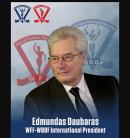
2026. “Ode to Dr. Edmundas Daubaras”.
Sometimes the greatest recognition does not come in the form of an order, a medal, or an honorary title. Sometimes it comes in the form of a poem.
Today, I was pleasantly and sincerely surprised by a very special gesture of recognition. A longtime employee of the Port of Klaipėda and my fellow bodybuilding colleague wrote a lengthy poem about me, which he entitled “Ode to Dr. Edmundas Daubaras.”
This has never happened to me before.
The poem can be found on my Facebook page. For me, this is a particularly meaningful and unexpected form of recognition, because throughout my life I have received various official awards and had the opportunity to meet presidents of different countries, prime ministers, ministers, government officials of various ranks, as well as renowned philanthropists and business leaders.
For my international public and civic activities, I have received numerous orders, medals, awards and honors, as well as honorary titles. Among them are an honorary Doctor of Science degree from Lviv University, a medal from the Pope, the Orthodox Church’s Gold and Silver Medal of St. Nicholas, and the Order of St. Stanislaus of Stanisław August Poniatowski, the last King of the Polish–Lithuanian Commonwealth.
Twenty-five years ago, in recognition of my activities, a bronze bust of me was even cast at the initiative of Natalija Murnikovienė, regarded as the greatest Lithuanian female bodybuilder of all time.
Yet the poem I received today is special for another reason: it is not an award from an institution, a committee, or an official ceremony. It is one person’s words dedicated to another person.
Throughout my life, I have always said what I believe and have tried to place the truth in the palm of my hand, without wrapping it in cotton wool. I understand that such an approach is not appreciated by everyone. But if speaking openly and remaining true to myself means facing criticism, envy or hostility, then that is simply the price of having the courage to speak honestly.
Therefore, I am especially grateful to all those who approach me with goodwill. Your support is not only appreciated – it is a responsibility that inspires me to keep moving forward.
I will not give up. I will continue my work.
And ahead lies a very special anniversary.
In 2027, one of the three oldest traditional bodybuilding competitions in the world – the “Amber Prix” – will celebrate its 60th anniversary.
This is more than just an impressive number. It represents six decades of bodybuilding history, athletes, coaches, organizers, traditions and people who have contributed to the development of the sport.
We will celebrate this exceptional anniversary in Klaipėda over three days.
And there is more. To mark the occasion, we will publish, in three languages, a unique historical book unprecedented in the world, documenting the history of the “Amber Prix”, its significance and its connections with the international world of sport.
It will not simply be a book about a competition.
It will be a book about the people who created history.
And that history is far from over.
The history of the “Amber Prix” continues.
More information is on international site www.wff.lt
The Stories of the “Amber Prix”.
VITALIJ ASOVSKIJ – A MAN FOR WHOM SPORT BECAME A PART OF LIFE.
Vitalij Asovskij (Виталий Асовский, 1952-2026) is one of the personalities of Lithuanian bodybuilding history whose activities went far beyond sport alone. His life story brings together bodybuilding, coaching, public activity, and literature.
From a Ban on Sport to Bodybuilding
Vitalij Asovskij was in poor health from childhood. In 1964, following a complicated operation, doctors forbade him from taking part in sports. However, this restriction did not stop the young man.
Cinema became the decisive inspiration. In 1966, after seeing the film “Hercules” starring Steve Reeves, the winner of the 1950 NABBA “Mr. Universe” title, Vitalij became interested in bodybuilding. At first, he trained at home, secretly from his parents.
This episode is important not merely as a biographical detail. It reveals one of Asovskij’s most important personal qualities – his determination to pursue his goal even when circumstances were unfavorable.
“Victoria” and Ceslav Tamulevic
In 1967, Vitalij Asovskij met Ceslav Tamulevic (Чеслав Тамулевич). This meeting became important not only for his own life – the two men remained friends for the rest of their lives.
That same year, Ceslav Tamulevic founded the Vilnius “Victoria” bodybuilding club, which later developed into what became known as the Vilnius School of Bodybuilding. Its influence on the development of bodybuilding in Lithuania and, later, throughout the Soviet Union was considerable.
Athletes from various Lithuanian cities, as well as bodybuilders from foreign countries, travelled to “Victoria”, located on Gorky Street in Vilnius (today Pilies Street), to learn the principles and techniques of bodybuilding.
It was more than a gym. “Victoria” became a place where knowledge was passed on, a sporting culture was developed, and a new generation of bodybuilders was trained.
Vitalij Asovskij worked at “Victoria” as assistant coach, while his connection with the “Amber Prix” tournament was different from that of most athletes – he served as a judge at the competition.
A New Chapter at the “Žalgiris” Stadium
In 1982, when Ceslavas Tamulevic withdrew from active work because of health problems, Vitalij Asovskij continued the club’s activities and moved them to premises at the “Žalgiris” Stadium.
During this period, he was assisted by coaches Viaceslav Federonko (Вячеслав Федоренко) and Anatolij Marcenko (Анатолий Марченко).
At the new location, Asovskij continued what had begun at “Victoria” – he not only coached athletes but also developed and mentored them, passing his accumulated knowledge and experience on to a younger generation.
Among his trainees were bodybuilders such as Oleg Zhur (Олег Жур) and Kshistof Cerniavskij (Кшистоф Чернявский).
Thus, Asovskij’s role in the history of Lithuanian bodybuilding is associated primarily not with his own competitive achievements, but with his work as a coach, educator, and custodian of bodybuilding traditions.
The “Amber Prix” – More Than a Competition
The international bodybuilding tournament “Amber Prix”, held in Klaipėda, was an important part of the sporting life of its time. Athletes from different cities and countries came together there. The competition was not merely a test of strength, muscular development, and physical preparation – it was also a meeting place for the bodybuilding community.
Vitalijus Asovskis’s story allows us to look at the “Amber Prix” from another perspective – not only as a stage on which athletes competed, but also as a space where judges, coaches, sports organizers, and people who shaped the traditions of the sport played an essential role.
That is why Asovskij’s name is important in the history of the “Amber Prix” as the name of one of the people who contributed to the development of the bodybuilding community and the preservation of its traditions.
Sport Was Only One Side of His Life
What makes Vitalij Asovskij’s story particularly interesting is that his activities were not limited to bodybuilding.
He is also a well-known poet and playwright, having worked for many years in the editorial offices of various newspapers, as well as for Lithuanian Radio and Television. From 2000 onward, he worked at the Lithuanian Russian Drama Theatre, where he served as head of the literary department.
Asovskij has also received various literary awards.
This part of his biography reveals a remarkable combination: sport and art, physical culture and literature, coaching and creative work. At first glance, these may seem to be completely different fields, yet in Asovskij’s life they existed side by side and complemented one another.
Recognition
In 2020, for his public activities, Vitalij Asovskij was awarded the Honorary Silver Medal of the World W.F.F.–W.B.B.F. Federation at the Seimas of the Republic of Lithuania.
This recognition symbolically continued the story of his many years of activity – from a young man who, despite being forbidden by doctors to participate in sports, began training at home, to a coach, custodian of bodybuilding traditions, judge, public figure, and cultural personality.
Conclusions
The story of Vitalij Asovskij is not merely the biography of one man. It is part of the history of bodybuilding in Lithuania.
First of all, his life demonstrates how much sports history depends not only on champions, but also on the people who train, teach, judge, and pass their experience on to others.
Secondly, Asovskij’s work at “Victoria” and later at the “Žalgiris” Stadium demonstrates the importance of continuity. What Ceslavas Tamulevic began, Asovskis took over and continued, passing the bodybuilding tradition on to a new generation of athletes.
Thirdly, his connection with the “Amber Prix” reminds us that the history of this tournament was shaped not only by the athletes who appeared on stage. Behind every competition stood coaches, judges, organizers, and an entire bodybuilding community.
Finally, Asovskij’s biography stands out because sport in his life was never merely about muscles and physical strength. Alongside it were creativity, literature, public activity, and, above all, people.
Therefore, Vitalij Asovskij can be regarded as a guardian of bodybuilding traditions and one of those people whose contribution often remains less visible than the achievements of athletes, yet without whom the history of the sport would have been different.
In the history of the “Amber Prix”, such personalities are especially important – they help us understand not only who won, but also who helped create the culture of bodybuilding itself.
More information is on international site www.wff.lt
“Amber Prix” Stories.
VALDAS ALIUBAVIČIUS – ONE OF THE PIONEERS OF LITHUANIAN BODYBUILDING.
Valdas Aliubavičius (Valdemaras Aliubavičius, Valdas Aliubavichus, 1942–2003) was a Lithuanian sculptor and bodybuilder, and one of the representatives of the “Vilnius School of Bodybuilding.” His competitive career lasted only a few years, from 1968 to 1972, yet during this period he achieved significant victories not only in Lithuania but also in international competitions.
Aliubavičius is first and foremost remembered in the history of Lithuanian bodybuilding as a junior champion. He won the Lithuanian Junior Championship in 1968, 1969, 1970 and 1971. These achievements demonstrate not only his athletic talent but also his sustained dominance in what was then a developing Lithuanian bodybuilding scene.
Victories in Lithuania and on the International Stage
One of Aliubavičius’ first major successes came in 1968 in Klaipėda, at the second international “Amber Prix” (“Gintarinis prizas”) tournament. There he became the overall winner of the junior categories. This achievement was important not only for the athlete himself. The international tournament in Klaipėda was one of the venues where Lithuanian bodybuilders could establish themselves within the broader sporting environment of the Soviet Union and beyond.
The year 1969 was particularly successful for Aliubavičius.
In Tyumen, Russia, at the international “Siberian Cup” (“Первенство Сибири”) tournament, he became the overall winner of the junior division. In the same year, representing the T.S.S.R., he took first place in his height category at the international “Warszawa-69” competition held in Warsaw, Poland.
He also continued to achieve victories in Lithuania. At an international tournament in Palanga, Aliubavičius won his height category, while at the third international “Amber Prix” tournament in Klaipėda he became the champion of his height category in the junior division.
Thus, 1969 marked a year in which Aliubavičius progressed from being a Lithuanian junior champion to an athlete capable of winning competitions at both national and international level.
Champion in Estonia and at the First Official T.S.S.R. Championships
In 1971 and 1972, Aliubavičius successfully competed in Estonia at the “Georg Tenno Memorial”, winning his category on both occasions.
An even more significant stage of his career came in 1971 and 1972 in Sverdlovsk, where the first official T.S.S.R. bodybuilding championships in history were held. Aliubavičius won the junior category at both championships.
These victories are particularly significant because they came at the very beginning of the period when bodybuilding was gaining official recognition within the Soviet Union. Aliubavičius’ name is therefore associated not only with individual championship titles but also with a formative period in which bodybuilding was evolving from an enthusiasts’ movement into an organized competitive sport.
An Athlete at a Turning Point in Bodybuilding History
Valdas Aliubavičius’ competitive career lasted from 1968 to 1972. During this relatively short period, he became a four-time Lithuanian Junior Champion, an international tournament winner, a champion at the “Amber Prix,” a category winner at the “Georg Tenno Memorial,” and the junior champion at the first two official T.S.S.R. bodybuilding championships.
Yet a list of victories alone does not fully reveal Aliubavičius’ significance.
His career coincided with a period when Lithuanian bodybuilding was still developing its traditions, competition structure and leading figures. Athletes such as Aliubavičius therefore played a role that went beyond competition: they helped shape the identity of Lithuanian bodybuilding and raise its sporting standards.
It is also important that Aliubavičius was not only a bodybuilder but also a sculptor. This aspect adds another dimension to his sporting biography. The human form, proportion, structure and aesthetics were central both to sculpture and to the classical concept of bodybuilding. In Aliubavičius’ life, the experiences of the artist and the athlete therefore naturally came together.
Conclusion
Valdas Aliubavičius can be regarded as one of the important historical figures of early Lithuanian bodybuilding. His achievements demonstrate remarkable competitive consistency, while his victories at the first official T.S.S.R. championships give his career a broader historical significance.
The period from 1968 to 1972 was relatively short, but exceptionally productive: from Lithuanian Junior Champion to international tournament winner and champion at the first official T.S.S.R. championships.
Aliubavičius’ story is more than a list of sporting victories. It is part of the history of the formation of Lithuanian bodybuilding, documenting a time when a discipline that is taken for granted today was still fighting for its place in the sporting world.
More information is on international site www.wff.lt
World Bodybuilding Hiostory.
Six Decades of the “Amber Prix”: What Remains in Sports History.
After many years have passed, it becomes surprisingly easy to evaluate events, people, and the work they accomplished. Time creates distance, and the past seems clearer: we can identify the key dates, name the winners, and highlight the most important events.
But sports history is not merely a list of victories and results.
An individual victory is an important event at a particular moment. That year, it excites the sporting community, receives media attention, and is remembered. But a year later, there are new victories, new champions, and new names. Sport moves forward.
History requires more than a moment. History requires continuity.
That is precisely why six decades of the “Amber Prix” represent an exceptional phenomenon, not only in the history of bodybuilding in Lithuania, but in the broader history of Lithuanian sport as well.
Not One Victory, but Six Decades
The first “Amber Prix” tournament was held in Klaipėda in 1967, shortly after the first historic international bodybuilding event in Vilnius in 1966. At that time, Kaunas-based organizers shared their organizational experience with their colleagues in Klaipėda. From that first tournament, a tradition began which, despite political, social, and sporting changes, has never been interrupted.
Therefore, today the “Amber Prix” should not be viewed simply as another bodybuilding competition. Its principal value lies in its six decades of continuity.
The tournaments of 1967, 1977, 1987, 1997, 2007, and 2017 became landmarks reflecting different periods in Lithuania's history.
1977 – When It Took More Than Sporting Courage
The tenth “Amber Prix” tournament, held in 1977, took place during a particularly difficult period – the years when bodybuilding was banned and persecuted. It was not a time when bodybuilding events could be organized freely and without risk. Nevertheless, the tournament was held at the Klaipėda Sea Port Culture Palace.
This is where Dr. Edmundas Daubaras deserves particular recognition. He took the risk of defying the restrictions of the time and organized the competition.
Therefore, today the 1977 “Amber Prix” should be regarded as more than a sporting event. It was an example of determination, organizational will, and the resolve to preserve the sport.
1987 – From the Thaw to Official Recognition
The twentieth “Amber Prix” tournament took place in 1987, in a very different political environment – during Mikhail Gorbachev's perestroika and the period commonly described as the political thaw.
Soon afterwards, and with the efforts of Dr. Edmundas Daubaras dating back to 1986, an officially recognized USSR Bodybuilding Federation was established in Moscow in 1987.
This period reveals another important characteristic of the “Amber Prix”: the tournament did not simply exist alongside historical change – it was itself part of that change.
At that time, the organization of sport was closely connected with state policy, official recognition, and the very possibility of the sport's existence.
1997 – Sport in Independent Lithuania
The thirtieth “Amber Prix” tournament was held in 1997 at the Mažeikiai Nafta Culture Palace.
This was already the period of independent Lithuania. The country, political system, opportunities for organizing sport, and society's attitude had all changed. It is also significant that, at that time, the activities surrounding the “Amber Prix” were supported by the Government of the Republic of Lithuania. This demonstrated that bodybuilding had become part of the country's broader sporting life.
Thus, the thirtieth tournament marks more than another anniversary. It symbolizes bodybuilding's transition from a period of bans and restrictions into the sporting system of an independent state.
An International Dimension
The fortieth “Amber Prix” tournament was held in the impressive hall of LCC International University in Klaipėda.
Almost 300 athletes from nine countries took part. The event was financed through a separate allocation in the budget of the Republic of Lithuania, approved by the Lithuanian Parliament.
This moment is important because the “Amber Prix” was no longer merely a local or regional event. Its scale, number of participants, and international character demonstrated growing organizational expertise and the integration of Lithuanian bodybuilding into the international sporting arena.
On the occasion of the 40th anniversary of the “Amber Prize,” Professor Alfred Gerstl, President of the Austrian Parliament, sent to Klaipėda a collection of original photographs of Arnold Schwarzenegger, who was Governor of California at the time, as well as a film about his life.
The photographs were displayed in the foyer of the LCC building, while the film was screened for the large crowd of Klaipėda residents who had gathered for the competition.
2017 – The “Amber Prix” on the World Stage
The fiftieth tournament, held in 2017, became another historic milestone.
Approximately 200 athletes from 17 countries participated in the competition in Klaipėda. Yet the most important aspect was not simply the statistics.
A report about the event was broadcast by the global CNN television network. As a result, the names of the “Amber Prix”, Klaipėda, and Lithuania reached an international audience. It was the moment when a long-standing Lithuanian bodybuilding tradition entered a much broader global information space.
From a local tournament to an event known to a worldwide audience – that is the journey of six decades.
2027 – Approaching the Sixtieth Tournament
The sixtieth “Amber Prix” tournament is planned for May 2027 in Klaipėda. It will not be merely another anniversary event. A three-day program is planned, with distinguished guests invited and bodybuilding veterans honored.
A particularly important part of the anniversary will be a historical book, to be published in several languages, which will seek to reveal the place of the “Amber Prix” in Lithuanian and world sports history, as well as its connections with broader political and social processes.
This matters because history must not only be remembered – it must be recorded and passed on to future generations.
What Is Significant – and What Is Not?
Looking back over six decades makes it easier to understand what is temporary in sports history and what endures. A single victory is temporary. One result. One champion. One competition. All of these are important to the athlete, the coach, and the audience of that particular time. But historically, the greatest value belongs to what has continuity, influence, and lasting consequences.
The history of the Amber Prize demonstrates precisely this kind of continuity.
1967 – the beginning of the tradition.
1977 – preserving the tradition under conditions of prohibition.
1987 – the era of political thaw and official recognition of bodybuilding.
1997 – bodybuilding within the sporting environment of independent Lithuania.
2007 – state support and international scale.
2017 – reaching the global information space.
2027 – giving meaning to sixty years of history.
Conclusion
Six decades of the “Amber Prix” allow us to draw a simple but very important conclusion: sports history is created not only by winners. It is also created by the people who preserve a tradition for decades, despite changing circumstances.
Therefore, the significance of the “Amber Prix” is not limited to the number of tournaments held or the collection of medals won at them. Its significance lies in its historical continuity.
The tournament has survived the prohibitions of the Soviet era, political transformations, the restoration of Lithuania's independence, changes in the country's sporting system, and the age of globalization. During that time, athletes, coaches, venues, organizational conditions, and bodybuilding itself have all changed.
Only one thing has remained unchanged – the tradition.
That is why the forthcoming sixtieth “Amber Prix” tournament is not merely an occasion for celebration. It is an opportunity to look back, evaluate what has been accomplished, and record it for future generations.
Because after sixty years, we can clearly distinguish between a moment and history.
A moment passes. History remains.
And the history of the “Amber Prix” is now six decades long.
The History of the “Amber Prix”.
Albertas Besakirskas – a prize-winner whose journey began during the years of the ban.
During the socialist period, Albertas Besakirskas, a bodybuilder from Kaunas’s “Olimpas” sports club, was one of the most prominent Lithuanian bodybuilders of his generation. Between 1978 and 1985, he competed in 21 events and finished among the prize-winners in all of them. As many as 15 of these competitions were international.
A particularly significant part of Albertas Besakirskas’s career was his participation in the “Amber Prix” tournaments. He competed in this international event six times and finished among the prize-winners on every occasion. This is not merely impressive statistics; it is evidence of his skill and consistency at a time when every international appearance was a significant achievement for Lithuanian bodybuilders.
Victories that became career highlights
Among Albertas Besakirskas’s finest achievements were his victories in his respective qualifying categories in 1981. That year, he won his category at the “Komsomol Cup” Championships in Kaunas, and later that same year he also won his category at the Georg Tenno Memorial in Tallinn.
These victories were important not only because of the places he achieved. They demonstrated that Lithuanian athletes were already capable of competing successfully on the international bodybuilding stage. Besakirskas was among those athletes whose performances helped establish the reputation of Lithuanian bodybuilding.
A story that began when bodybuilding was still banned
Albertas Besakirskas’s story is particularly remarkable because the beginnings of his international sporting path date back to a period when bodybuilding was still officially banned in the USSR.
In 1978, Dr. Edmundas Daubaras, working together with the Czechoslovak bodybuilding federation, was preparing a project for joint international competitions. Albertas Besakirskas, together with several other leading bodybuilders of the time, was included in the planned USSR national team.
Two competitions were envisaged. One was to take place in Klaipėda in 1979, during the “Amber Prix” tournament, while the other was planned in Czechoslovakia, during that country’s national bodybuilding championships.
Considerable preparations had already been made. During several visits by Dr. Edmundas Daubaras to the Czechoslovak Ministry of Sport, approval was obtained for such international events to be organized. The Czechoslovak side even sent personal invitations to members of the USSR national team. This was particularly important at the time, as such official invitations were essential for athletes seeking permission to travel abroad from the USSR.
Everything appeared to be ready for the international exchange.
But the project ultimately collapsed.
According to accounts from the period, Roman Kalinauskas, secretary of the then formally operating USSR bodybuilding federation, undermined Dr. Edmundas Daubaras’s initiative by submitting complaints to various authorities. Personal and institutional disagreements reportedly played a role: the initiative had not originated with Kalinauskas, and he himself had not been included in the planned delegation.
Thus, a carefully prepared project for international cooperation never became a reality.
The “Amber Prix” – more than just a competition
Albertas Besakirskas’s story also reveals the broader significance of the “Amber Prix.” At that time, the tournament was more than simply a sporting competition. It became one of the venues where Lithuanian bodybuilders could meet athletes from abroad, gain international experience and demonstrate their abilities on a broader stage.
Besakirskas’s six prize-winning appearances at the “Amber Prix” are an important part of this history. His results show that Lithuanian bodybuilders were not merely enthusiasts operating on the margins of organized sport. They were ambitious athletes capable of competing successfully at an international level.
Conclusion
Albertas Besakirskas was one of the athletes whose achievements helped shape the history of Lithuanian bodybuilding. Twenty-one competitions and twenty-one finishes among the prize-winners, six prize-winning appearances at the “Amber Prix,” and category victories in 1981 demonstrate an exceptional level of consistency and sporting ability.
Yet another aspect of his story is equally important. Besakirskas’s career developed during a period when bodybuilding in the USSR was subject to bans and severe administrative restrictions. Consequently, every international appearance represented not only a sporting challenge but also an organizational and political one.
Looking back today, Albertas Besakirskas’s story reminds us that Lithuania’s international bodybuilding achievements did not emerge by themselves. They were built by athletes, coaches and organizers who, despite the circumstances of the time, sought ways to enter the international arena. The “Amber Prix” was one of the platforms that made this possible.
More information is on international site www.wff.lt
THE HISTORY OF THE “AMBER PRIX”.
BRONÉ DUBAR – A PIONEER IN WOMEN’S SPORTS HISTORY.
The woman who entered sports history before the world was ready to call it fitness.
There are athletes whose names are written into history by medals. There are champions whose names are preserved in record books. But there are also people whose historical significance lies somewhere entirely different.
They appear before the sporting system.
Before the rules. Before the championships. Before the federations. Before established social perceptions.
Broné Dubar (Broné “Brownie” Dubar, Daubaraitė, 1906–1986) was one of these individuals.
An American of Lithuanian origin, she represents an early era when women’s physical education and sport were only beginning to make their way into the public sphere. Today, her activities can be viewed as one of the early manifestations of women’s fitness culture. But what matters most is not what we would call her activities today. What matters is that Broné Dubar was doing, in her time, what later became part of modern women’s fitness culture.
THE HISTORICAL SIGNIFICANCE OF A HISTORICAL FIGURE
A historical figure is not simply a famous person. A historical figure is someone whose activities help us better understand the changes of their era and the subsequent development of history. Broné Dubar’s story meets this criterion.
She lived at the beginning of the 20th century – an era when the place of women in sport was still being shaped. Women’s sports were only beginning to establish themselves in international sporting life. Modern fitness sport did not yet exist. There was no contemporary system of women’s fitness competitions. There were no world championships. There was no international fitness sports structure.
Yet Broné Dubar was already training, creating physical exercise programs, and publicly demonstrating her physical abilities.
This is the core of her historical significance. She was ahead of the system.
LITHUANIA, AMERICA, AND A WOMAN OF A NEW ERA
In 1912, Broné Dubar emigrated from Lithuania to the United States with her parents and four brothers.
This detail is important not only to her biography. It places Broné’s story within the broader context of Lithuanian emigration to America. She belonged to a generation of people whose lives connected two different cultural worlds: Lithuanian heritage and the American environment; tradition and a rapidly modernizing world.
In this environment, Broné chose sport.
She grew up in an athletic family. Her brothers participated in boxing, ice hockey, and baseball competitions. Broné herself took part in swimming and diving. But her interests were broader. She enjoyed books and chess.
Thus, in her personality, physical and intellectual development formed a unified whole.
She represented the portrait of a modern 20th-century woman – a person who wanted to develop not only the body, but also the mind.
SHE DID NOT JUST PRACTICE SPORT – SHE CREATED
This is where Broné Dubar’s true historical distinctiveness begins.
She did not limit herself to the sporting activities common at the time. Through constant training, she achieved a high level of physical fitness and created her own exercise program.
This was an important step.
An athlete who performs already-known exercises is a participant in an existing sporting system. A person who begins creating their own physical training program and presenting it to the public becomes a disseminator of an idea.
Broné chose the second path.
She did not merely practice sport. She created her own form of sport.
Today, we would easily recognize this type of activity as part of fitness culture. But in Broné’s time, this phenomenon still lacked its modern name, structure, and sporting institutions.
Her innovation, therefore, lay not in using an established system, but in acting before that system had been formed.
THE WOMAN WHO TURNED HER BODY INTO HER MESSAGE
Broné Dubar’s sporting activities went beyond training. She began giving public performances.
During the 1920s and 1930s, she traveled across the United States with her programs – from New York to Seattle, from Ohio to California. This was an era when a woman publicly demonstrating physical strength, endurance, flexibility, and acrobatic abilities was an unusual phenomenon. Through her body, Broné communicated something that was not yet universally accepted at the time: A woman can be strong. A woman can be athletic. A woman can publicly demonstrate her physical abilities. A woman can create her own path in sport. This was not merely a sporting performance. It was a social statement.
INNOVATION THAT CAME BEFORE THE NAME
Broné Dubar’s activities contain several elements that later became foundations of modern fitness:
• an individual training program;
• systematic physical development;
• a combination of strength and flexibility;
• the development of endurance and coordination;
• the public demonstration of physical fitness;
• the promotion of health and an active lifestyle;
• the aesthetics of the athletic body.
She did all of this at a time when these elements were not yet united by a single global sporting system.
Therefore, Broné Dubar’s historical significance lies not only in her personal abilities.
She helps us see that fitness culture did not appear overnight. It developed through people who began consciously training their bodies, demonstrating their achievements, and inspiring others long before a formal system existed.
Broné was one of the representatives of this early culture.
STRENGTH, ACROBATICS, AND AESTHETICS
Broné Dubar’s performances were original. During one performance, she carried out her program on a second-floor balcony so that the audience could see her better. The climax was a jump over the heads of the assembled spectators into a swimming pool below. This story is important not only because of the stunt itself. It reveals Broné’s approach to sport.
For her, sport was an action that had to be performed in a way that left an impression.
Her performances brought together: athleticism, acrobatics, courage, and aesthetics. It was an early synthesis of sport and public spectacle.
THE ATHLETE WHO ATTRACTED THE ATTENTION OF THE PRESS
Broné Dubar’s performances attracted the attention of the American press of the time. Newspapers wrote about her physical abilities, but they also noted her clothing and appearance. In photographs, she was compared to the image of a Vogue magazine cover. Today, this may seem like nothing more than a colorful biographical detail. But from a historical perspective, it is significant. In Broné’s case, society encountered a new image of a woman: an athlete did not necessarily have to abandon femininity; physical strength could coexist with aesthetics. Today, this is a completely ordinary part of fitness culture. At the time, it was one of its innovations.
THE HISTORICAL FIGURE TEST – WHAT REMAINS AFTER A PERSON?
Broné Dubar ended her public performances with the beginning of the Second World War. She never returned to the stage. But this is precisely where we can distinguish short-lived fame from historical legacy. Short-lived fame ends when a person withdraws from public life. Historical legacy begins when an idea remains after the person is gone. In Broné’s case, the sporting tradition continued within her family. And this is one of the strongest elements of her historical story.
FAMILY CONTINUITY – A LIVING LINE OF HISTORY
A close relative of Broné Dubar, Dr. Edmundas Daubaras, became an international fitness sports organizer and leads the global WFF-WBBF federation. His daughter, Edita Daubaraitė (Sendrienė), became the first absolute world fitness champion representing Eastern Europe in 1997. These facts give Broné’s story a special sense of continuity. In one generation there was a pioneer. In the next – an international sports organizer. And in another – a world champion. This is more than a family genealogy. It is a genealogy of a sporting idea. Broné’s generation developed a personal understanding of physical training. Later generations transferred that idea into organized sport. Eventually, it reached the level of a world championship. This is the journey from personal initiative to an international sporting system.
BRONÉ DUBAR – THE PIONEER, EDITA – THE CHAMPION
The comparison between these two generations is particularly revealing. Broné Dubar worked at a time when the modern world of women’s fitness championships did not yet exist. Edita Daubaraitė (Sendrienė) became a world champion within an established international fitness system. One began the journey. The other followed it all the way to the top of the world. This is the true meaning of sporting continuity. The significance of a pioneer is not always measured by their own titles. Sometimes it is measured by how far later generations travel along the path they began.
THE “AMBER PRIX” – NOT A PRIZE, BUT A SYMBOL OF MEMORY
Here, the true symbolism of the “Amber Prix” emerges. Amber in Lithuania is not merely a beautiful stone. It is a symbol of the Baltic region, Lithuania, and historical time. Amber preserves what became trapped within it thousands of years ago. In the same way, the memory of sport should preserve what began decades ago. Broné Dubar’s family left Lithuania in 1912. Her life took shape in America. Yet the family’s sporting tradition survived. Across several generations, it connected Lithuanian heritage, American sporting culture, and international fitness. Therefore, the “Amber Prix” can become a symbol of this memory.
Symbolically, it connects:
Lithuania and the world.
The past and the present.
Pioneers and champions.
Family and the sporting community.
An idea and its continuation.
AMBER AS THE MEMORY OF SPORT
If a medal commemorates a specific victory, amber can commemorate historical memory. A medal says: “Today, you won.” Amber says: “We have not forgotten those who came before you.” This distinction is essential. Because without pioneers, there would be no champions. Without the first training sessions, there would be no sporting systems. Without traditions passed down through families and teachers, there would be no sporting generations. Therefore, the value of the “Amber Prize” may lie not only in the award itself, but also in preserving memory.
BRONÉ DUBAR – HISTORICAL TESTIMONY
Broné Dubar’s story demonstrates that the history of sport does not begin with the first world championship. It begins much earlier. With the person who first asks: “What if I can do more?” With the person who begins training. With the person who is not afraid to be different. With the person who shows their achievements to others. With the person who inspires another person.
Broné Dubar was one of those beginnings. Therefore, her place in history belongs not only in a family album. She is part of a broader story – the story of the development of women’s sports, physical education culture, and the path toward modern fitness.
HISTORICAL CONCLUSION
Broné Dubar deserves to be remembered not because she lived at a time when sport was different. She deserves to be remembered because she herself was one of the signs of change. She lived in an era when women’s sports were still searching for their place. She trained. She created her own programs. She publicly demonstrated her physical abilities. She traveled throughout America. She inspired women to take an interest in physical education. And she left behind a sporting tradition that continued within her family. Her activities did not have the modern name of fitness in her own time, yet many of her principles are inseparable from fitness culture today. Therefore, Broné Dubar can be regarded as an early pioneer of women’s fitness and physical education, a historical figure whose activities were ahead of the sporting understanding of her time.
EPILOGUE
Broné Dubar – the beginning.
Her family – continuity.
Edita Daubaraitė – championship.
The “Amber Prix” – memory.
This four-word chain contains more than one family story. It contains more than the history of a single sport. It contains a story about how a person’s idea can outlive its time, be passed on to another generation, and ultimately become part of international sport. Therefore, Broné Dubar’s name in the history of the “Amber Prix” should not be spoken merely as the name of a sportswoman who lived long ago. It should be spoken as the name of a pioneer. A woman who was there when there was still no path. And she was the first to begin walking it. Because every sports champion has a predecessor. Every sport has its pioneers. Every tradition has its first generation. And history begins with those whom later generations must not forget. Broné Dubar – one of them.
“Amber Prix” Today – 60 Years of History, a Legacy Far Greater Than Bodybuilding.
There are sporting competitions. There are tournaments. And then there are phenomena that, over time, become history. The “Amber Prix” belongs to the latter category.
In May 2027, Klaipėda will host the 60th historic “Amber Prix” tournament. This will be neither an ordinary bodybuilding competition nor simply an anniversary event.
It will be a moment in a six-decade-long history.
In terms of longevity, few bodybuilding events in the world can rival the “Amber Prix.” Only the NABBA “Universe,” first held in 1950, and Joe Weider’s “Olympia,” launched in 1965, have somewhat older traditions.
Yet longevity alone does not explain why the “Amber Prix” matters.
What matters most is what has happened around it during those six decades.
What is often misunderstood today
Some athletes of earlier generations, coaches, and people who were in one way or another connected with the historic “Amber Prix” tournament still remember it as it was in their youth.
To them, the “Amber Prix” was, is, and remains simply a bodybuilding competition.
But this is precisely where the fundamental misunderstanding lies.
Over six decades, almost everything has changed: countries, political systems, sports organizations, international relations, the concept of bodybuilding, the geographical reach of competitions, and the scale of the event itself.
Thousands of athletes from different countries and continents have participated in the history of the “Amber Prix.” They left Klaipėda, but they also took with them knowledge of Lithuania, of the tournament, of its organizational culture and its traditions.
The “Amber Prix” traveled with the people who took part in it.
Its history spread far beyond Klaipėda and Lithuania.
Therefore, today it is no longer possible to speak of the “Amber Prix” as just another bodybuilding competition.
It is an international sporting phenomenon that has endured for more than half a century.
1978 – Breaking Through the Wall
There are dates in this history that deserve to be recorded in the history of Lithuanian sport.
One of them is 1978.
Thanks to a petition by Dr. Edmundas Daubaras, presented in Moscow to the Central Committee of the Communist Party of the Soviet Union, the exclusive right to organize bodybuilding competitions in Klaipėda was secured.
Today, this might look like a formal administrative decision.
At the time, it was something entirely different.
The position of bodybuilding within the Soviet sports system was complicated. Therefore, the opportunity to organize competitions of this kind in Klaipėda meant more than sporting freedom.
It created an opportunity to build.
To build a tradition.
To build international relationships.
To build Lithuania’s sporting authority.
And this is where the true historical significance of the “Amber Prix” begins.
1986 – Thinking Not About One Competition, but About an Entire Sport
In 1986, at the initiative of Dr. Edmundas Daubaras, a decision was made during the “Amber Prix” tournament in Klaipėda to establish the USSR Bodybuilding Federation in 1987 and seek official recognition of bodybuilding as a sport.
This was a crucial moment.
Why?
Because the “Amber Prix” was no longer limited to a stage, judges and medals.
The future of the entire sport was being discussed and shaped there.
The tournament became a place where not only athletes, but also people capable of influencing the development of the sport, could meet.
It was no longer simply a competition.
It had become a platform.
1988–1991 – An Attempt to Bring Lithuania into the World
Another historic stage came between 1988 and 1991.
Building on the international experience and connections accumulated through the “Amber Prix” tournaments, Dr. Edmundas Daubaras conducted negotiations with IFBB President Ben Weider regarding Lithuania’s independent admission and participation in IFBB activities, bypassing the USSR Bodybuilding Federation.
Ben Weider did not support this possibility and maintained the Moscow position.
But history is not measured only by what was ultimately achieved.
Sometimes, what people attempted before their time is equally important.
Lithuanian sports leaders were already thinking about an independent place for Lithuania in the international bodybuilding community.
This was a period when political reality still restricted possibilities, while the ambitions of sportspeople had already gone beyond the borders of the USSR.
Independence – and the First Signs of International Recognition
After the restoration of Lithuania’s independence, this work gained entirely new momentum.
With the support of the Ministry of Sports of the Republic of Lithuania and personally Minister Algirdas Raslanas, the first national bodybuilding organization in independent Lithuania – LNKA – was registered.
Under the leadership of Dr. Edmundas Daubaras, the first gold medals were brought to Lithuania from France. They were awarded by the international NABBA organization to “Amber Prix” champions Natalija Murnikovienė and Rolandas Bučinskas.
Recognition documents from the international NABBA organization were also obtained from the Republic of Lithuania and the Lithuanian National Olympic Committee.
This was a symbolic yet very important turning point: Lithuanian bodybuilding was leaving the Soviet sphere and beginning to establish its own international identity.
When Lithuania Became Not a Spectator, but a Host
In 1996, 1997 and 1998, under the leadership of Dr. Edmundas Daubaras, European Championships were organized in Klaipėda, Vilnius and Palanga with state support and financing. Events were televised by “Eurosport”.
In 1998, 2004, 2005, 2006 and 2007, World Championships were held in Palanga and Vilnius.
The organizing committees were chaired by the highest-ranking representatives of the Republic of Lithuania.
This fact is highly significant.
Lithuania was no longer merely sending athletes into the world. The world was beginning to come to Lithuania.
And this is one of the most important achievements in the history of the “Amber Prize.”
Klaipėda, Palanga and Vilnius became venues for major international bodybuilding events.
Foreign delegations were received at the Seimas of the Republic of Lithuania. International press conferences were held at the ELTA news agency.
This was no longer just sport.
It was Lithuania representing itself to the international community through sport.
2007 – Recognition by the State
In 2007, the Seimas of the Republic of Lithuania decided that the 40th anniversary “Amber Prix” tournament in Klaipėda would receive a separate line of funding from the national state budget.
Today, viewed from a historical distance, this should be understood as one of the clearest signs of state recognition.
The international stature of the event was further emphasized by an extraordinary gesture.
Professor Alfred Gerstl, President of the Austrian Parliament, sent to Klaipėda an authentic collection of photographs of Arnold Schwarzenegger, Governor of California, as well as a film about his life.
The collection was displayed to participants and spectators, while the film was shown before the competition.
Arnold Schwarzenegger’s name became a symbolic bridge between the history of world bodybuilding and Klaipėda.
When CNN Reported on Klaipėda
Another symbolic moment came with the 50th anniversary of the “Amber Prix.”
Global CNN television broadcast a report about the tournament from Klaipėda to billions of viewers around the world.
The significance of this fact should not be underestimated.
A bodybuilding event taking place in Klaipėda had become an object of attention for global television media.
This meant that the “Amber Prix” had already moved beyond Lithuania’s information space.
Its name had reached a worldwide audience.
Therefore, 2027 Is Not Just Another Anniversary
We are now approaching a new historic milestone.
In May 2027, Klaipėda will host the 60th “Amber Prix” tournament.
Preparations have already been underway since 2025.
This is not simply another event on the calendar.
It is an opportunity to reassess what has been built over six decades.
A particularly solemn international event is being planned, with prominent guests from Lithuania and abroad to be invited.
To mark the 60th anniversary, a unique historical book will also be published, telling the story of the “Amber Prix” against the broader background of events in Lithuania, Europe and the world.
And this is extremely important.
History must not only be remembered. History must be recorded.
Because what is not recorded can be lost after a few generations.
Sixty Years Is Not Just a Number
Sixty years means six decades during which the world has changed beyond recognition.
Countries have changed.
One political system collapsed.
Independent Lithuania was restored.
International sports organizations evolved.
Bodybuilding itself changed.
Generations changed.
And the “Amber Prix” remained.
Therefore, today its significance cannot be measured merely by medals, champions’ names or competition results.
Its true scale must be measured by the people it brought together.
By the countries with which it established connections.
By the international events it helped create.
By the Lithuanian name it carried into the world.
And, above all, by the fact that a bodybuilding tradition born in Klaipėda survived changing eras and became part of international sporting history.
The Main Conclusion
Therefore, the 60th “Amber Prix” tournament in 2027 should not be understood as a beautiful remembrance of the past.
This is not an event of nostalgia.
It is an event of historical continuity.
It must demonstrate that what was created decades ago can not only be remembered today, but also carried forward.
And this is where the greatest value of the “Amber Prix” lies.
It has survived eras.
It has outlived political systems.
It has crossed national borders.
It has grown from a sporting event in one city into an international phenomenon.
Therefore, in May 2027, Klaipėda will not merely celebrate 60 years of bodybuilding competitions.
It will celebrate a part of Lithuania’s sporting history.
It will celebrate the history of Klaipėda.
It will celebrate the history of the people who built this tradition over decades.
And it will look toward the future.
Because a true tradition is not simply what remains in the past.
A true tradition is what passes from the past into the future.
And the history of the “Amber Prix” is certainly not over.
2027 should mark not the closing of a chapter in history, but the beginning of a new one.
2026 International News:
Lithuania Strengthens International Cooperation Through Sport.
The Ministry of Foreign Affairs of the Republic of Lithuania has officially expressed its support for the international initiatives of the global WFF-WBBF Federation and for cooperation aimed at strengthening Lithuania’s relations with foreign countries.
Today, the global WFF-WBBF Federation unites members from more than 140 countries across several continents. For more than three decades, the Federation’s international activities have been based in Lithuania and have contributed not only to the development of bodybuilding and fitness, but also to promoting Lithuania internationally.
The Federation has received an official letter from the Ministry of Foreign Affairs of the Republic of Lithuania, expressing support for its initiatives and confirming cooperation in developing Lithuania’s international relations.
This represents important recognition for an organization whose international activities have been conducted from Lithuania for more than 30 years.
The International Sports Community Is Coming to Lithuania
Two major international WFF-WBBF events are planned in Lithuania in the near future.
The 37th WFF-WBBF World Championship will take place in Neringa on October 24–26, 2026. The three-day international programme will be held at the prestigious “Agila” Cultural Centre in Nida. Athletes from different countries, representatives of international sports organisations, as well as prominent public and cultural figures, are expected to be invited to the event.
Meanwhile, in May 2027, Klaipėda is scheduled to host one of the world’s oldest traditional bodybuilding and fitness events – the “Amber Prix” Tournament.
Preparations for both events began as early as 2025. The programme is planned to include not only sporting competitions, but also an extensive international programme, meetings with international guests and opportunities to present Lithuania to representatives of foreign countries.
This means that Lithuania will welcome members of the international sports community, while Neringa and Klaipėda will become important centres of the Federation’s international activities.
Sport as a Tool for Lithuania’s International Visibility
Cooperation between the WFF-WBBF Federation and the Ministry of Foreign Affairs of the Republic of Lithuania dates back to 1991. Over the years, there have been numerous occasions when international sporting events have provided an opportunity to present Lithuania to a global audience.
One of the most notable examples was the 50th anniversary of the “Amber Prix” in Klaipėda, when, with the assistance of the Ministry of Foreign Affairs, the global television network CNN produced a report from Klaipėda that reached a worldwide audience of billions.
This example demonstrates that international sport can serve a much broader purpose than simply organising competitions. Through sport, countries, cities, their culture, people and opportunities for international cooperation can be presented to the world.
The 2026–2027 Events: A New Opportunity for Lithuania
The forthcoming 37th World Championship in Neringa and the “Amber Prix” Tournament in Klaipėda can provide another important platform for increasing Lithuania’s international visibility.
The fact that the Federation brings together representatives from more than 140 countries is particularly significant. Athletes and international guests travelling to Lithuania can become informal ambassadors of the country in their respective nations, taking home impressions and information about Lithuania, its cities and its international events.
This is the practical meaning of sports diplomacy: an international sporting event becomes a meeting point not only for athletes, but also for people, organizations and communities from different countries.
Key Conclusion
The support expressed by the Ministry of Foreign Affairs of the Republic of Lithuania demonstrates that international sport can play a meaningful role in strengthening Lithuania’s foreign relations and international image.
More than 30 years of WFF-WBBF international cooperation and experience provide a strong foundation for continuing to organise major international events in Lithuania.
The events planned in Neringa in October 2026 and in Klaipėda in May 2027 are more than sporting competitions. They are an opportunity to bring the international sports community to Lithuania, strengthen international relations and once again present Lithuania to the world as a country capable of hosting significant international events.
The WFF-WBBF Federation looks forward to strong public interest and support in Lithuania for these forthcoming international events.
More information is on international site www.wff.lt
The History of the “Amber Prix”.
EDITA DAUBARAITĖ – THE FIRST OVER ALL WORLD FITNESS CHAMPION.
In 2027, Klaipėda will commemorate an important anniversary in the history of the “Amber Prix”, one of the long-standing international sporting tournaments associated with the city and with Lithuania’s sporting heritage.
This history is inseparable from the name of Edita Daubaraitė (now Sendrienė). Thirty years ago, in 1997, in Mannheim, Germany, she became the over all World Fitness Champion at the W.F.F. World Fitness Championships.
This was more than a personal sporting victory. At the time, it represented a remarkable achievement for Lithuanian sport: a representative of Lithuania—and, more broadly, of the former socialist world—had reached the very top of the emerging international fitness movement.
From ballet and gymnastics to the fitness stage
Edita’s path to fitness was unusual. From an early age, she was involved in ballet and artistic gymnastics, disciplines in which movement, flexibility, coordination, musicality and stage presence are essential.
A turning point came in 1995. While attending N.A.B.B.A. competitions in Malta, Edita saw athletes whose performances combined physical strength with aesthetics, choreography and gymnastics.
One athlete in particular made a strong impression on her: Daniela Harič of Croatia. Her performance stood out for its lightness, sophisticated gymnastics elements and stage presence.
Edita remembers thinking:
“I want to do that, too...”
That thought marked the beginning of a new chapter in her sporting life.
After returning to Lithuania, she began serious fitness training. Her first successes came at national competitions, followed by victories at the Lithuanian National Championships and increasingly important international appearances.
The “Amber Prix” – an important part of her career
International “Amber Prix” tournaments held in Klaipėda also became an important part of Edita Daubaraitė’s sporting career.
In 1996, she won first place in the fitness category, and in 1997, she finished second.
This was a period when fitness was still defining itself as a distinct sporting discipline. There was growing emphasis on separating fitness from traditional bodybuilding and highlighting a combination of physical conditioning, flexibility, gymnastics, choreography and stage presentation.
Edita’s athletic background made her particularly well suited to this emerging concept of fitness.
A new federation and a new sporting concept
In 1995, Dr. Edmundas Daubaras, German Klaus P. J. Hoffmann, Greek Anargiros Tsopouridis and Austrian Peter Papula met at the Sheraton Hotel in Stuttgart, Germany. The foundations of the World Fitness Federation (W.F.F.) were established there.
The federation sought to develop a different concept of the sport—a form of fitness in which physical development was combined with movement, gymnastics, flexibility, aesthetics and stage performance. A new chapter in the history of fitness had begun.
Edita Daubaraitė would soon become one of Lithuania’s most prominent representatives of this new sporting movement.
1997 – the historic triumph in Mannheim
The decisive moment came in 1997 in Mannheim, Germany.
At the W.F.F. World Fitness Championships, Edita Daubaraitė won the title of over all World Fitness Champion. W.F.F. archival material lists her as the first athlete among the absolute women’s world champions. W.F.F. archival material
Her achievement was presented as a historic event in Lithuanian fitness. Reports of her victory also reached a wider international audience, including television coverage on Eurosport. W.F.F. archival material states that her performance was broadcast several times. W.F.F. archival material
Edita’s victory was significant in an even broader historical context. W.F.F. historical sources describe her as the first over all World Fitness Champion representing the former socialist world. W.F.F. archival material
But the most important point is not simply the title.
A Lithuanian athlete demonstrated that success on the international stage could be achieved not only through physical strength, but also through movement, gymnastics, elegance and stage mastery.
A victory that might have received state recognition
Edita Daubaraitė’s achievement did not go unnoticed in Lithuania.
At the time, Rimas Girskis, a deputy ministerial-level official within the Lithuanian national sports administration, sought to have her achievement recognized with a state award.
The initiative, however, was not ultimately successful. W.F.F. archival material also refers to the consideration of state recognition for Edita, but confirms that the award was not granted. W.F.F. archival material
Three decades later, this part of the story can be viewed more calmly.
What remains most important in sporting history is not the controversy or disagreements of the time, but the achievement itself:
a Lithuanian athlete had reached the international summit of a rapidly developing new sport.
From champion to coach
After completing her physical education studies at Klaipėda University, Edita Daubaraitė-Sendrienė chose a career as a coach.
This was a natural continuation of her sporting journey.
Her competition experience, understanding of stage performance, gymnastics background and international knowledge became valuable tools in preparing a new generation of athletes. A number of her students later achieved major victories, including titles and medals at World and European Championships.
Her contribution to sport therefore did not end with her 1997 victory.
The champion became a coach, and the coach became a mentor to a new generation of champions.
The “Amber Prix” and Edita’s story
Edita Daubaraitė’s story has particular meaning as the anniversary of the “Amber Prix” approaches.
The “Amber Prix” is more than the name of a competition or an award. It represents decades of sporting history, bringing together athletes, coaches, organizers, judges and spectators across generations.
Edita’s story stands out because it reflects one of the important turning points in the development of the sport—the transition from traditional bodybuilding concepts toward a more modern understanding of fitness.
Her journey began with ballet and artistic gymnastics, continued on the “Amber Prix” stage, and ultimately led to the title of over all World Fitness Champion.
Later, that same journey continued through coaching.
Conclusion: history must not only be remembered – it must be preserved
Thirty years after Edita Daubaraitė’s historic triumph, her achievement should be viewed not merely as an episode in the career of one athlete.
It is part of the history of Lithuanian fitness.
It is the story of a woman from Klaipėda who moved from ballet and artistic gymnastics into a new sporting discipline, accepted an international challenge and, in 1997, reached the highest level of world fitness competition.
It is also the story of a period when fitness itself was still developing and establishing its identity as a distinct sport.
And finally, it is a story of continuity: the athlete became a coach, and her experience was passed on to a new generation.
As the anniversary of the “Amber Prix” approaches, it is worth remembering not only competition results and lists of winners. Behind every name is a person, a choice, years of work, courage and an era.
Edita Daubaraitė’s story is one of those stories.
1997 remains a landmark year in Lithuanian fitness history—the year when Klaipėda-born Edita Daubaraitė reached the summit of the sport and became over all World Fitness Champion.
And the 2027 anniversary of the “Amber Prix” provides an opportunity to bring this story back into the light—not merely as a legend, but as a valuable part of Lithuania’s sporting heritage.
The Years of Bodybuilding Prohibition in Klaipeda.
The Period Before the Public “Amber Prix” Tournament (Until 1976).
The history of bodybuilding in Klaipeda differed little from developments in other Lithuanian cities or throughout the socialist countries. It was a period when an officially prohibited sport survived solely through the efforts of enthusiasts — in basements, bomb shelters, and illegal clubs. Today, this era is regarded as a unique testimony to its time and an important part of Lithuania’s sports history.
In 1969, Edmundas Daubaras purchased his first barbell and, together with Algis Zivelis, began training at home. Soon, increasing numbers of local young people gathered at the Daubaras family apartment to exercise. As the constant flow of visitors became difficult for the family to accommodate, training sessions were moved first to the basement of an apartment building and later to the railway workers’ pioneer camp in Giruliai. One of the leading authorities of the time became Rimantas Budrys. Although conditions were extremely modest, the athletes remained dedicated.
In 1970, after the withdrawal from active activity of Klaipeda bodybuilding leader Antanas Jonuskutis (1942–2003), the city’s athletes dispersed among various adapted and non-adapted training premises. Nevertheless, the bodybuilding movement did not stop.
A major turning point came in 1971, when Klaipeda Seaport employee Vytautas Daubaras obtained premises for young athletes in a bomb shelter belonging to the port on Sportininku Street. There, the “Gintaras” (“Amber”) club was established, becoming the main bodybuilding center in Klaipeda during the harshest prohibition years. Around one hundred enthusiasts attended the club. Remarkably, the club’s traditions continue to this day — it is now known as “Amber Gym” and remains one of the organizers of the “Amber Prix” competition.
In 1971, in Tallinn, then part of the Estonian SSR, Innar Mardo (1945-2002) launched the tournament that later became a traditional event known as the “Georg Tenno Memorial.” The overall winners of the first competition were Valdas Aliubavičius from Vilnius in the junior division (the 1968 overall junior winner of the “Amber Prize” tournament) and Vladimir Dubinin from Leningrad in the adult division.
A few words about Georg Tenno. An officer in the Soviet Army, he was accused of espionage in 1948 and sentenced to imprisonment in the Gulag system. While incarcerated, he shared a prison cell with the future Nobel Prize laureate Aleksandr Solzhenitsyn. During his imprisonment, Georg Tenno attempted to escape five times. In his famous work “The Gulag Archipelago” (“Архипелаг ГУЛАГ”), Aleksandr Solzhenitsyn dedicated a chapter to him titled “The Convicted Escapee” (“Убежденный беглец”).
In 1972, Edmundas Daubaras left to study philology at Vilnius State University but maintained close ties with Klaipeda athletes. He continued to lead the “Gintaras” club through his associates Algimantas Stalnionis and Algimantas Ratas.
After the USSR and other socialist countries officially banned bodybuilding, activities moved underground. In 1973, Edmundas Daubaras organized illegal bodybuilding competitions in the basement of the old city prison, attended by the bravest Klaipeda athletes of the time. In the adult division, Mindaugas Liaugaudas won first place, while the youth category was won by Algimantas Ratas.
That same year, Edmundas Daubaras gathered athletes from illegally operating clubs in Vilnius and organized strength dual competitions. Forty-six athletes from Vilnius, Klaipeda, and Siauliai participated. It was one of the first attempts to preserve a united Lithuanian bodybuilding community despite the prohibitions.
In 1974, the “Amber Prix” tournament was held in the bomb shelter premises of the “Gintaras” club. Athletes from four underground Klaipeda clubs took part. The competition program consisted of three parts: strength exercises, mandatory posing routines, and freestyle performances.
The junior divisions were won by Antanas Kazlauskas, Algimantas Ratas, and Sigitas Kisonas. In the youth divisions, the strongest competitors were Kestutis Virketis and Evaldas Sorius, while the adult categories were won by Sigitas Vilutis and Vytautas Zenkevicius. The absolute winners of their respective age groups were Antanas Kazlauskas, Evaldas Sorius, and Vytautas Zenkevicius.
After a two-year break, Estonian organizer Inar Mardo (Innar Mardo, 1945–2002) managed to revive the “Georg Tenno Memorial” competition in 1974. He succeeded in convincing Estonian political authorities that bodybuilding was a national Estonian sport with deep traditions. The competition took place at the Tallinn Technical School. Athletes from the “Vilnius School of Bodybuilding” won all first places except in the tallest height category, where Estonian Olev Annus defeated the favored RSFSR representative Vladimir Dubinin. The overall champion became Pranas Murauskas.
In 1975, the “Amber Prize” tournament was already being held in one of Klaipėda’s secondary schools. In addition to local athletes, competitors from Telšiai and Vilnius participated. The junior groups were won by Leonidas Rodionovas, Rimas Apulskis, and Antanas Dobrodzejus. In the youth categories, first places were claimed by Antanas Bašermanas, Algimantas Ruplys, and Aimontas Dolgichas. In the adult groups, the winners were Vytautas Zenkevičius, Olegas Serovas, and Rišardas Krinickis. The absolute winners were Rimas Apulskis, Algimantas Ruplys, and Rišardas Krinickis.
Despite prohibitions, constant surveillance, and poor training conditions, bodybuilding in Klaipeda not only survived but continued to grow stronger. During this period, the foundations were laid for a tradition that would later become one of most famous international bodybuilding events — the “Amber Prix” competition.
In 1975, during a university student exchange program, Edmundas Daubaras spent two months in Prague (Czechoslovak Socialist Republic). There he met Vojtech Fiala, president of the Czechoslovak Bodybuilding Federation. Vojtech Fiala was delighted to meet a representative of Soviet bodybuilding after a ten-year break. Seeking to demonstrate good relations with the USSR, he introduced Edmundas Daubaras to officials of the Czechoslovak Ministry of Sports (ČSTV – Československý svaz tělesné výchovy).
Edmundas Daubaras was surprised that, during the years when bodybuilding was banned in the USSR, Czechoslovak bodybuilders enjoyed official government support. In 1975, they participated for the first time in the IFBB European Championship held in the West. At that championship, Czech athlete Petr Stach not only won his category but also became the overall European champion.
At the initiative of Vojtech Fiala, Edmundas Daubaras visited the town of Rodotín, where the renowned athlete Petr Stach lived. The European champion welcomed the distinguished guest by holding an exhibition training session, during which he demonstrated his excellent physical condition and impressive musculature.
Among the participants of the “Amber Prix” tournaments were individuals who later became prominent Lithuanian public officials. Risardas Krinickis, who served for many years as one of the leaders of the State Control Committee under the Government of the Republic of Lithuania, made a significant contribution to organizing numerous international “Amber Prix” tournaments between 1995 and 2008. For his merits to the international bodybuilding movement, he was awarded the “International Honor Gold Medal” of the World WFF-WBBF Federation in 2008.
Another participant was Kestutis Virketis, long-time Director of the Legal Department of the Parliament of the Republic of Lithuania. He also made an important contribution to organizing the 40th anniversary “Amber Prix” tournament. In 2024, he too was awarded the “International Honor Gold Medal” of the World WFF-WBBF Federation for his contribution to the international bodybuilding movement.
More information is on international site www.wff.lt
2026 News International.
Lithuania Strengthens International Sports Cooperation: Focus on Taiwan and Upcoming WFF-WBBF Events.
On August 27, 2026, an official meeting took place in Vilnius between the leadership of the World WFF-WBBF Federation and representatives of the Taiwan Embassy. The meeting focused on the possibility of Taiwan’s official delegation participating in major international sporting events in Lithuania, as well as prospects for further cooperation between Lithuania and Taiwan in the field of sport.
The World WFF-WBBF Federation is currently preparing for two major international events in Lithuania: the 37th World Championship in Neringa, scheduled for October 24–26, 2026, and the 60th edition of the historic international “Amber Prix” Tournament in Klaipėda, planned for May 2027.
The international significance of these events was further highlighted by the meeting held in Vilnius on August 27 with representatives of the Taiwan Embassy. The meeting was attended by Mr. Elvie Wu, Deputy Head of the Taiwan Embassy, and Ms. Lee Chun-Chih, First Secretary of the Embassy.
The meeting was held with the official support of the Ministry of Foreign Affairs of the Republic of Lithuania, providing an important broader context for the international cooperation being developed by the Federation.
Taiwan’s Participation – One of the Key Issues Discussed
One of the main topics of discussion was the possibility of an official Taiwan delegation participating in upcoming WFF-WBBF international events.
The participation of Taiwanese athletes and an official delegation in the World Championship in Neringa and the “Amber Prix” Tournament in Klaipėda could represent an important step toward strengthening international sporting relations.
In this context, sport serves not only as a field of competition but also as a platform for international dialogue, people-to-people contacts and institutional cooperation. International championships and tournaments with long-standing traditions provide opportunities for representatives of different countries to meet, establish contacts and develop long-term partnerships.
Looking Ahead to 2027
The discussions were not limited to upcoming events in Lithuania. The parties also discussed the possibility of organizing a major international WFF-WBBF event in Taiwan in 2027 – the 52nd International “World Grand Prix” Tournament.
This demonstrates that the potential cooperation is not being considered merely as a one-time participation of a Taiwanese delegation in events held in Lithuania. Rather, the discussions point toward a broader partnership in the organization of international sporting events, potentially involving sports organizations and athletes from both Lithuania and Taiwan.
Lithuania as a Meeting Point for International Sport
As the 37th World Championship in Neringa approaches, Lithuania is once again emerging as a country where sports communities from different parts of the world can meet.
The World Championship in Neringa in October 2026 and the 60th “Amber Prix” Tournament in Klaipėda in May 2027 are more than events on the international sporting calendar. They provide a platform for international cooperation, bringing together countries, federations, athletes and sports organizations.
The possibility of developing new event destinations – from Lithuania to Taiwan – adds another important dimension to this process.
A New Stage in International Cooperation
The August 27 meeting in Vilnius may mark a new stage in Lithuania–Taiwan sports cooperation. The immediate practical step is to continue coordinating the possible participation of a Taiwanese delegation in WFF-WBBF events in Lithuania. The longer-term perspective is the possible organization of the 52nd International “World Grand Prix” Tournament in Taiwan in 2027.
In this way, sport becomes a concrete and practical instrument for strengthening international relations.
The key conclusion of the meeting is that the potential cooperation extends beyond a single event. A broader international sports cooperation framework is taking shape, bringing together Lithuania, Taiwan and the international WFF-WBBF event network.
The coming months will show how the discussed opportunities and arrangements develop in practice. Meanwhile, the WFF-WBBF Federation continues preparations for one of its major events of 2026 – the 37th World Championship in Neringa.
More information is on international site www.wff.lt
Let us look at the 2025.
W.F.F. – W.B.B.F. Continues to Move Forward.
For W.F.F. – W.B.B.F., 2025 was not a year of promises, but a year of concrete work.
While part of the international bodybuilding movement is losing mass participation, influence and prospects, we continue to develop.
We do not hide the crisis.
We see it. And we are confronting it.
Bodybuilding Is in Crisis
Today, too many organizations are trying to present crisis as success.
But reality is determined not by statements, but by results.
When the number of athletes declines, young people disappear from the sport, and competitions become closed events for a narrow circle of professionals — this is not development.
It is a crisis.
W.F.F. – W.B.B.F. has chosen a different path.
We expand the sports programme.
We create new disciplines.
We develop children’s and mass sport.
We open competitions to veterans and athletes with disabilities.
We strengthen international cooperation.
We do not cling to old models.
We create new ones.
2025: The Facts
In 2025, W.F.F. – W.B.B.F. organized major international competitions:
• the 58th Amber Prix International;
• the 36th World Championship;
• the 30th European Championship;
• the 26th Universe.
This is not a museum of the past.
It is an active international sports system.
In 2025, an international judges’ seminar was also held in Klaipėda, together with numerous national and international competitions.
The geographical reach of athletes and specialists continues to expand.
We Are Not an Organization of the Past
W.F.F. – W.B.B.F. moved beyond the boundaries of traditional bodybuilding a long time ago.
As early as 1995, we began systematically separating bodybuilding and fitness.
Today, that decision has become even more obvious.
Fitness must exist as an independent official sport.
It has its own disciplines.
Its own athletes.
Its own judges.
Its own competitions.
Its own international future.
In 2025, the Lithuania Sport Fitness Federation was registered in Lithuania and announced its adherence to the World Anti-Doping Code of WADA.
We support a direction in which national fitness championships are organized separately, with full sporting and anti-doping control.
Lithuania: 60 Years of Bodybuilding
2025 was a historic year for Lithuania.
It marked 60 years of bodybuilding in Lithuania — 1965–2025.
The anniversary event was held in Gargždai.
We honoured the athletes and veterans who built Lithuanian bodybuilding at a time when the sport was only beginning to develop.
Sports history does not belong to one generation.
But forgotten history ceases to be history.
That is why we preserve it.
50 Years of Lithuania Cup Open
In 2025, the Lithuania Cup Open celebrated its 50th anniversary.
It also marked 50 years since the historic participation of Czechoslovak athletes, led by Vojtech Fiala, in an IFBB European Championship during the period of socialist restrictions.
At that championship, Petr Stach became the overall European champion.
This is not merely a sporting result.
It is part of the history of European bodybuilding.
In 2027, the Amber Prix International will celebrate its 60th anniversary.
We are already preparing for this important date.
We Preserve the Memory
In 2025, Valerij Koreškov (1940–2025) passed away — a journalist, writer, poet, artistic photography specialist and one of the early figures of European bodybuilding.
He was a member of Vilnius “Victoria” bodybuilding club and a laureate of the international UNESCO Award.
People like him must not disappear from the history of our sport.
We do not forget our own.
Information and Influence
For several months, WFF.lt received around 400,000 visits per month.
Our materials are published in different languages.
Our articles are read.
Our ideas are discussed.
Our formats are used by others.
This demonstrates one thing:
W.F.F. – W.B.B.F. cannot be ignored.
The International System Is Developing
In 2025, an international judges’ seminar was held in Klaipėda, with specialists from Germany, Latvia, Estonia, Lithuania and Ukraine.
We consider professional judges’ education to be one of the foundations of international sport.
Without objective judging, there is no trust.
Without trust, there is no future.
We Are Moving Forward
W.F.F. – W.B.B.F. continues to pursue international recognition.
We seek associated membership in the United Nations and the International Olympic Committee.
We continue to pursue international recognition of fitness as an independent official sport and its development in the Olympic direction.
We understand the scale of this objective.
But we are not interested in easy tasks.
2025 Is Only Another Stage
We do not intend to justify ourselves to those who do not believe in our development.
The results speak for themselves.
While some discuss the past, we are creating the future.
While some reduce their activities, we expand ours.
While some fear change, we experiment.
While some forget history, we preserve it.
W.F.F. – W.B.B.F. continues moving forward.
And we have no intention of stopping.
History continues.
Dr. Edmundas Daubaras
President of W.F.F. – W.B.B.F.
WFF-WBBF – New Times, New People, New Opportunities.
The World WFF-WBBF Federation is constantly moving forward. Sport is changing, and so are the people who are shaping its future.
We have written more than once about the innovations introduced by the WFF-WBBF Federation and its continuous commitment to progress. For three decades, the Federation has been searching for new solutions, experimenting with new ideas and improving its competitions in order to make international events increasingly attractive to both athletes and spectators.
Today, the results are clearly visible. In recent years, between 200 and 300 athletes from different countries around the world have taken part in WFF-WBBF international events. At the same time, a new generation of talented organizers, coaches and judges has become increasingly involved in the Federation's activities.
One of them is Alina Pelepko.
From Athlete to International Federation Official
Alina Pelepko, a coach from a sports club in Gargždai, joined the activities of the World WFF-WBBF Federation several years ago. She did not enter the international sports scene as a newcomer – she had already gained valuable experience as an athlete.
Her sporting career began under the guidance of coach Aleksas Stankus. Alina competed in numerous events and soon achieved significant results. In 2003, she became the Champion of the Republic of Lithuania and the winner of the WFF-WBBF World Amateur Championship in the Bikini category.
Her experience as an athlete, combined with the knowledge she gained and her passion for sport, naturally developed into a career as a coach and sports organizer.
The encouragement of the Federation's Secretary General, Ugnė Raudytė-Daubarienė, played an important role in the next stage of Alina's professional development.
Since 2024, Alina Pelepko has headed the Fitness Model and Bikini divisions of the World WFF-WBBF Federation.
Today, she not only holds responsible positions within the Federation, but is also actively involved in preparing athletes for international competitions. Alina coaches athletes from Lithuania and Latvia, gives lectures at seminars, conducts practical training sessions and shares her sporting and coaching experience.
The results of her work are already visible on the international stage – her athletes have achieved high placements at World and European Championships.
Important Events Ahead
The WFF-WBBF Federation continues to move forward, with a number of important events approaching.
The 37th WFF-WBBF World Championship in Nida is just around the corner. The championship will be held together with the 3rd Neringa Mayor's Cup at the prestigious “Agila” Cultural Centre in Nida.
On September 27, in Klaipėda, an international seminar for coaches and judges will take place on the eve of the events.
In May 2027, Klaipėda will host a special anniversary celebration – the 60th anniversary of the “Amber Prix” tournament, one of the oldest competitions in our sport in the world.
This is yet another example of how the WFF-WBBF Federation continues its long-standing tradition while looking firmly toward the future.
A New Generation – The Future of the Federation
Alina Pelepko's story is a good example of how experience is passed from one generation to the next in sport. An athlete becomes a coach, a coach becomes involved in international activities, and the knowledge gained is passed on to a new generation of athletes.
These are precisely the people who are helping shape the future of the WFF-WBBF Federation today.
New times. New ideas. New talent. And the same determination to keep moving forward.
We wish Alina Pelepko continued success, strength and new victories – both on her personal journey and in developing a new generation of champions in Lithuania and on the international stage.
To move forward means not being afraid to change. The WFF-WBBF Federation has been doing exactly that for three decades.
More information is on international page www.wff.lt
“Amber Prix” stories.
EDMUNDAS REPŠYS.
Former weightlifter, Lithuanian national bodybuilding champion, and member of Klaipėda’s “Gintaras Club,” Edmundas Repšys competed in eleven N.A.B.B.A. and I.F.B.B. bodybuilding competitions of various levels between 1986 and 1995.
Among the most significant achievements of his sporting career were his victories in his category at the 1990 and 1991 International “Amber Prix” (“Gintarinis prizas,” “Янтарный приз”) tournaments, held in Klaipėda.
Edmundas Repšys’s sporting career is closely associated with an important period in the history of bodybuilding in Klaipėda, when the “Amber Prix” tournament was one of the most significant international bodybuilding events in the socialist countries.
2008 INTERNATIONAL TOURNAMENT "AMBER PRIX"
Klaipėda, Lithuania, 2008
In 2008, alongside the international “Amber Prix” tournament held in Klaipėda, the organizers of the global WFF–WBBF federation were actively working on staging the traditional “Universe” competition in Vilnius, as well as the WBBF World Professional Championship. At the same time, the WFF World Professional Championship, featuring substantial prize money, was again organized in Prague at the Žofín Palace by Czech businessman Martin Kuta.
Edmundas Daubaras Inducted into the Kingdom of Denmark Hall of Fame
In 2008, during the WFF–WBBF World Federation "Universe" championship held in Vilnius to commemorate the 40th anniversary of the "Amber Prix International", representatives of Denmark officially informed, by means of a formal letter, that Edmundas Daubaras had been inducted into the Hall of Fame of the Kingdom of Denmark.
This international distinction is awarded to individuals who have made an outstanding contribution to the development of international sports cooperation. Daubaras' induction into the Hall of Fame recognized his many years of dedication and significant achievements in promoting international bodybuilding and fitness.
Following a meeting between the leaders of the WFF-WBBF Federation and the Minister of Sport of the Republic of Poland, Zbigniew Pacelt, Bydgoszcz businessman Jerzy Gotowski took the initiative to organize the WFF-WBBF World Amateur Championship in his city.
This important decision became a significant step in strengthening the Federation’s international recognition and promoting the development of bodybuilding and fitness sports throughout Europe. The organization of the event brought together the efforts of the city authorities, the business community, and sports organizations, while the championship itself became one of the most important WFF-WBBF sporting events of the year.
The World Amateur Championship held in Bydgoszcz gathered athletes from numerous countries and further reinforced the Federation’s position in the international sports arena.
“Amber Prix”
The 2008 "Amber Prix" competition took place in the sports hall of LCC International University.
On the occasion of the event, former President of the Austrian Parliament Professor Alfred Gerstl presented the people of Klaipeda with a unique collection of original photographs of his protégé, then Governor of California Arnold Schwarzenegger, as well as a documentary film depicting Schwarzenegger’s life journey and athletic career.
The photographs were displayed in an exhibition held on the premises of LCC International University, while the documentary film was screened for the large audience gathered to watch the competition.
The official opening ceremony was attended by members of the Parliament of the Republic of Lithuania, representatives of national and municipal institutions, and other distinguished guests. The event was filmed by a production crew from the Lithuanian National Radio and Television (LRT), which had arrived from Vilnius.
During the 2008 “Amber Prix” tournament, both living and deceased veterans were honored. After the competition, heads of foreign delegations visited the Parliament of the Republic of Lithuania and the Ministry of Sport of the Republic of Lithuania, and also attended a press conference held at the ELTA news agency.
On the occasion of the event, a historical trilingual magazine (10,000 copies) and 3,000 copies of the competition DVD were published. These materials were distributed free of charge at various international events around the world.
A total of 293 athletes from 21 countries participated in the event: Argentina, Austria, Belarus, Bulgaria, Czech Republic, Estonia, Germany, Greece, Hungary, Israel, Latvia, Lithuania, Mexico, Montenegro, Poland, Russia, Serbia, Slovakia, Slovenia, Finland, and Ukraine.
Results
(only first three places)
FIT-KIDS DIVISION
Girls up to 8 years
1. Marcelina Porożyńska (Poland)
2. Maja Dembowska (Poland)
3. Karolina Młot (Poland)
Girls up to 10 years
1. Nikola Szydłowska (Poland)
2. Natalia Janta (Poland)
3. Ugnė Klumbyte (Klaipeda, Lithuania)
Girls up to 12 years
1. Klaudia Korpan (Poland)
2. Paulina Rocławska (Poland)
3. Aleksandra Dudáková (Slovakia)
Girls up to 14 years
1. Miriama Zigálová (Slovakia)
2. Stanislava Dolinská (Slovakia)
3. Kateryna Bezrodna (Ukraine)
Girls up to 16 years
1. Joanna Kwiatkowska (Poland)
2. Oksana Didukh (Ukraine)
3. Sylwia Kaczmarek (Poland)
Boys up to 10 years
1. Anton Florija (Vilnius, Lithuania)
Boys up to 14 years
1. Dmytro Girya (Ukraine)
AEROBIC FITNESS
Up to 18 years
1. Anita Bekus (Poland)
2. Radvile Jokubauskyte (Klaipeda, Lithuania)
3. Marta Noska (Poland)
Up to 21 years
1. Alina Olefirenko (Ukraine)
2. Agata Czerkawska (Poland)
3. Daria Shumarova (Ukraine)
Women – Category I
1. Natalia Bocian (Poland)
2. Ivana Sokolova (Slovakia)
3. Elena Tarasova (Russian Federation)
Women – Category II
1. Marija Deksne (Latvia)
2. Irina Nikitina (Klaipeda, Lithuania)
3. Vilma Asijaviciene (Marijampole, Lithuania)
Men
1. Andrius Smaguris (Vilnius, Lithuania)
2. Mikhail Glazunov (Russian Federation)
3. Piotr Grinevich (Belarus)
Women's Masters
1. Erzsébet Herczog (Hungary)
2. Elena Odentsova (Ukraine)
3. Svetlana Galkina (Russian Federation)
ATHLETES WITH DISABILITIES DIVISION
Wheelchair Category
1. Petar Milenković (Serbia)
2. Arturas Krutulis (Marijampole, Lithuania)
3. Genadij Zametaskin (Kaunas, Lithuania)
General Disability Category
1. Nikolaj Mironov (Vilnius, Lithuania)
FITNESS MODEL
Category I
1. Lenka Maková (Slovakia)
2. Aušra Tasiukeviciute (Kaunas, Lithuania)
3. Weronika Krajewska (Poland)
Category II
1. Roberta Burokaite (Kaunas, Lithuania)
2. Ksenija Dunderski (Serbia)
3. Juste Matulyte (Kaunas, Lithuania)
Category III
1. Eva Martinková (Slovakia)
2. Jadwiga Krizanovska (Latvia)
3. Sylwia Kaczmarek (Poland)
Category IV
1. Rita Elksniņa (Latvia)
2. Aleksandra Sizonova (Klaipeda, Lithuania)
3. Veronika Juhaseva (Slovakia)
WOMEN'S SPORT FITNESS
Juniors up to 16 years
1. Brigita Vecerskaite (Palanga, Lithuania)
2. Vaida Grebliauskaite (Kaunas, Lithuania)
3. Aleksandra Ivanova (Bulgaria)
Juniors up to 18 years
1. Radvile Jokubauskyte (Klaipeda, Lithuania)
2. Juste Matulyte (Kaunas, Lithuania)
3. Anita Bekus (Poland)
Youth up to 21 years
1. Zita Satkauskaite (Telsiai, Lithuania)
2. Alina Olefirenko (Ukraine)
3. Lenka Maková (Slovakia)
Women – Category I
1. Oksana Rumyantseva (Russian Federation)
2. Nataša Maksimović (Serbia)
3. Nora Loranen (Finland)
Women – Category II
1. Oksana Usachova (Russian Federation)
2. Kristina Serksnaite (Kaunas, Lithuania)
3. Tatiana Dudneva (Russian Federation)
Women – Category III
1. Jamila Vanessa Toledo (Argentina)
2. Irina Pateshkina (Russian Federation)
3. Kirsi Marika Tuominen (Finland)
Women – Category IV
1. Monika De Jesus Bolaños (Mexico)
2. Odeta Vaisnoriene (Vilnius, Lithuania)
3. Natalia Lysenko (Ukraine)
Women – Category V
1. Ilona Kokos (Vilnius, Lithuania)
2. Irina Fedoruk (Belarus)
3. Andrea Koflach (Austria)
MEN'S SPORT FITNESS
Juniors up to 16 years
1. Rokas Kasperavicius (Kaunas, Lithuania)
2. Deividas Savickas (Vilnius, Lithuania)
3. Valdas Miseikis (Klaipeda, Lithuania)
Juniors up to 18 years
1. Edgaras Linortas (Kaunas, Lithuania)
2. Tadas Tumbortas (Kaunas, Lithuania)
3. Lukás Palaga (Slovakia)
Youth up to 21 years
1. Erik Tóth (Slovakia)
2. Deividas Ignatavicius (Vilnius, Lithuania)
3. Mantas Stankevicius (Kaunas, Lithuania)
Men – Category I
1. Anton Yezhov (Russian Federation)
2. Alexey Chigarov (Russian Federation)
3. Artur Sinickij (Vilnius, Lithuania)
Men – Category II
1. Vadim Gushchin (Russian Federation)
2. Jukka-Pekka Nousiainen (Finland)
3. Deniss Gladkijs (Latvia)
Men – Category III
1. Leonid Filatov (Russian Federation)
2. Roman Polsin (Estonia)
3. Dmytro Strelnikov (Ukraine)
Men – Category IV
1. Darius Buksnaitis (Sakiai, Lithuania)
2. Davyd Tukhtayev (Russian Federation)
3. Nikolaos Giannakis (Greece)
Men – Category V
1. Arvydas Miseikis (Klaipeda, Lithuania)
2. Sergej Kiriuchin (Vilnius, Lithuania)
3. Predrag Milosević (Serbia)
Men – Category VI
1. Vladimir Polyakov (Russian Federation)
2. Normunds Jurans (Latvia)
3. Eduard Larin (Russian Federation)
Men – Category VII
1. Vitalijus Kuzmycius (Vilnius, Lithuania)
2. Aleksandr Shevtsov (Estonia)
3. Alexey Tarasov (Russian Federation)
OVERALL CHAMPIONS
Women's Overall Champion: Jamila Vanessa Toledo (Argentina)
Men's Overall Champion: Darius Buksnaitis (Lithuania)
THE HISTORY OF WORLD SPORT.
SIX DECADES OF INTERNATIONAL SPORT IN LITHUANIA.
THE GEOGRAPHY, TRADITIONS AND HISTORICAL SIGNIFICANCE OF WFF-WBBF EVENTS.
IS THERE ANOTHER SPORTS ORGANIZATION IN LITHUANIA THAT CAN MATCH THIS SCALE?
There are sporting events that come and go.
There are championships that become entries in official records.
There are victories that become part of statistics.
But there are also traditions that survive generations.
The history of WFF-WBBF in Lithuania can be described as precisely such a tradition.
It is a history measured not only in years, but in decades, international championships, hundreds of events, dozens of Lithuanian cities, thousands of athletes, and a truly global geographical reach.
In May 2027, Klaipėda will proudly host the celebration of a remarkable milestone – the 60th anniversary of the “Amber Prix,” one of the three oldest traditional international competitions in the world.
Sixty years.
This is far more than a symbolic number.
Over six decades, entire generations of athletes have changed. States and political systems have changed. Sports infrastructure has evolved. Communication technologies have transformed. The world itself has changed.
Yet some sporting traditions have endured.
The “Amber Prix” tradition has survived.
And it continues today.
NIDA – ANOTHER PAGE IN THE HISTORY OF WORLD SPORT
On October 24–26, 2026, Nida will host the 37th World Professional and Amateur Championships.
This is not simply another date on the international sporting calendar.
It is another chapter in a long-standing tradition that brings the international sports community together in Lithuania.
Nida will become a meeting place for sport, international cooperation and the unique atmosphere of Lithuania’s Baltic coast.
But the significance of this event must be viewed in a much broader historical context.
Behind the 37th World Championships stand decades of organizational experience.
Behind every championship stand people.
Behind every international event are athletes, coaches, judges, organizers, partners and host cities.
And behind all of this stands tradition.
60 YEARS – WHEN SPORT BECOMES HISTORY
Throughout six decades of activity, the World WFF-WBBF Federation, operating under various legal statuses, has organized and continues to organize hundreds of international and national sporting events in countries around the world.
Today, the federation brings together members from 141 countries, representing every continent.
That is the scale of a truly international sports organization.
Yet Lithuania holds a particularly significant place in this history.
During this period, WFF-WBBF has organized more than 100 sporting events of various levels in Lithuania.
World Championships.
European Championships.
“Amber Prix” tournaments.
“Universe” competitions.
International and national championships.
Hundreds of events over six decades are not merely a quantitative indicator.
They are evidence of consistent, long-term work.
LITHUANIA AS PART OF THE INTERNATIONAL SPORTING MAP
The scale of this history becomes even more impressive when we examine the geography of the events.
WFF-WBBF competitions have been held repeatedly in:
Vilnius, Kaunas, Klaipėda, Panevėžys, Telšiai, Palanga, Kretinga, Mažeikiai, Ukmergė, Kėdainiai, Kaišiadorys, Nida, Šilutė, Trakai, Vilkaviškis, Zarasai, Ignalina, Raudondvaris, Kazlų Rūda, and other cities and districts throughout Lithuania.
The capital.
The major cities.
Resort towns.
Regional centres.
Smaller Lithuanian communities.
This is not simply a random collection of points on a map.
It is the geography of six decades of sporting history.
It demonstrates that international sport in Lithuania was not developed only in the capital or in the largest cities.
It travelled throughout the country.
From city to city.
From region to region.
From generation to generation.
And together with the athletes, the world came to Lithuania.
INTERNATIONAL SPORT BEYOND THE MAJOR ARENAS
One aspect of this history deserves particular attention.
An international sporting event is much more than a sports hall or an arena.
It is also a representation of a city, a region and a country.
When athletes from different nations arrive in a Lithuanian city, cultures, sporting traditions and people come together.
For this reason, every international championship becomes not only a sporting event, but also an opportunity to present Lithuania to the world.
The geography of WFF-WBBF events demonstrates that this process has continued in Lithuania for decades.
Cooperation has taken place with Lithuania’s highest state institutions, municipal authorities, mayors and local organizations.
This is an important part of the story.
International sport did not exist in isolation.
It became part of the life of Lithuanian cities and regions.
FROM KLAIPĖDA TO NIDA – FROM LITHUANIA TO THE WORLD
Today, it is particularly symbolic to speak about Klaipėda and Nida.
In 2027, Klaipėda will celebrate the 60th anniversary of the “Amber Prix.”
In October 2026, Nida will host the 37th World Professional and Amateur Championships.
Two locations on Lithuania’s Baltic coast.
Two important milestones in international sporting history.
And between them – six decades.
This reminds us that a sporting tradition is not a museum exhibit.
It is not simply a chapter of the past locked away in archives.
A true tradition lives as long as it continues.
WHAT DO THE NUMBERS TELL US?
Sometimes a few numbers are enough to understand the scale of history.
60 years – the tradition of the “Amber Prix.”
37 World Championships – evidence of a long-standing international competitive tradition.
More than 100 events in Lithuania – the scale of international and national sporting activity.
141 countries – the federation’s current international reach.
Every continent in the world – the global dimension of the organization.
Dozens of Lithuanian cities and districts – the geographical reach of its events across the country.
But numbers are only the beginning.
Behind every number are people.
Behind every event is a story.
Behind every medal is an athlete’s dedication.
Behind every championship is the responsibility of organizers.
And behind six decades stands the continuity of generations.
IS THERE ANOTHER ORGANIZATION IN LITHUANIA THAT CAN COMPARE?
It is therefore worth asking a question that is neither a rhetorical trick nor simply a promotional statement.
Is there another sports organization in Lithuania that can demonstrate six decades of international sporting traditions, more than one hundred events of various levels in the country, a history of World and European Championships, such a broad geographical presence across Lithuanian cities, and international representation in 141 countries around the world?
The answer does not necessarily have to be found in words.
The answer can be found in history.
In archives.
In competition records.
In photographs.
In the memories of athletes.
In the cities that hosted the events.
And in the people who created and continue this tradition.
A HISTORY THAT CONTINUES
There are countless sports organizations around the world.
There are thousands of championships.
There are countless tournaments.
But not every sports organization has the opportunity to look back and say:
“We were here six decades ago. We are here today. And we intend to be here tomorrow.”
That is the essence of a genuine sporting tradition.
Not only the past.
Continuity.
Not only history.
The future.
In May 2027, Klaipėda will become the city where the 60-year history of the “Amber Prix” will be celebrated.
In October 2026, Nida will become another international meeting point for athletes from around the world.
And the entire geography of WFF-WBBF events in Lithuania reminds us of one simple but profoundly important truth:
the international sporting history of Lithuania was created not only in the capital and not only in the largest arenas. It was created throughout the country.
From Vilnius to Klaipėda.
From Kaunas to Panevėžys.
From Palanga to Nida.
From the largest cities to the smallest regions of Lithuania.
Across decades.
Across generations.
Through hundreds of events.
THIS IS MORE THAN SPORTING HISTORY
It is part of the history of sport in Lithuania.
It is a history of international cooperation.
It is the history of people who worked for sport for decades.
It is the history of Lithuanian cities that welcomed athletes from around the world.
It is a tradition that travelled from Lithuania to the world – and from the world back to Lithuania.
Therefore, the 60th anniversary of the “Amber Prize” is more than an anniversary.
It is a testament to six decades in which a sporting tradition became history.
And history becomes truly meaningful when it is not only remembered, but continued.
60 YEARS.
37TH WORLD CHAMPIONSHIPS.
MORE THAN 100 EVENTS IN LITHUANIA.
141 COUNTRIES.
EVERY CONTINENT OF THE WORLD.
DOZENS OF LITHUANIAN CITIES.
SIX DECADES OF INTERNATIONAL SPORT.
THE HISTORY OF WFF-WBBF CONTINUES.
THEY BANNED BODYBUILDING.
HE HELD THE COMPETITIONS ANYWAY.
From illegal competitions in Soviet Lithuania to a Pope’s medal in the Vatican — a story that sounds almost impossible today
1976. Soviet Lithuania.
Bodybuilding was banned.
The authorities did not want it. The system regarded it as something foreign, suspicious and unnecessary.
But someone decided that a ban would not be the final word.
Edmundas Daubaras began organizing bodybuilding competitions.
Public competitions.
At the time — illegal in the eyes of the authorities.
And this is where a story began that, decades later, would lead from Lithuania to Moscow — and ultimately to the Vatican.
NOT IN A GYM. AGAINST THE SYSTEM.
Today, bodybuilding competitions seem completely ordinary.
A stage. Spotlights. Athletes. Judges. Medals.
But in Soviet Lithuania, everything was different.
In 1976–1977, organizing public bodybuilding competitions meant challenging the system.
Athletes wanted to train.
They wanted to compete.
They wanted to demonstrate the results of their work.
And the system said: no.
The answer was simple:
“The competitions will take place anyway.”
And they did.
In Klaipėda, the authorities later permitted bodybuilding competitions to be held.
But that was not the end of the story.
It was only the beginning.
1978. A PETITION — TO MOSCOW
When organizing competitions was no longer enough, an even bolder step was taken.
In 1978, Edmundas Daubaras wrote a petition defending bodybuilding.
And he did not take it to some local authority.
Not to a sports club.
Not to a newspaper editorial office.
He took it to Moscow. To the Central Committee of the Communist Party of the Soviet Union.
It was an attempt to address the system itself.
Directly.
Without intermediaries.
To demand recognition of the right of a sport to exist — a sport to which the system had imposed restrictions.
Today, individual circumstances of that period may be interpreted in different ways. But one fact cannot be denied:
A man living under the Soviet system chose to openly defend something that the system sought to restrict.
DECADES PASSED.
Time changed the world.
The Soviet Union disappeared.
The Iron Curtain fell.
Bodybuilding became an international sport.
And a story that had once been associated with bans and state control eventually reached a completely different place.
The Vatican.
2011. THE VATICAN.
During an official reception for WFF-WBBF leaders at the Vatican, representatives of the Catholic Church were introduced to this history.
They learned about the position of bodybuilding under the communist system.
About the bans.
About the first competitions.
About the petition to Moscow.
About the activities of Edmundas Daubaras.
And then something happened that nobody at the beginning of this story could have predicted.
Cardinal Jozef Tomko described Edmundas Daubaras’s actions toward the communist regime as dissident in nature.
And there was more.
Edmundas Daubaras was awarded a medal of Pope Benedict XVI.
Later, the WFF-WBBF federation received an official letter from the Vatican blessing the federation’s activities.
From illegal competitions in Soviet Lithuania — to the Vatican.
From prohibition — to blessing.
Could there be a more striking historical irony?
60 YEARS. AND ONE EXTRAORDINARY STORY.
Today, WFF-WBBF celebrates its 60th anniversary.
Six decades of sporting history.
But among the countless dates, championships, athletes and titles, there is one story that stands out.
Because it did not begin under comfortable circumstances.
Not in a free country.
Not at a time when everything was permitted.
It began when people had to fight for the very right to organize bodybuilding competitions.
And that is precisely why this story deserves to be remembered.
BECAUSE SOMETIMES A MEDAL IS NOT FOR MUSCLES.
In sports history, medals are usually awarded for victories.
For records.
For championship titles.
But in this story, the medal presented at the Vatican carried an entirely different meaning.
It became a symbolic recognition of the work of a man who began acting at a time when even the right to organize bodybuilding competitions could not be taken for granted.
1976–1977 — illegal competitions.
1978 — petition to Moscow.
2011 — the Vatican.
Medal of Pope Benedict XVI.
Recognition by Cardinal Jozef Tomko.
Official Vatican blessing of WFF-WBBF activities.
That is the journey.
And so, as the federation marks its 60th anniversary, one can say it very simply:
WHEN THE SYSTEM SAID “NO” — SPORT SAID “YES.”
And history remembered it.
60 YEARS OF WORLD SPORTS HISTORY:
LITHUANIA — AN IMPORTANT PART OF THE WFF-WBBF JOURNEY.
From the “Amber Prix” to World Championships — for decades, Lithuania has been a place where international sports history has been made.
Six decades are more than simply a period of time. They represent people, generations, traditions, competitions, victories, meetings and stories that remain long after an individual sporting event has ended.
As the WFF-WBBF Federation approaches the 60th anniversary of its international activities, it can be said with confidence that Lithuania holds a special place in this history.
Over more than half a century, more than 100 international WFF-WBBF events have been held in Lithuania. Vilnius, Kaunas, Klaipėda, Panevėžys, Telšiai, Šilutė, Vilkaviškis and Nida have hosted World and European Championships, international “Amber Prix” and “Universe” tournaments, as well as numerous other high-level international competitions.
Over the decades, athletes and delegations from Europe, Asia, Africa, North and South America, and Australia have travelled to Lithuania. Today, the WFF-WBBF Federation is represented in 141 countries around the world, covering all continents.
It is particularly significant that, for many years, Lithuania has been one of the important venues for the Federation’s international events. International sporting relations were developed here, representatives of different countries met, and new chapters of world sports history were created.
Lithuania — A Meeting Place for International Sport
WFF-WBBF events in Lithuania became much more than sporting competitions. They developed into meeting places where athletes, coaches, judges, organisers and representatives of the sporting community from different countries came together.
Over the years, delegations from numerous European countries travelled to Lithuania — Latvia, Estonia, Poland, the Czech Republic, Slovakia, Hungary, Bulgaria, Romania, Serbia, Bosnia and Herzegovina, Greece, Italy, Spain, Germany, Switzerland, the Netherlands, Denmark, France, the United Kingdom, Ireland, Portugal, Belgium, Finland, Norway and many others.
However, the international geography of these events extended far beyond Europe.
Athletes from the Republic of South Africa, Algeria, Nigeria, Mozambique and Egypt came to Lithuania. South America was represented by Argentina, Brazil, Uruguay, Paraguay and Venezuela, while the United States, Canada and Mexico represented North America. Athletes from Australia also participated in events held in Lithuania.
Asia was particularly broadly represented. Lithuanian competitions welcomed athletes from Japan, Malaysia, Thailand, Iran, Israel, Syria, India, Pakistan, Uzbekistan, Turkmenistan, Kazakhstan and other countries.
Such a geographical reach allows us today to look at the history of Lithuanian sport from a broader perspective. A small country on the shores of the Baltic Sea has, for decades, served as a venue for international sporting meetings, attracting people from many different parts of the world.
Sport That Brought People Together
The sporting result was not the only important aspect of these major international events. Equally significant were personal encounters, international relationships and shared experiences.
The heads of many foreign delegations were officially received at the Seimas of the Republic of Lithuania on numerous occasions. Participants of WFF-WBBF events also took part in international press conferences held at the ELTA news agency.
Many major international events were organised with the support and financial assistance of institutions of the Republic of Lithuania. This demonstrated the country’s attention to international sport and provided an opportunity to present Lithuania more widely to the global sporting community.
Over the decades, the international relationships that were established did not disappear. On the contrary, they became the foundation for new competitions, new generations of athletes and new international cooperation projects.
The History of the “Amber Prix”
A special place in this history belongs to the “Amber Prix” tournament.
It is more than simply the name of a sporting competition. Over many years, the “Amber Prix” has become a tradition and an important part of Lithuania’s sporting history, gaining recognition in many countries around the world.
In May 2027, Klaipėda will ceremonially mark the 60th anniversary of the “Amber Prix” tournament.
This will be a symbolic opportunity to remember the people who created the history of the tournament, the athletes who competed for victory over the years, and the coaches, judges and organisers who devoted many years to developing this tradition.
Sixty years is already a legacy — one that is passed from generation to generation.
A New Chapter of History — in Nida
But history is not only about memories. It continues today.
From 24–26 October 2026, the 37th World Championship for Professionals and Amateurs will take place in Nida.
This will be another major international sporting event in Lithuania, once again bringing athletes and delegations from different countries around the world to our country.
And in 2027, the jubilee celebration of the “Amber Prix” in Klaipėda will provide another opportunity to look back at the path that has been travelled while also looking towards the future.
The History Continues
Over six decades, countries, cities, generations of athletes and the world itself have changed. Yet one thing has remained constant — the desire to compete, achieve outstanding results, meet one another and build friendships.
Today, with WFF-WBBF activities reaching 141 countries around the world, Lithuania’s role in this history is clear.
More than 100 international events held in Lithuania are more than statistics.
They represent thousands of athletes, hundreds of delegations, dozens of countries, countless competitions and six decades of accumulated experience.
This is a history created not only through results and medals. It was created by people.
And this history is far from over.
The 2026 World Championship in Nida and the 60th anniversary of the “Amber Prix” in Klaipėda in 2027 will become new chapters in this remarkable history.
After six decades, the journey continues.
Lithuania remains, and will continue to remain, a part of world sports history.
More information is on international site www.wff.lt
When the “Amber Prix” Had to Hide:
The Story of Klaipėda’s Bodybuilding Breakthrough.
Bodybuilding was banned. Official clubs did not exist. Competitions could end in trouble. Yet in Klaipėda, athletes did not stop. They trained in a bomb shelter, competed in a prison basement, gathered in school gyms, and eventually stepped into the public eye. In this way, one of Lithuania’s most determined bodybuilding movements preserved and continued the tradition of the “Amber Prix.”
Today, as the 60th anniversary of one of the world’s oldest traditional bodybuilding competitions, the “Amber Prix,” approaches, it is difficult to imagine the circumstances under which this tournament survived. Today, the “Amber Prix” is associated with the stage, athletes, judges, spectators, and international bodybuilding. But there was a time when simply wanting to train was already a kind of challenge to the system. Bodybuilding was banned in socialist countries. Officially, it was supposed to disappear. In Klaipėda, it did not disappear. It went underground.
The Beginning – Before the Ban
The beginnings of bodybuilding in Klaipėda were shaped by Antanas Jonuškutis. He established a sports club on the premises of the Polytechnic and organized the first four “Amber Prix” tournaments, held in 1967, 1968, 1969, and 1970. These were the days when bodybuilding was only beginning to find its place in Lithuania’s sporting life. The first clubs, athletes, and competitions appeared. At the same time, however, competition was growing.
In 1970, Antanas Jonuškutis withdrew from organizational activities and completely distanced himself from bodybuilding. For some time, Klaipėda no longer had a single clear center. Athletes trained wherever and however they could. But this was only the calm before the storm.
A Bomb Shelter Becomes a Bodybuilding Club
The year 1971 became a turning point in Klaipėda’s bodybuilding history.
Vytautas Daubaras, an employee of the Klaipėda State Seaport, obtained premises in a bomb shelter belonging to the port on Sportininkų Street for young athletes to train. This was how the “Gintaras” club was established. The location itself sounds almost unbelievable today. A bomb shelter—a place intended to protect people from the dangers of war—became a place where young people were building their sporting futures. The “Gintaras” club quickly became the main bodybuilding center in Klaipėda. Around one hundred enthusiasts attended the club. These were no longer isolated athletes. They were a community. And this community was soon to face a ban.
When Sport Went Underground
The ban on bodybuilding changed everything.
The operation of official clubs became impossible, and competitions became illegal. Athletes had to choose: give up the sport they loved or continue training despite the circumstances. The people of Klaipėda chose the second path. Training did not stop. It moved to places that did not need to be spoken about openly.
In 1973, Edmundas Daubaras organized an illegal bodybuilding competition in the basement of the old city prison. The prison basement became the competition venue. That day, the athletes stepped onto the stage knowing that their sport was officially banned. In the senior category, Mindaugas Liaugaudas won, while Algimantas Ratas took first place among the juniors. These results matter not only because someone won. What mattered most was that the competition took place at all.
46 Athletes Defying the Ban
That same year, in 1973, Edmundas Daubaras brought together athletes from illegally operating clubs in Vilnius and organized a strength-dueling competition in Vilnius. Forty-six athletes from Vilnius, Klaipėda, and Šiauliai took part. The ban could close clubs, but it could not so easily destroy the connections between people. Athletes found one another. They met. They trained. They competed. In this way, not only their physical condition but also Lithuania’s bodybuilding community was preserved.
The “Amber Prix” Returns to Klaipėda
In 1974, a tournament for the “Amber Prix” was held at the “Gintaras” club, in the same bomb shelter on Sportininkų Street. Athletes from four underground bodybuilding clubs in Klaipėda took part. The competition was a full-fledged event. The athletes performed strength exercises, demonstrated the compulsory poses, and presented a free routine.
In the junior groups, the winners were Antanas Kazlauskas, Algimantas Ratas, and Sigitas Kišonas. In the youth categories, the strongest were Kęstutis Virketis and Evaldas Šorius. In the senior categories, the winners were Sigitas Vilutis and Vytautas Zenkevičius. Antanas Kazlauskas, Evaldas Šorius, and Vytautas Zenkevičius were named the overall winners in their respective age groups.
But behind the lines of the official results was something much more important. Every such victory was proof that the ban had not destroyed the sport.
The School Gym
In 1975, the “Amber Prix” tournament moved to one of Klaipėda’s general education schools. Athletes from Telšiai and Vilnius came to compete. In the junior groups, the winners were Leonidas Rodionovas, Rimas Apulskis, and Antanas Dobrodzejus. In the youth categories, first places went to Antanas Bašermanas, Algimantas Ruplys, and Aimontas Dolgichas. In the senior groups, the strongest were Vytautas Zenkevičius, Olegas Serovas, and Rišardas Krinickis. Rimas Apulskis, Algimantas Ruplys, and Rišardas Krinickis were named the overall winners.
The geography was expanding. Klaipėda was no longer the only point on the map. The bodybuilding movement was connecting different cities and different generations of athletes.
A Risky Step in Telšiai
In 1976, Edmundas Daubaras took another step.
He organized the “Amber Prix” tournament together with the “Žemaitija Cup” in Telšiai. The strength event took place at one of the city’s schools, while the physique presentation was held at the Telšiai Cultural Centre. This is where the story becomes particularly interesting. Bodybuilding was still banned. Yet the athletes had to appear in public. Edmundas Daubaras took a risk. He managed to convince the administration of the Cultural Centre that the event was not a violation. What is more, the Cultural Centre advertised the event to the residents of the city. And then something happened that perhaps few could have expected. The hall filled with people. Bodybuilding, which had been pushed underground, became a public spectacle for one evening. Athletes from Vilnius, Klaipėda, and Šiauliai took part in the competition. In the junior subcategories, the winners were Rimas Apulskis, Stasys Stanius, and Rimas Česaitis. In the youth categories, the winners were Antanas Bašermanas, Aimontas Dolgichas, and Evaldas Šorius. In the senior categories, the winners were Valentinas Vandys and Rišardas Krinickis. The overall winners were Rimas Apulskis, Evaldas Šorius, and Rišardas Krinickis. The competition went smoothly. Nothing happened that people had feared might happen.
And this changed Edmundas Daubaras’s understanding of what was possible.
1977: The Doors Open
After Telšiai, Edmundas Daubaras became even more confident.
With the assistance of his father, Vytautas Daubaras, the 1977 “Amber Prix” tournament was held at the Cultural Centre of the Klaipėda State Seaport. This time, only the physique presentation was included. There were no strength exercises. But the most important thing was not the program. It was the venue. A cultural centre. A public hall. Spectators. And athletes who only a few years earlier had competed in a prison basement were now standing before a packed audience. There was no official advertising. The spectators were brought to the event “live,” through word of mouth, by Klaipėda’s athletes themselves. The hall was packed with enthusiasts. Athletes from Vilnius, Kaunas, and Klaipėda took part. The journey from the bomb shelter to the Cultural Centre had been completed.
From the Underground to History
Looking back today, the journey seems almost symbolic.
In 1971, bodybuilding in Klaipėda found shelter in a bomb shelter.
In 1973, athletes competed in the basement of an old prison.
In 1974, the “Amber Prix” once again echoed underground.
In 1975, the competition was already being held in a school.
In 1976, the bodybuilders stepped onto the stage of the Telšiai Cultural Centre.
And in 1977, the “Amber Prix” appeared at the Cultural Centre of the Klaipėda State Seaport, before a packed audience. This was not merely a change in the geography of sporting events. It was a journey from the underground into the public eye. And along this journey, the most important thing was preserved: the tradition. During the years when bodybuilding was banned, it was not easy to train in Klaipėda. It was not easy to organize competitions. It was not even easy to meet with like-minded people. But there were people who refused to give up. Vytautas Daubaras provided a place for training. Edmundas Daubaras took the organizational risks. The athletes attended training sessions, prepared for competitions, and ignored the fact that their sport existed outside the official system. That is why the history of the “Amber Prix” is not simply a sequence of winners, records, and dates. It is a story of perseverance. A story about people who refused to let the tradition disappear. A story about a sport that, although banned, remained alive. And perhaps that is why, when looking back at the history of the “Amber Prix” today, it is important to remember not only those who stood on the stage and were announced as winners, but also those who took risks simply to make sure that the stage existed at all.
The “Amber Prix” never stopped. For a while, it simply took place where it was not supposed to.
More information is on international site www.wff.lt
SOCIALIST BODYBUILDING — THE UNKNOWN PART OF WORLD SPORT HISTORY.
Against the Background of Western Bodybuilding — Another History That Remained Behind the Iron Curtain for Decades
What is known today about the bodybuilding that developed on the other side of the Iron Curtain?
When we speak about the history of world bodybuilding, we most often think of the United States, Great Britain, California, the famous “Mr. Universe” and “Mr. Olympia” competitions, world-renowned athletes, and the major Western bodybuilding organizations.
But this is only one side of the story.
On the other side of the Iron Curtain, bodybuilding also existed. There were athletes, coaches, judges, gyms, clubs, competitions, organizers, and people who, despite the political system and various restrictions, created their own bodybuilding traditions.
Today, this part of history remains virtually unknown to many followers of world bodybuilding.
And that is precisely why it must be remembered.
HISTORY WAS WRITTEN NOT ONLY BY THE WEST
Since 2012, the World WFF-WBBF Federation has been preparing a major historical project in three languages — the World Bodybuilding Encyclopedia.
This is not simply another book about champions, medals, and sporting records.
It is an attempt to look at bodybuilding as a global historical phenomenon.
As this material has been researched, one fact has become increasingly clear: until now, the history of world bodybuilding has often been presented primarily from a Western perspective. Much attention has been devoted to sports organizations and competitions in Western countries. This is an important part of bodybuilding history, but it is far from the whole story.
During the 20th century, the world was divided into two major political and economic systems — East and West.
There were not only political borders between them.
There was also an information barrier.
The sporting world was divided as well.
As a result, for many years the West knew very little about what was happening in Eastern Europe and other socialist countries.
But sporting history did not stop there.
It was simply being created on the other side of the border.
A BODYBUILDING THAT “DID NOT EXIST”?
In a certain sense, the history of socialist bodybuilding is a paradox.
Bodybuilding existed even though it was not always recognized within the official sports system.
Athletes trained even though their sport was viewed with suspicion in some countries.
Competitions were held even though many of them never became part of the official international sporting record.
There were people who created bodybuilding clubs and traditions, even though their activities often depended on the attitude of the particular political and sporting system.
Therefore, socialist bodybuilding cannot be judged today solely by how much information about it survived in the Western press.
The absence of information is not proof that historical events did not take place.
This is one of the main reasons why the history of socialist bodybuilding deserves to be studied separately.
FOUR PERIODS IN THE HISTORY OF SOCIALIST BODYBUILDING
Based on the historical material collected so far, four major periods in the development of socialist bodybuilding can be identified.
I. THE ROMANTIC PERIOD OF BODYBUILDING — 1963–1973
This was a period of beginnings and enthusiasm.
Bodybuilding was only beginning to establish itself within the sporting world. There was no unified system, no common set of rules, and no international flow of information comparable to what exists today.
Individual enthusiasts played an enormous role.
They searched for information, read foreign magazines, studied photographs, followed Western athletes, developed training methods on their own, and tried to apply whatever knowledge they were able to obtain.
A new culture gradually developed in gyms.
The body became not only a symbol of physical strength, but also an object of discipline, aesthetics, and personal improvement.
Many traditions that would survive for decades were born during this period.
This was the romantic period of bodybuilding — a time when the sport was often built not for financial gain, but through enthusiasm and dedication.
II. THE PERIOD OF BANS AND PERSECUTION — 1973–1987
This period was completely different.
In some socialist countries, bodybuilding faced official distrust, various restrictions, bans, and administrative pressure.
Attitudes toward bodybuilding were contradictory.
In some countries it was regarded as something foreign, unnecessary, or ideologically unacceptable. Particularly controversial was the influence of Western culture, which increasingly reached Eastern European athletes through the press, photographs, sports literature, and training methods.
Yet something paradoxical happened.
The more restrictions appeared, the more bodybuilding moved into the sphere of enthusiasts, sports clubs, and private gyms.
It did not disappear.
It continued to exist.
Sometimes officially.
Sometimes semi-officially.
Sometimes almost underground.
This period is especially important because it tested the determination of many bodybuilding enthusiasts.
Some were forced to withdraw.
Others continued their work.
Still others became mentors to a new generation of bodybuilders.
Therefore, this period can be described not only as a period of bans, but also as a period of bodybuilding's survival.
III. THE TRANSITIONAL PERIOD — THE COLLAPSE OF THE SOCIALIST SYSTEM
At the end of the 1980s, the political map of Europe began to change rapidly.
Sport changed as well.
New opportunities for travel emerged.
Information channels opened.
Athletes gained the opportunity to see directly what was happening in the West.
They could participate in international competitions, establish direct contacts with foreign organizations, and exchange experience.
The bodybuilding world, which for decades had been divided into two separate systems, began to come together.
But another process began at the same time.
The old history began to disappear.
Some of the people who had built bodybuilding during the socialist period withdrew from active involvement.
Some archives remained in private hands.
Some documents were lost.
Many old competitions and their participants were not included in later international historical publications.
Thus, political borders collapsed, but the historical gap did not disappear overnight.
IV. THE PRESENT PERIOD
Today, bodybuilding is global.
An athlete from Lithuania can compete in the United States.
A coach from Europe can communicate directly with colleagues in Asia.
Information about training, nutrition, and sporting methods is available throughout much of the world.
But globalization has another side.
Globalization can sometimes erase historical differences.
The new generation sees the present, but does not always know what came before it.
That is why it is especially important today to preserve not only current sporting achievements, but also the history of the people, organizations, and competitions that shaped the sport.
THE “AMBER PRIX” — A LIVING TESTIMONY OF HISTORY
In the history of Lithuanian bodybuilding, the “Amber Prix” holds a special place.
In 2027, Klaipėda will mark the 60th anniversary of this traditional bodybuilding event.
This is not simply a symbolic anniversary.
It represents six decades of sporting history.
Six decades during which political systems, state borders, the organization of sport, access to information, and bodybuilding itself all changed.
But the tradition survived.
That is why the history of the “Amber Prix” is important not only to Lithuanian sport.
It is part of the broader European and world history of bodybuilding.
There are few traditional bodybuilding competitions in the world whose history reaches back so many decades.
Only the NABBA “Mr. Universe,” organized in England since 1950, and the “Mr. Olympia” competition, organized in the United States since 1965, have older traditions.
Therefore, the 2027 anniversary is an opportunity not only to remember the past, but also to take a new look at the history of bodybuilding.
WHY DO WE NEED TO RETURN TO THE PAST TODAY?
Because history very quickly becomes legend.
And legend does not always coincide with fact.
One person remembers events one way.
Another remembers them differently.
One publication gives one date.
Another gives a different one.
One athlete remains in collective memory.
Another, although perhaps equally important, is forgotten.
That is why history must not only be told.
It must be documented.
Old competition records must be found.
Photographs must be preserved.
Competition posters must be collected.
Those who personally witnessed these events must be interviewed.
Dates and facts must be verified.
And, above all, history must be viewed from a broader perspective.
NOT EAST AGAINST WEST, BUT ONE COMMON HISTORY OF BODYBUILDING
When we speak about the history of socialist bodybuilding, the goal is not to set East against West.
Quite the opposite.
The goal is to show that both parts of this history existed simultaneously and influenced one another.
Western bodybuilding influenced the East.
Eastern athletes and coaches also developed their own methods, traditions, and sporting culture.
The conditions were different.
The opportunities were different.
The political environment was different.
But the human desire to become stronger, to improve oneself, and to achieve better physical development was the same.
Therefore, there is little value today in asking which side of bodybuilding history is more important.
What matters is understanding that without one of these parts, the history of world bodybuilding remains incomplete.
HISTORIES THAT MUST NOT BE LOST
The preparation of the World Bodybuilding Encyclopedia and the historical project dedicated to the 60th anniversary of the “Amber Prize” provide an opportunity to fill one of the significant gaps in the history of world bodybuilding.
It is an opportunity to bring together, in a single historical narrative, what was divided for decades.
The history of Western and Eastern bodybuilding.
The world's major competitions and smaller events that were nevertheless historically significant.
International organizations and local sports clubs.
Famous champions and the people who never became world champions but whose work laid the foundations for future generations.
Because sporting history is created not only by winners.
It is created by people.
And if we do not preserve their stories today, tomorrow there may be no one left to tell them.
THE HISTORY OF BODYBUILDING HAS NOT YET BEEN FULLY WRITTEN
The history of bodybuilding is not a finished book.
It is still being written.
Every newly discovered document, every old photograph, every competition record, and every eyewitness account can add something to the overall picture of world bodybuilding.
Therefore, studying the history of socialist bodybuilding is not simply a look into the past.
It is a responsibility to the future.
So that future generations will know that bodybuilding did not emerge in one country, one city, or one organization.
It developed in many places.
Under different conditions.
Within different political systems.
In different languages.
But it was created by people who shared the same desire — to become stronger, to improve themselves, and to build a sport.
Therefore, socialist bodybuilding is not a forgotten footnote in the history of world sport.
It is a part of world bodybuilding history that finally deserves to be told.
THE HISTORY OF WOMEN AT THE “AMBER PRIX”: A 60-YEAR JOURNEY FROM LITHUANIA TO THE WORLD STAGE.
The “Amber Prix International” is not simply a bodybuilding competition. It is a living part of the history of international bodybuilding, a competition whose roots go back decades and whose name has become closely associated with Klaipėda and Lithuania.
In 2027, the “Amber Prix International” in Klaipėda will celebrate its 60th anniversary. According to the historical information of the World Fitness Federation (W.F.F. International / W.F.F.–W.B.B.F.), it is one of the three oldest traditional competitions of its kind in the world.
The history of the women’s competition emerged later than the men’s, but it developed its own remarkable tradition. The list of champions reveals much more than a collection of names and years. It reflects the changing geography of women’s bodybuilding, the rise and decline of different national sports schools, and the growing international importance of the competition.
THE LITHUANIAN ERA OF THE “AMBER PRIX”
Looking at the history of the women’s “Amber Prix International” champions, one fact immediately stands out: Lithuania occupies a unique place in the competition’s history.
The 1990s were particularly significant. Among the championship years listed for that decade, Lithuanian athletes won every one: Natalia Murnikovičienė in 1990 and 1991, Idalija Kaminskaitė in 1994 and 1996, and Simona Misevičienė in 1997, 1998 and 1999.
This was not an isolated success. It was an entire era.
The Lithuanian victories of that period demonstrate that the country was not merely participating in the international bodybuilding movement. Lithuanian athletes were setting the standard and establishing a tradition that would remain visible for decades.
The names of those champions have therefore become part of the historical identity of the “Amber Prix”.
LITHUANIA’S FOOTPRINT — THE LARGEST
In the championship list covering the period from 1990 to 2026, Lithuanian athletes account for 11 championship victories, the highest total of any country represented.
The Lithuanian champions include Natalia Murnikovičienė, Idalija Kaminskaitė, Simona Misevičienė, Lilija Degutienė, Jolanta Mileriūtė, Aleksandra Sorokina-Kukres and Vilma Povilionienė.
This continuity is particularly important.
A competition can become historically significant not only because of its age, but because generations of athletes repeatedly return to its history. The Lithuanian connection to the “Amber Prix” is precisely such a phenomenon.
The competition was held in Klaipėda, but its champions gradually turned its name into an international reference point.
FROM LITHUANIAN DOMINANCE TO INTERNATIONAL COMPETITION
The history of the women’s “Amber Prix” also reflects a broader transformation in the sport.
During the early period represented in the available list, Lithuania played a dominant role. Later, the competitive geography expanded.
Russia, Latvia, Belarus and Argentina became important forces. Athletes from Israel, Cyprus, India, Finland, Poland and Denmark subsequently joined the list of champions.
This evolution is significant because it demonstrates that the “Amber Prix” did not remain a regional competition.
Its champions increasingly represented different continents, different training traditions and different generations of athletes.
The competition’s geography was changing — and with it, the meaning of the title itself.
THE ARGENTINIAN PHENOMENON
One of the most impressive individual stories belongs to Yamila Vanessa Toledo of Argentina.
She won the “Amber Prix” four times — in 2008, 2011, 2013 and 2016.
No other athlete in the supplied championship list has more victories.
Toledo’s achievements represent something larger than individual success. They demonstrate the extent to which the “Amber Prix” had become attractive to athletes from outside Europe.
Argentina’s presence in the history of the competition is particularly striking. Argentine athletes won five listed championships, making the country one of the most successful nations in the women’s history of the event.
Toledo’s four victories form a separate chapter within that story.
RUSSIA AND LATVIA — MAJOR BODYBUILDING SCHOOLS
Russia and Latvia also occupy an important position in the history of the women’s “Amber Prix”.
Russian champions include Viktoria Glagoleva, Svetlana Pugacheva, Olga Jakovleva, Vera Vlasova and Marina Vlasova.
Latvia produced champions such as Marina Burinskaja, Svetlana Borisova, Alina Isidorova and Jelena Ivanova.
Together, these results demonstrate the strength of the Eastern European bodybuilding tradition.
The “Amber Prix” became one of the places where different national schools could meet and compete directly. Its champions therefore provide an interesting map of the development of women’s bodybuilding across the region.
THE “AMBER PRIX” OPENS TO THE WORLD
The later history becomes increasingly international.
India appears in the championship list through Moumita Mazumder, who won in 2019.
Finland entered the list through Hanna Skytta, who won two consecutive titles in 2020 and 2021.
Poland followed with Anna Sobolewska-Kucharska in 2022 and Olga Bogacz in 2025.
Cyprus was represented by Halina Halavei in 2017, while Israel entered the list through Jelena Frenkel in 2007.
Argentina had already established a strong presence, while Lithuania, Latvia, Russia and Belarus continued to contribute champions.
The result is a remarkable geographical expansion.
The women’s “Amber Prix” champion list now represents 11 countries: Lithuania, Latvia, Russia, Belarus, Argentina, Israel, Cyprus, India, Finland, Poland and Denmark.
That is a substantial international footprint for a competition whose roots are firmly connected to Klaipėda.
THE LAST DECADE — A COMPLETELY DIFFERENT PICTURE
The period from 2020 to 2026 reveals perhaps the clearest sign of the competition’s international evolution.
In seven listed championship years, the title was shared among athletes from five different countries.
Finland won in 2020 and 2021. Poland followed in 2022. Lithuania returned to the top in 2023 with Vilma Povilionienė. Latvia took the title in 2024 through Jelena Ivanova. Poland returned to the top in 2025 with Olga Bogacz.
Then came Denmark.
This succession demonstrates that the modern “Amber Prix” is no longer dominated by one national school.
The competition has entered a period in which the title can move rapidly from one country to another.
That makes every new victory more difficult — and potentially more valuable.
DENMARK’S VICTORY — A NEW PAGE IN HISTORY
The 2026 victory of Jasmin Norgard of Denmark is historically significant.
Denmark had not previously appeared among the women’s champions in the supplied “Amber Prix” history.
Norgard therefore became the first Danish woman to claim the title.
This is precisely how sporting history expands: one victory adds not merely another name, but an entire country to the competition’s historical map.
And it happened immediately before the 60th anniversary.
That gives the 2026 result additional symbolic significance.
CHAMPIONSHIP DYNASTIES
The “Amber Prix” history is also a history of individual dynasties.
Yamila Vanessa Toledo’s four victories stand at the top of the supplied list.
Simona Misevicienė created another remarkable chapter by winning three consecutive titles in 1997, 1998 and 1999.
Natalia Murnikovičienė won two consecutive championships in 1990 and 1991.
Idalija Kaminskaitė also returned to the top twice, in 1994 and 1996.
Hanna Skytta repeated the achievement in 2020 and 2021.
These repeated victories are important because they reveal something that statistics alone cannot fully explain: the ability of an athlete to remain competitive across different editions of an international event.
Winning once is an achievement.
Returning and winning again is evidence of sustained excellence.
THE NUMBERS THAT TELL THE STORY
The championship list contains 39 listed title entries from 1990 through 2026, with 35 different champion athletes representing 11 countries.
Lithuania leads with 11 victories.
Argentina and Russia follow with five each, while Latvia has four.
Finland, Poland and Belarus have two victories each.
Denmark, Israel, Cyprus and India have one victory apiece.
These numbers show a clear historical transformation.
At first, the “Amber Prix” was strongly associated with Lithuania and the wider Eastern European bodybuilding tradition.
Over time, the competition became increasingly international.
Today, its history connects Klaipėda with athletes from Europe, Asia and South America.
There is, however, one important archival detail: the supplied historical list does not contain entries for 1992 and 1993. Therefore, statistical conclusions should be understood as applying to the championship entries provided in the historical list, rather than as a claim that no competition or champion existed in those years.
WOMEN’S SPORTING HISTORY IS NOT AN APPENDIX — IT HAS ITS OWN VALUE
The women’s history of the “Amber Prix” deserves to be viewed independently.
It is not simply a supplement to the men’s competition.
Women’s bodybuilding has undergone its own development, its own international expansion and its own generational changes.
The champions listed in the history represent different periods of the sport — from the Lithuanian dominance of the 1990s to the increasingly global competition of the 21st century.
Their victories demonstrate how women’s bodybuilding developed from a more concentrated regional tradition into a genuinely international discipline.
The “Amber Prix” became part of that process.
2027 — MORE THAN AN ANNIVERSARY
The 60th anniversary in 2027 should therefore be viewed as more than a ceremonial date.
It is an opportunity to look back at the entire historical journey of the competition.
From the first decades of the event to the emergence of women’s bodybuilding, from Lithuanian champions to athletes from Argentina, Finland, India, Poland and Denmark — the “Amber Prix” tells a story of international sport through individual champions.
The anniversary also provides an opportunity to preserve historical records, recognize former champions and remind a new generation of athletes that they are entering a competition with a remarkable legacy.
Few competitions can claim six decades of continuity.
Even fewer can demonstrate such a broad international evolution through their list of champions.
KLAIPĖDA HAS EVERY REASON TO BE PROUD
The most important element of the “Amber Prix” story may be the place where it has been rooted for decades.
Klaipėda.
A competition can travel through time, its champions can come from different continents, and the sport itself can change dramatically.
But the historical address remains.
Klaipėda is not simply the location where the “Amber Prix” was held.
It is part of its identity.
The women’s championship history proves that the competition has grown far beyond its original geographical boundaries. What began as a Lithuanian sporting tradition has become an international platform whose champions now represent 11 countries.
And that is perhaps the strongest argument for the significance of the 60th anniversary.
In 2027, Klaipėda will not simply celebrate another edition of a bodybuilding competition.
It will celebrate 60 years of sporting history.
Sixty years of champions.
Sixty years of changing generations.
Sixty years of Lithuania’s connection with international bodybuilding.
And, above all, six decades of a competition whose name — “Amber Prix International” — has become part of the history of the sport itself.
60 YEARS OF LITHUANIAN BODYBUILDING:
ATHLETES WHO LEFT A LASTING MARK ON HISTORY.
1965–2025: The history of Lithuanian bodybuilding spans six decades of hard work, outstanding personalities, memorable victories, and sporting traditions that have reached far beyond Lithuania's borders.
In 2025, the 60th anniversary of Lithuanian bodybuilding was solemnly celebrated in Gargždai, Lithuania. This anniversary provided an excellent opportunity to look back on the journey, remember the pioneers of the sport, and pay tribute to the athletes whose achievements have left a lasting mark on the history of Lithuanian and international bodybuilding.
Over six decades, countries, political systems, sporting organizations, and competition formats have changed. Yet the most important things have remained the same: the determination of athletes, the dedication of coaches, and the ambition to demonstrate that Lithuanian bodybuilding can earn recognition not only at home but also on the international stage.
The history of Lithuanian bodybuilding includes numerous names and victories. However, certain athletes stand out not only for the titles they won but also because their achievements marked important milestones in the development of the sport.
Česlovas Tamulevičius and the Vilnius School of Bodybuilding
Any account of Lithuanian bodybuilding history must begin with Česlovas Tamulevičius and his contribution to the establishment of what became known as the Vilnius School of Bodybuilding.
This school became an important center for the development of bodybuilding in Lithuania. It produced athletes whose results subsequently earned recognition throughout the Soviet Union. The Vilnius School influenced not only individual athletes' preparation but also training methods, approaches to bodybuilding, and standards of athletic excellence.
It was a period when bodybuilding faced considerable obstacles. Its enthusiasts had to do more than train and pursue sporting achievements; they also had to work toward gaining recognition for bodybuilding itself.
For this reason, the efforts of the sport's early pioneers deserve an important place in Lithuanian sporting history.
Valdas Aliubavičius and Leonas Pivoriūnas — Symbols of Early Victories
Among the most prominent representatives of the Vilnius School of Bodybuilding were Valdas Aliubavičius and Leonas Pivoriūnas.
Both athletes demonstrated exceptional ability and achieved significant victories. Their place in the history of the early Amber Prix International competitions is particularly noteworthy: both became overall winners of the tournament.
Valdas Aliubavičius also distinguished himself by winning an official USSR bodybuilding championship. This achievement demonstrated that Lithuanian athletes could compete successfully against the strongest bodybuilders of their era and attain the highest levels of success.
The achievements of Valdas Aliubavičius and Leonas Pivoriūnas became an important part of Lithuanian bodybuilding history. Their names remain associated with the sport's early period of major victories.
Pranas Murauskas — Triumph at the Georg Tenno Memorial
Another outstanding representative of the Vilnius School of Bodybuilding was Pranas Murauskas, whose sporting achievements secured him a prominent place in Lithuanian bodybuilding history.
One of his most significant accomplishments was winning the overall title at the Georg Tenno Memorial competition in 1974.
This victory was particularly important because of the high standard of the competition. Murauskas faced some of the strongest bodybuilders in the Soviet Union at the time, and his ultimate victory confirmed his exceptional athletic ability.
Achievements of this kind strengthened Lithuania's position in bodybuilding and demonstrated that athletes from a relatively small country could become leaders within a large and highly competitive sporting system.
Viktoras Jucys — A Historic Achievement at the USSR Championship
A special place in Lithuanian bodybuilding history belongs to Viktoras Jucys of Klaipėda, a multiple overall winner of the Amber Prix International tournament.
His career was marked by consistent results and the ability to demonstrate his superiority in high-level competitions. However, one particular achievement became a defining moment in his sporting career.
In 1988, Viktoras Jucys became the overall USSR bodybuilding champion. The significance of this victory lay in the fact that a Lithuanian athlete had won the highest title at an official Soviet Union bodybuilding championship.
Jucys's victory demonstrated the strength of Lithuanian athletes and once again confirmed that Lithuania's bodybuilding schools were capable of producing competitors of the highest standard.
Natalija Murnikovienė and Rolandas Bučinskas — European Champions
The achievements of both men and women hold an important place in Lithuanian bodybuilding history.
Natalija Murnikovienė of Klaipėda and Rolandas Bučinskas of Šiauliai were known as multiple winners of the Amber Prix International tournament. One of the most significant milestones in their sporting careers came at the 1991 NABBA European Championships in France.
Both athletes won European championship titles.
These results acquired particular symbolic significance during a period of historic change. Lithuania was moving toward the restoration of its independence, and the victories of its athletes on the international stage became an important expression of the country's sporting identity.
The achievements of Natalija Murnikovienė and Rolandas Bučinskas demonstrated that Lithuanian bodybuilding had not only preserved the experience accumulated over previous decades but was also competing successfully at the international level.
Their victories became a significant milestone in Lithuanian bodybuilding history, associated with the period surrounding the restoration of Lithuania's independence.
Olegas Žuras — A World Championship Title
As the twenty-first century began, another outstanding athlete emerged in Lithuanian bodybuilding history: Olegas Žuras of Vilnius.
A multiple winner of the Amber Prix International tournament, Žuras continued Lithuania's bodybuilding traditions and achieved the highest level of international recognition.
In 2004, Olegas Žuras became the overall IFBB World Champion. This achievement is regarded as one of the most significant results in the history of Lithuanian athletes competing at world bodybuilding championships.
A world championship title represents more than an individual's success. Behind it lie years of preparation, discipline, coaching, and experience gained through participation in competitions at various levels.
Žuras's victory became a powerful symbol of international recognition for Lithuanian bodybuilding and demonstrated that athletes from Lithuania could achieve the highest honors in the world.
Amber Prix International — An Important Part of Lithuanian Bodybuilding History
It is impossible to discuss Lithuania's outstanding bodybuilders without highlighting the Amber Prix International tournament.
These competitions occupy an important place in the history of Lithuanian bodybuilding. They gave athletes opportunities to test their abilities, pursue outstanding results, and demonstrate their sporting excellence.
The careers of many athletes mentioned in this article were closely connected with the Amber Prix International tournament. Their victories illustrate the important role these competitions played in developing athletes and establishing Lithuania's bodybuilding traditions.
The tournament's history also reflects broader developments in the sport, from the activities of the first bodybuilding enthusiasts to Lithuanian athletes competing on the international stage.
Six Decades That Shaped Lithuanian Bodybuilding
Over sixty years, Lithuanian bodybuilding has traveled a remarkable path. Its history has been shaped by successive generations of athletes, coaches, organizers, and judges. Each generation has contributed to the development of the sport, and their victories have become part of Lithuania's shared sporting heritage.
The work of Česlovas Tamulevičius and the Vilnius School of Bodybuilding; the victories of Valdas Aliubavičius and Leonas Pivoriūnas; Pranas Murauskas's triumph at the Georg Tenno Memorial; Viktoras Jucys's achievement at the USSR Championship; the European championship titles won by Natalija Murnikovienė and Rolandas Bučinskas; and Olegas Žuras's world championship victory represent important milestones in Lithuanian bodybuilding history.
These athletes' achievements illustrate how the opportunities available to Lithuanian bodybuilders evolved over several decades and how the sport's international profile grew.
Of course, the history of Lithuanian bodybuilding extends far beyond these names. Many other athletes, coaches, and organizers have also made contributions that deserve recognition. Nevertheless, the achievements described here stand out for their historical significance and their place in the development of bodybuilding in Lithuania.
The 60th anniversary of Lithuanian bodybuilding, celebrated in 2025, offers an opportunity not only to remember the past but also to recognize the people whose dedication helped shape the history of the sport.
Sixty years is more than an anniversary. It represents sporting traditions, a legacy preserved through memory, and the achievements of Lithuanian athletes that have become part of our country's sporting history.
More detailed information about the history of Lithuanian, European, and world bodybuilding is available on the international website www.wff.lt.