
Thread Rating:
  • 6 Vote(s) - 4.17 Average
  • 1
  • 2
  • 3
  • 4
  • 5
WFF-WBBF North America
Let us look at the 2025.
W.F.F. – W.B.B.F. Continues to Move Forward.
For W.F.F. – W.B.B.F., 2025 was not a year of promises, but a year of concrete work.
While part of the international bodybuilding movement is losing mass participation, influence and prospects, we continue to develop.
We do not hide the crisis.
We see it. And we are confronting it.
Bodybuilding Is in Crisis
Today, too many organizations are trying to present crisis as success.
But reality is determined not by statements, but by results.
When the number of athletes declines, young people disappear from the sport, and competitions become closed events for a narrow circle of professionals — this is not development.
It is a crisis.
W.F.F. – W.B.B.F. has chosen a different path.
We expand the sports programme.
We create new disciplines.
We develop children’s and mass sport.
We open competitions to veterans and athletes with disabilities.
We strengthen international cooperation.
We do not cling to old models.
We create new ones.
2025: The Facts
In 2025, W.F.F. – W.B.B.F. organized major international competitions:
• the 58th Amber Prix International;
• the 36th World Championship;
• the 30th European Championship;
• the 26th Universe.
This is not a museum of the past.
It is an active international sports system.
In 2025, an international judges’ seminar was also held in Klaipėda, together with numerous national and international competitions.
The geographical reach of athletes and specialists continues to expand.
We Are Not an Organization of the Past
W.F.F. – W.B.B.F. moved beyond the boundaries of traditional bodybuilding a long time ago.
As early as 1995, we began systematically separating bodybuilding and fitness.
Today, that decision has become even more obvious.
Fitness must exist as an independent official sport.
It has its own disciplines.
Its own athletes.
Its own judges.
Its own competitions.
Its own international future.
In 2025, the Lithuania Sport Fitness Federation was registered in Lithuania and announced its adherence to the World Anti-Doping Code of WADA.
We support a direction in which national fitness championships are organized separately, with full sporting and anti-doping control.
Lithuania: 60 Years of Bodybuilding
2025 was a historic year for Lithuania.
It marked 60 years of bodybuilding in Lithuania — 1965–2025.
The anniversary event was held in Gargždai.
We honoured the athletes and veterans who built Lithuanian bodybuilding at a time when the sport was only beginning to develop.
Sports history does not belong to one generation.
But forgotten history ceases to be history.
That is why we preserve it.
50 Years of Lithuania Cup Open
In 2025, the Lithuania Cup Open celebrated its 50th anniversary.
It also marked 50 years since the historic participation of Czechoslovak athletes, led by Vojtech Fiala, in an IFBB European Championship during the period of socialist restrictions.
At that championship, Petr Stach became the overall European champion.
This is not merely a sporting result.
It is part of the history of European bodybuilding.
In 2027, the Amber Prix International will celebrate its 60th anniversary.
We are already preparing for this important date.
We Preserve the Memory
In 2025, Valerij Koreškov (1940–2025) passed away — a journalist, writer, poet, artistic photography specialist and one of the early figures of European bodybuilding.
He was a member of Vilnius “Victoria” bodybuilding club and a laureate of the international UNESCO Award.
People like him must not disappear from the history of our sport.
We do not forget our own.
Information and Influence
For several months, WFF.lt received around 400,000 visits per month.
Our materials are published in different languages.
Our articles are read.
Our ideas are discussed.
Our formats are used by others.
This demonstrates one thing:
W.F.F. – W.B.B.F. cannot be ignored.
The International System Is Developing
In 2025, an international judges’ seminar was held in Klaipėda, with specialists from Germany, Latvia, Estonia, Lithuania and Ukraine.
We consider professional judges’ education to be one of the foundations of international sport.
Without objective judging, there is no trust.
Without trust, there is no future.
We Are Moving Forward
W.F.F. – W.B.B.F. continues to pursue international recognition.
We seek associated membership in the United Nations and the International Olympic Committee.
We continue to pursue international recognition of fitness as an independent official sport and its development in the Olympic direction.
We understand the scale of this objective.
But we are not interested in easy tasks.
2025 Is Only Another Stage
We do not intend to justify ourselves to those who do not believe in our development.
The results speak for themselves.
While some discuss the past, we are creating the future.
While some reduce their activities, we expand ours.
While some fear change, we experiment.
While some forget history, we preserve it.
W.F.F. – W.B.B.F. continues moving forward.
And we have no intention of stopping.
History continues.
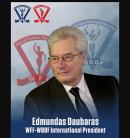
Dr. Edmundas Daubaras
President of W.F.F. – W.B.B.F.


Attached Files Thumbnail(s)
   
Reply
60 YEARS OF WORLD SPORTS HISTORY:
LITHUANIA — AN IMPORTANT PART OF THE WFF-WBBF JOURNEY.
From the “Amber Prix” to World Championships — for decades, Lithuania has been a place where international sports history has been made.
Six decades are more than simply a period of time. They represent people, generations, traditions, competitions, victories, meetings and stories that remain long after an individual sporting event has ended.
As the WFF-WBBF Federation approaches the 60th anniversary of its international activities, it can be said with confidence that Lithuania holds a special place in this history.
Over more than half a century, more than 100 international WFF-WBBF events have been held in Lithuania. Vilnius, Kaunas, Klaipėda, Panevėžys, Telšiai, Šilutė, Vilkaviškis and Nida have hosted World and European Championships, international “Amber Prix” and “Universe” tournaments, as well as numerous other high-level international competitions.
Over the decades, athletes and delegations from Europe, Asia, Africa, North and South America, and Australia have travelled to Lithuania. Today, the WFF-WBBF Federation is represented in 141 countries around the world, covering all continents.
It is particularly significant that, for many years, Lithuania has been one of the important venues for the Federation’s international events. International sporting relations were developed here, representatives of different countries met, and new chapters of world sports history were created.
Lithuania — A Meeting Place for International Sport
WFF-WBBF events in Lithuania became much more than sporting competitions. They developed into meeting places where athletes, coaches, judges, organisers and representatives of the sporting community from different countries came together.
Over the years, delegations from numerous European countries travelled to Lithuania — Latvia, Estonia, Poland, the Czech Republic, Slovakia, Hungary, Bulgaria, Romania, Serbia, Bosnia and Herzegovina, Greece, Italy, Spain, Germany, Switzerland, the Netherlands, Denmark, France, the United Kingdom, Ireland, Portugal, Belgium, Finland, Norway and many others.
However, the international geography of these events extended far beyond Europe.
Athletes from the Republic of South Africa, Algeria, Nigeria, Mozambique and Egypt came to Lithuania. South America was represented by Argentina, Brazil, Uruguay, Paraguay and Venezuela, while the United States, Canada and Mexico represented North America. Athletes from Australia also participated in events held in Lithuania.
Asia was particularly broadly represented. Lithuanian competitions welcomed athletes from Japan, Malaysia, Thailand, Iran, Israel, Syria, India, Pakistan, Uzbekistan, Turkmenistan, Kazakhstan and other countries.
Such a geographical reach allows us today to look at the history of Lithuanian sport from a broader perspective. A small country on the shores of the Baltic Sea has, for decades, served as a venue for international sporting meetings, attracting people from many different parts of the world.
Sport That Brought People Together
The sporting result was not the only important aspect of these major international events. Equally significant were personal encounters, international relationships and shared experiences.
The heads of many foreign delegations were officially received at the Seimas of the Republic of Lithuania on numerous occasions. Participants of WFF-WBBF events also took part in international press conferences held at the ELTA news agency.
Many major international events were organised with the support and financial assistance of institutions of the Republic of Lithuania. This demonstrated the country’s attention to international sport and provided an opportunity to present Lithuania more widely to the global sporting community.
Over the decades, the international relationships that were established did not disappear. On the contrary, they became the foundation for new competitions, new generations of athletes and new international cooperation projects.
The History of the “Amber Prix”
A special place in this history belongs to the “Amber Prix” tournament.
It is more than simply the name of a sporting competition. Over many years, the “Amber Prix” has become a tradition and an important part of Lithuania’s sporting history, gaining recognition in many countries around the world.
In May 2027, Klaipėda will ceremonially mark the 60th anniversary of the “Amber Prix” tournament.
This will be a symbolic opportunity to remember the people who created the history of the tournament, the athletes who competed for victory over the years, and the coaches, judges and organisers who devoted many years to developing this tradition.
Sixty years is already a legacy — one that is passed from generation to generation.
A New Chapter of History — in Nida
But history is not only about memories. It continues today.
From 24–26 October 2026, the 37th World Championship for Professionals and Amateurs will take place in Nida.
This will be another major international sporting event in Lithuania, once again bringing athletes and delegations from different countries around the world to our country.
And in 2027, the jubilee celebration of the “Amber Prix” in Klaipėda will provide another opportunity to look back at the path that has been travelled while also looking towards the future.
The History Continues
Over six decades, countries, cities, generations of athletes and the world itself have changed. Yet one thing has remained constant — the desire to compete, achieve outstanding results, meet one another and build friendships.
Today, with WFF-WBBF activities reaching 141 countries around the world, Lithuania’s role in this history is clear.
More than 100 international events held in Lithuania are more than statistics.
They represent thousands of athletes, hundreds of delegations, dozens of countries, countless competitions and six decades of accumulated experience.
This is a history created not only through results and medals. It was created by people.
And this history is far from over.
The 2026 World Championship in Nida and the 60th anniversary of the “Amber Prix” in Klaipėda in 2027 will become new chapters in this remarkable history.
After six decades, the journey continues.
Lithuania remains, and will continue to remain, a part of world sports history.
More information is on international site www.wff.lt


Attached Files Thumbnail(s)
           
Reply
World Bodybuilding History.
BOB HOFFMAN – “FATHER OF WORLD WEIGHTLIFTING”.
Bob Hoffman, known during his lifetime and still often referred to as the “Father of World Weightlifting,” driven by the idea of creating and building a “Muscle Empire,” which he turned into a sport officially recognized throughout the world, Bob Hoffman (Robert Collins Hoffman, 1898–1985) was born in the State of Georgia, USA.
At the age of eighteen, he participated in the First World War. During the war, Bob Hoffman was awarded several times for bravery. In 1919, he ended his military service. Speaking about sport, Bob Hoffman stated: “We didn’t get into this business to make money; we got into it to build a stronger and healthier America.”
In 1920, Bob Hoffman entered the oil business, from which he withdrew in 1938. He created his sports empire with the money he had earned from the oil business.
In 1922, Bob Hoffman began publishing the magazine Strength and Health, and in 1932 the magazine Muscular Development. He called his publications “a magazine for real men” and “the family health magazine.”
The exceptional athletic talent of John Grimek and Bob Hoffman’s enormous efforts concentrated the attention of the sports world on York. People eagerly bought bodybuilding magazines featuring photographs of John Grimek and descriptions of his training and went to train in gyms. Bob Hoffman and John Grimek became very close friends, and this friendship lasted until Bob Hoffman’s death.
In 1924, Bob Hoffman organized the first weightlifting competitions in America. In 1940, the York Club team, led by Bob Hoffman, took all first places at the U.S. national weightlifting championships.
Between 1936 and 1968, Bob Hoffman was the official coach of the U.S. Olympic weightlifting team. This period is regarded by many specialists in the history of weightlifting as the “Golden Age” of American weightlifting.
In 1930, Bob Hoffman became involved in the activities of the A.A.U. (Amateur Athletic Union). Sports historians unanimously recognize that from the 1930s until the 1980s, the main center of American weightlifting and bodybuilding was Bob Hoffman’s “York Barbell Company,” founded in the State of Pennsylvania, and the sports club of the same name, the “York Barbell Club.”
Beginning with the 1932 Olympic Games, Bob Hoffman worked extensively for and served the U.S. national weightlifting team. From 1948 to 1968, he was the coach of the U.S. national weightlifting team, while his sports club’s athletes won the U.S. weightlifting championship team trophy forty-eight times.
Jim Murray, who for many years worked as an editor for the magazines of Bob Hoffman and Joe Weider, recalls Bob Hoffman introducing himself: “Hello, my name is Bob Hoffman. I’m the coach of the U.S. Olympic team, and I just might be the world’s healthiest man.”
Among other products, Bob Hoffman’s company manufactured barbells and dumbbells, which he sold according to a model devised back in 1902 by Alan Calvert, the owner of the “Milo Barbell Company.” Bob Hoffman purchased Alan Calvert’s company in 1924.
It was precisely through the activities of his company that, throughout all those years, Bob Hoffman sought to involve Americans in health and physical education activities. He stated that “the success of every American’s life is achieved through physical development of the body.” For millions of people, Bob Hoffman turned American York into a true “Mecca for lifters everywhere.”
Sometimes new, non-standard activities were introduced to the public. John Figarelli wrote that in 1962 Bob Hoffman introduced people to isometric training, which required little time and effort to achieve results.
Bob Hoffman was the first to begin the business of selling exercise equipment and nutritional supplements. The press called him a “living pioneer of the health food industry.”
Throughout his entire period of activity, Bob Hoffman was a leader in the production and sale of health and sports products. He gathered promising American athletes, provided them with jobs in his companies, and prepared them for national and international weightlifting and bodybuilding competitions.
Among these athletes were John Grimek, Steve Stanko, John Davis, John Terpak, Tony Terlazzo, John Terry, Dick Bachtell, Yas Kazuhara, Jim Park, and Jules Bacon.
One of Bob Hoffman’s followers was also Sigmund Klein. Some of Bob Hoffman’s famous athletes, such as John Grimek, Steve Stanko, and Tommy Kono, were simultaneously successful weightlifters and bodybuilders.
Bob Hoffman believed that it was possible to lift enormous weights and at the same time be a good bodybuilder and look good. Time showed that he was mistaken.
Having himself been an athlete, Bob Hoffman throughout his life won and was presented with more than six hundred various prizes and awards.
In 1961, Bob Hoffman was officially received at the White House, where, during an official meeting, he inducted U.S. President John Fitzgerald Robert Kennedy (1917–1963) as an honorary member of the A.A.U.
In 1969, together with Congressman George Atlee Goodling, Bob Hoffman was officially received at the White House for the second time, where he met with U.S. President Richard Milhous Nixon (1913–1994).
Bob Hoffman was a supporter of U.S. President Richard Nixon and, together with athletes, participated in the president’s election campaign. He published a monthly sports publication, Activity Report, and regularly provided it to the President of the country and many members of the U.S. Congress.
In 1970, President Richard Nixon appointed Bob Hoffman as his adviser on physical fitness matters, while Bob Hoffman himself referred to himself as the “Father of Physical Fitness.”
Famous for his philanthropic activities, Bob Hoffman supported various sports competitions and various educational institutions. During the 1970s, he appeared on various U.S. television programs and was frequently written about in the American press. Throughout his life, Bob Hoffman published a number of popular books.
The world press frequently carried information about the fierce competition in bodybuilding and commerce between Bob Hoffman and the President of the I.F.B.B., Ben Weider.
Until 1970, when the I.F.B.B. took its decisive step at its founding congress in Belgrade, Yugoslavia, Bob Hoffman was the single most influential figure both in professional American bodybuilding and in the country’s physical culture.
Before that, Bob Hoffman had no competitors in officially recognized bodybuilding because he represented an officially recognized sport. Bodybuilding was under the F.I.H.C. federation, which in turn was a member of the International Olympic Committee (I.O.C.).
In 1970, the situation changed. Following the founding congress held in Belgrade, Yugoslavia, the I.F.B.B. federation quickly became a member of G.A.I.S.F. (Global Association of International Sports Federations), and in this way closed the way to official recognition for other international federations for several decades.
Bob Hoffman publicly expressed his outrage at this injustice, all the more because Oscar State, Secretary General of the World Weightlifting Federation, who through his personal assistance to I.F.B.B. President Ben Weider played a decisive role in Belgrade, had for many years been his close colleague in weightlifting activities.
Bob Hoffman stated that “IFBB is not a democratic organization because it does not allow its athletes to participate in A.A.U. competitions.”
At the same time, also angered by Oscar State’s cooperation with the Weider brothers, in Europe an authoritative continental bodybuilding leader, called the “anti-Weider Crusade,” the Englishman Oscar Heidenstam, adopted a strict anti-Weider position.
Seeking to calm the passions, Ben Weider came up with the idea that the I.F.B.B. could become a member of the A.A.U. Thus, in 1972, Ben Weider registered as a participant in the A.A.U. congress held in the State of Kansas.
The congress discussed the legitimacy of the I.F.B.B.’s membership in the G.A.I.S.F. organization. A number of well-known sports personalities were outraged by the Weiders’ actions and threatened to protest against the I.F.B.B.’s membership in G.A.I.S.F.
It is not surprising that at that time the A.A.U. congress did not support Ben Weider’s initiative, which was supported by only two congress participants. The I.F.B.B. was not admitted to the A.A.U., and Oscar Heidenstam was especially pleased about this.
The ideology of both Ben Weider and Bob Hoffman was the same – it was a synthesis of personal ego, sport, and business.
Ben Weider was more energetic, and therefore he managed to overtake the A.A.U. According to Oscar Heidenstam, Ben Weider significantly overtook Bob Hoffman through aggressive bodybuilding magazine publishing and magazine distribution.
Oscar Heidenstam regarded the I.F.B.B.’s membership in the G.A.I.S.F. organization as a great mistake (“it was a terrible mistake”) and expected a stronger protest from Bob Hoffman.
Of course, Bob Hoffman was also dissatisfied. He wrote that through membership in the G.A.I.S.F. organization, “the Weiders, who for many years had been engaged in publishing pornography, seek only material benefit” (“Weiders who for many years had been ‘publishing pornographic magazines’ were only interested in money...” ).
The opposition to the Weider brothers failed.
After almost five decades of dominating bodybuilding, Bob Hoffman had to give way to the Weider brothers. For Bob Hoffman, this was a real tragedy of his life.


Attached Files Thumbnail(s)
           
Reply


Forum Jump:


Users browsing this thread: 2 Guest(s)