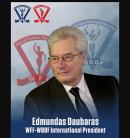
THE 2008 WFF-WBBF “UNIVERSE” IN VILNIUS.
The History of a Tournament and an Era in International Fitness.
On November 22, 2008, Vilnius hosted the WFF-WBBF “Miss & Mister Universe” international tournament. Today, this event should be regarded not simply as another competition on the federation’s calendar, but as a historical document of its time — evidence of what international fitness and bodybuilding looked like at the end of the first decade of the 21st century.
To understand the significance of the 2008 tournament, it is not enough to list its winners and medalists. Behind the results lies an entire era: the expansion of international sport, the development of new competitive categories, the growth of masters’ and junior competitions, the evolution of fitness beyond traditional bodybuilding, and the formation of international connections between sporting organisations from different countries.
It is precisely in this broader context that the Vilnius “Universe” acquires its historical significance.
2008 — Sport on the Threshold of a New Era
The year 2008 represented something of a boundary between two eras.
On the one hand, international bodybuilding already had a long-established history, strong traditions, recognised names and well-developed schools.
On the other hand, fitness was changing rapidly.
Aesthetic physique, physical conditioning, athleticism, stage presentation and different forms of fitness were becoming increasingly important on the international scene.
This is why the structure of competitions at the end of the 2000s is particularly interesting from a historical perspective.
It reveals the transition from the concept of bodybuilding as a relatively narrow sporting discipline towards a broader understanding of fitness and physical culture as an entire system of competitive disciplines.
The WFF-WBBF model reflected this development.
The 2008 “Universe” was a characteristic example of this era.
Vilnius in the International WFF-WBBF System
The decision to hold the “Universe” in Vilnius was not accidental.
By that time, Lithuania had already become one of the important centres of WFF-WBBF international activity. International championships and tournaments were being held in Klaipėda, Trakai, Panevėžys and other Lithuanian cities.
A particularly important event was the traditional international “Amber Prix International” (“Gintarinis prizas”) tournament in Klaipėda.
The 40th anniversary edition received state support. This significantly expanded the possibilities for organising the event: inviting foreign teams and delegations, providing television and media coverage, and producing multilingual promotional and video materials.
As a result, a broader international sporting environment was developing — one in which Lithuania became a regular meeting place for athletes, coaches, judges, organisers and sports representatives from different countries.
The Vilnius “Universe” should therefore be viewed as part of this wider system.
The International Map Preserved by the Tournament
The results protocol itself is of particular historical value.
It includes representatives of Russia, Ukraine, Latvia, Slovakia, Denmark, Venezuela, Uruguay, Argentina, Mexico, Belarus, Poland, Bulgaria, Greece, Finland, Estonia, Germany, England, the Czech Republic, Brazil, Serbia, France and other countries.
This was no longer a local sporting meeting.
It was an international map of fitness at the end of the 2000s.
Its foundation consisted largely of countries from Eastern and Central Europe, but alongside them were representatives of Western Europe and South America.
The geographical diversity is important in itself.
Russia and Ukraine.
Latvia and Belarus.
Poland and the Czech Republic.
Germany and England.
Uruguay, Argentina, Venezuela, Mexico and Brazil.
Different sporting traditions, training schools and concepts of the ideal physique met on one stage.
This geography is what makes the protocol historically significant.
Eastern Europe as One of the Centres of Development
A close examination of the results reveals the strong presence of Eastern Europe.
Russian and Ukrainian athletes appear in numerous categories and regularly feature among the medalists.
This was not accidental.
Following the dissolution of the Soviet Union, strong traditions of physical culture, strength sports and athletic training continued to develop in the countries of the region. However, these traditions were now evolving within new national and international circumstances.
International federations became platforms where athletes from the former Soviet republics could meet competitors from Western Europe and other regions.
In this sense, international competitions of the late 1990s and 2000s became a kind of bridge between different sporting traditions of the post-Soviet and Western worlds.
The Vilnius “Universe” is one of the historical episodes that illustrates this process.
But “Universe” Was No Longer Exclusively European
At the same time, the results demonstrate that the international WFF-WBBF system was not confined to Europe.
The presence of athletes from Uruguay, Argentina, Venezuela, Mexico and Brazil shows that the federation's international reach already extended significantly into South America.
These athletes were not merely symbolic participants.
They competed for medals.
And the highest women's title of the tournament went to Uruguay.
Alexandra Ximena Aguiar Fernandez became the overall women's winner.
The overall men's title went to England's Dayo Audi.
The official WFF-WBBF historical records identify these two athletes as the overall winners of the 2008 “Universe”.
Thus, the symbolic summit of the tournament was divided between two countries — Uruguay and England.
This is a highly revealing result.
Dayo Audi — A Victory at the End of a Major Competitive Career
The story of the men's overall winner adds another historical dimension to the event.
Dayo Audi later indicated that his final bodybuilding competition took place in Vilnius in November 2008, where he won the Mr. Universe title. By that point, he had already achieved British, European and world NABBA titles, as well as an IFBB professional title. The “Universe” title was the remaining major achievement he wanted to obtain before ending his competitive career.
For this athlete, therefore, the Vilnius tournament had a special personal significance.
The 2008 “Universe” was not only the culmination of his competitive career, but also its final chapter.
From a historical perspective, this transforms a simple line in a results sheet — “1st place” — into something much more meaningful.
The Uruguayan Women's Victory — Another Symbol of the Era
The story of the overall women's winner is equally revealing.
Alexandra Ximena Aguiar Fernandez's victory meant that the women's international summit belonged to an athlete from South America.
This is important because the geography of international fitness was no longer one-dimensional.
By 2008, it was no longer possible to speak of a single centre determining the development of the sport.
Different regional schools were emerging and competing.
European.
Eastern European.
South American.
International competitions allowed these schools to compare their achievements directly on the same stage.
The Revolution of Competitive Categories
The structure of the tournament itself is another important historical document.
The programme included:
Model Fitness, Fitness, Performance, Athletic, Super Athletic, Classic and Extreme.
There were also separate competitions for juniors, masters and disabled athletes.
To a modern observer, such differentiation may appear normal. Historically, however, it reflects a fundamental change in the concept of physical culture.
An athlete no longer had to fit a single universal model.
There were different forms of physical development.
Some athletes represented the aesthetics of Model Fitness.
Others represented Performance.
Others Athletic.
Others Super Athletic or Extreme.
Thus, the competitive system itself recognised the diversity of the athletic physique.
This was one of the defining characteristics of the era.
From Juniors to Athletes Over 60
The age range represented at the tournament is equally remarkable.
At one international event, athletes under 21 competed alongside athletes over 60.
Between them were the Over 40 and Over 50 categories.
This was more than simply a classification system.
It represented a model of sport as a lifelong activity.
A junior could enter the competitive system at a young age.
An adult athlete could continue competing.
After the age of 40, dedicated competitive categories were available.
After 50, there were new opportunities.
And even after 60, an athlete could step onto an international stage.
Historically, this conveyed an important message:
physical culture was no longer perceived exclusively as an activity for the young.
Disabled Athletes — An Important Part of the Picture
The programme also included a separate Disabled Sportsmen category.
The winner was France's Michael Louvel.
The existence of this category is historically significant in its own right.
The international tournament demonstrated that the sporting stage could belong not only to athletes representing an idealised physical model.
It could also provide space for people with different physical abilities.
Within the history of fitness, this reflects the gradual expansion of the very concept of participation in sport.
“Universe” as a Social Model of Sport
The 2008 results protocol should therefore be read as more than a list of placements.
It is effectively a social map of sport.
Within it we find:
• youth and maturity;
• men and women;
• professional and amateur competition;
• aesthetic fitness and athletic development;
• classic and extreme categories;
• athletes without disabilities and athletes with disabilities;
• Europe and South America.
All of these elements were brought together within one international competition.
This is one of the defining historical characteristics of the “Universe”.
2008 as the Peak of a Particular Period
The year 2008 becomes even more interesting when viewed in a broader historical sequence.
Official WFF-WBBF statistics show that overall “Universe” winners in different years came from a wide range of countries, including Russia, Latvia, Finland, Argentina, Uruguay, France, South Africa, England and others.
In 2008, the women's overall title went to Uruguay and the men's title to England.
This allows us to draw a broader conclusion.
The “Universe” was not a competition dominated by one national school.
It was an international system in which the geography of champions continually changed.
That is why the historical value of the tournament lies not only in its individual results, but in the broader process it represents.
Vilnius as a Meeting Point of Sporting Traditions
In 2008, Vilnius stood at the intersection of several major developments.
On one side was the strong tradition of Eastern European strength and physical culture.
On another was the growing international importance of fitness.
There was also the expanding participation of Western European athletes.
At the same time, South American competitors were increasingly visible on the international stage.
And finally, the concept of participation was becoming broader, encompassing juniors, masters and athletes with disabilities.
For this reason, the significance of Vilnius cannot be reduced simply to the fact that the tournament took place there.
For a particular moment in history, the city became a meeting point for different currents within the international sporting movement.
History Cannot Be Read Through Medals Alone
If we remove all the names from the 2008 protocol and leave only its structure, we still see an extraordinarily important historical picture.
We see dozens of countries.
We see several continents.
We see numerous categories.
We see different generations.
We see fitness developing beyond traditional bodybuilding.
We see an attempt to create an international system in which different forms of physical culture could exist side by side.
This is the tournament's most important historical legacy.
A medal is the result of one day.
A protocol is a document of an era.
Historical Conclusion
The 2008 WFF-WBBF “Universe” in Vilnius was not simply an international tournament. It was a reflection of a transitional period in the history of international fitness and bodybuilding.
It was a time when established sporting traditions remained highly influential, while a new form of international fitness was emerging — more diverse, more specialised and geographically more open.
Eastern Europe retained a strong position.
Western Europe was actively participating in international competition.
South America was becoming increasingly visible.
The boundaries of a competitive athletic career were expanding.
New categories were emerging.
Women's fitness was developing.
Disabled athletes were being incorporated into competitive programmes.
And the overall titles could travel from Vilnius to Uruguay and England.
This is the historical significance of the 2008 “Universe”.
It does not tell us only who won.
It tells us what the sport itself looked like.
What its geographical landscape was.
What its concepts of physical excellence were.
What its international community was becoming.
And, finally, what that particular moment in history looked like — a period when fitness was becoming increasingly global, diverse and open to new countries, new categories and new generations of athletes.
2008 in Historical Perspective
Today, the tournament can be regarded as one of the archival “snapshots” of its era.
Its records preserve more than statistics.
They preserve the geography of the sport.
They preserve its sporting values.
They preserve its model of international cooperation.
They preserve the understanding of what an athlete should be — and how diverse the path towards physical excellence could become.
For this reason, the 2008 Vilnius “Universe” deserves a place not only in the WFF-WBBF sporting calendar.
It deserves a place in the history of international fitness at the turn of the 21st century — as evidence of an era when the sport was becoming increasingly global, diverse and open to new countries, new categories and new generations of athletes.
World Sport History.
Klaipėda Welcomed a European Generation of Fitness and Bodybuilding Athletes.
From May 18 to 20, 2007, Klaipėda hosted the WFF and WBBF European Amateur Championships, bringing together fitness and bodybuilding athletes from numerous European countries. The competition featured a wide range of categories, from Classic Fitness and Athletic Fitness to bodybuilding, as well as dedicated events for juniors and children.
For three days in May 2007, Klaipėda became an international meeting point for athletes representing different generations, countries and disciplines within the rapidly developing world of fitness and bodybuilding.
The 2007 European Amateur Championships, organised by the World Fitness Federation (WFF) and the World Bodybuilding Federation (WBBF), offered a broad competition programme. Separate championships were held for women and men, with categories covering Classic Fitness, Performance, Athletic and Super Athletic divisions, alongside traditional bodybuilding competitions.
The official results provide more than a list of winners. They offer a snapshot of the European fitness and bodybuilding scene of the time – a sporting environment in which athletes from Eastern, Central and Northern Europe competed alongside representatives of countries farther afield.
A championship built around different disciplines
One of the defining features of the event was the variety of disciplines.
Rather than concentrating exclusively on traditional bodybuilding, the programme included several fitness categories designed to highlight different aspects of physical development, athletic ability and stage presentation.
The Women’s Classic Fitness category was one of the largest competitions of the championship. Its final included 24 competitors representing countries including Lithuania, Ukraine, Russia, Poland, Latvia, Belarus, Bulgaria and Hungary. The first three places were taken by athletes representing Lithuania, Ukraine and Russia.
The size and international composition of the category demonstrate how competitive fitness had already become by the middle of the 2000s. Reaching the final meant competing against athletes from a wide range of national sporting backgrounds.
The final ranking also included competitors from Poland, Belarus, Latvia, Bulgaria and Hungary, creating a particularly diverse European field.
An increasingly international fitness scene
The Performance category provided an even broader picture of the championship's international character.
Competitors included athletes from Israel, Lithuania, Poland, Latvia, England, Russia, Ukraine, Moldova and Belarus. The title went to Israel's Jelena Frenkel, while Lithuania's Inga Naslėnaitė finished second and Poland's Karolina Strzyżewska took third place.
The category also featured more than twenty athletes in the final results. Such participation indicates that fitness competitions were no longer limited to a small circle of specialists. They had developed into a competitive international discipline attracting athletes from many different countries.
Athletic categories bring together different European schools
The Athletic divisions formed another important part of the women's programme.
The first Athletic category included competitors from Lithuania, Ukraine, Russia, Belarus, Latvia, Poland and other countries. The second division was particularly strong for Russian athletes: Irina Stavitskaya and Irina Simonova took first and second place respectively. Lithuania's Kristina Serksnaitė finished third, followed by Latvia's Marija Deksne, Poland's Joanna Kwiatkowska and Germany's Anke Babel.
The results also included competitors from Ukraine, Belarus and other European countries. The international composition of these divisions illustrates the increasingly broad reach of the sport across the continent.
The highest-level women's category
The Super Athletic category represented one of the most advanced levels of the women's competition.
Nine athletes from Russia, Poland, Lithuania, Ukraine and Belarus took part. Russia's Tatjana Bojciuk won the title, followed by compatriot Olesia Siomina in second place and Poland's Agata Czerkawska in third. Athletes from Lithuania, Russia and Ukraine also completed the top six.
The results demonstrate the strength of several national fitness traditions, particularly those from Eastern and Central Europe. At the same time, the presence of athletes from several countries made the category a genuinely international contest.
Bodybuilding remains at the heart of the programme
Alongside the fitness divisions, traditional women's bodybuilding remained one of the championship's central competitions.
Ukraine's Maria Akizanova won the title. Russia's Darja Morozova finished second, while Ukraine's Halina Macykur took third. Belarusian athlete Irina Lebedeva finished fourth.
The result reflects the strong presence of Ukrainian, Russian and Belarusian athletes on the women's bodybuilding stage at the time. These countries repeatedly appeared among the leading positions throughout the championship.
A broad men's programme
The men's championship was similarly diverse.
Its programme included Wheel-Chair, Junior, Classic Fitness, Performance, Athletic, Super Athletic and bodybuilding categories. The structure allowed athletes with different physical abilities, ages and competitive backgrounds to participate within their respective divisions.
The inclusion of a dedicated Wheel-Chair category was an important feature of the programme. The category was won by Lithuania's Artūras Krutulis.
The Junior Bodybuilding competition for athletes under 21 also demonstrated the organisers' emphasis on developing the next generation of competitors. Lithuania's Mantas Lukošius won the category, ahead of athletes representing Ukraine, Russia, Germany, Russia and Slovakia.
Classic Fitness – a meeting of different traditions
The men's Classic Fitness category provides another particularly clear example of the championship's international character.
Latvia's Viktor Sarko won the title, followed by Lithuania's Vytautas Brazaitis and Russia's Dmitry Krivchikov. The final results also included athletes from Turkey, Belarus, Germany and Moldova, among others.
The category brought together athletes from across the Baltic region and Eastern Europe with competitors from farther south and west. It reflected the growing geographical reach of fitness as a competitive discipline.
Youth competition – starting at an early age
The championship was notable not only for its senior competitions. A separate Fit-Kid European Championship was also held, with competitors divided into age groups.
The youngest athletes competed in an under-eight category. The under-ten division included representatives of Poland, Lithuania and Latvia, while the under-twelve competition featured athletes from Poland, Lithuania and Russia.
In the under-twelve category, Polish athletes took the first two places, followed by a Lithuanian competitor, with additional representatives from Lithuania and Russia appearing in the final results.
The inclusion of children in the European championship programme shows that the organisers viewed the development of the sport as a long-term process. The event was not simply a competition for established athletes; it also provided a platform for younger generations entering the world of fitness.
A map of European fitness in 2007
Taken as a whole, the results of the Klaipėda championship provide an interesting map of the European fitness and bodybuilding scene in 2007.
Names from Russia, Ukraine, Belarus, Poland, Latvia and Lithuania appear repeatedly throughout the results. At the same time, the championship attracted athletes from a much wider geographical area, including Estonia, Germany, Slovakia, Turkey, Bulgaria, Hungary, Moldova, Israel, England, Cyprus, Kazakhstan, Australia and other countries.
The distribution of medals also shows that there was no single dominant nation across every discipline. Different countries produced winners in different categories. Israel claimed the Performance title, Russia was particularly strong in the higher-level women's categories, Ukraine produced winners in bodybuilding, Latvia topped the men's Classic Fitness division, while athletes from several other countries reached the podium.
This variety is perhaps one of the most interesting features of the championship. Instead of presenting a single national hierarchy, the results reveal a competitive landscape in which different sporting traditions excelled in different disciplines.
More than a list of results
Today, the official results of the 2007 European Amateur Championships provide a valuable record of a period when fitness and bodybuilding were developing into increasingly diverse and international sports.
The Klaipėda event brought together several generations of athletes and a wide range of disciplines – from Classic Fitness and Athletic Fitness to traditional bodybuilding, junior competitions and children's Fit-Kid events.
The results also demonstrate the scale of international participation. Athletes from numerous European countries, together with competitors from countries beyond Europe, appeared across the different categories. Their presence turned the championship into a meeting point for different approaches to training, physique development and competitive presentation.
For that reason, the Klaipėda championship is significant not simply because of who won individual titles. It offers a broader picture of the sporting culture of the period – the growing popularity of fitness, the continuing importance of bodybuilding and the emergence of new competitive categories designed for different ages and athletic profiles.
Nearly two decades later, the official results allow us to reconstruct that sporting moment: a European championship in which established athletes, emerging juniors and children shared the same event, while competitors from different countries met on the same stage in Klaipėda.
World Sport History.
PALANGA, 1998: WHEN THE WORLD OF FITNESS CAME TOGETHER ON THE BALTIC SEA.
186 athletes, 15 countries, and the first official WFF World Fitness Championship held in the Republic of Lithuania. At the time, the federation was still experimenting with categories and judging criteria, searching for its own direction. Nearly three decades ago, Palanga became the setting for a chapter that has since become part of fitness history.
The event was supported by the Government of the Republic of Lithuania. The chairman of the Organizing Committee was Kęstutis Skrebys, Minister of Public Administration Reforms and Municipal Affairs of the Republic of Lithuania. One of the main sponsors was the daily newspaper “Respublika”. The championship in Palanga was filmed by Eurosport television, which prepared an approximately one-hour report for European audiences. A report for Lithuanian national television was prepared by journalist Laima Janušonytė.
JUNE 6, 1998. PALANGA
A seaside resort, the eve of the summer season, and athletes arriving in Lithuania from across Europe.
But on that day, the most important thing happening in Palanga was neither the beach nor the summer entertainment. The city was hosting a World Fitness Championship.
186 athletes from 15 countries came together: Germany, Switzerland, Austria, Belarus, Russia, Lithuania, Latvia, Estonia, Ukraine, France, Slovenia, Greece, the United Kingdom, Uruguay and Italy.
This was more than just another international competition. In historical WFF sources, the Palanga event is described as the first official World Fitness Championship held in Lithuania.
Today, looking back at the championship protocols, we can see more than just names and rankings. They reflect the entire European fitness scene of that era.
FITNESS SEARCHING FOR ITS OWN IDENTITY
In the late 1990s, fitness was not yet what we know it as today.
Gym culture was growing rapidly, while attitudes toward the body, physical conditioning, and athletic aesthetics were changing. Alongside traditional bodybuilding, a new discipline was becoming increasingly visible – fitness.
The championship program included Classic Fitness and Aerobic Fitness categories.
It was an important development.
Athletes were not expected to demonstrate muscle mass alone. Body proportions, physical conditioning, aesthetics, athleticism, and overall presentation were becoming increasingly important.
Palanga in 1998 became a place where these emerging ideas of fitness were tested on an international stage.
15 COUNTRIES – ONE STAGE
The geographical diversity of the championship was impressive.
Athletes from Western, Central, and Eastern Europe met on the same stage.
Germany arrived in Palanga with a particularly strong team. Switzerland was also among the leading nations. They were challenged by athletes from Belarus, Russia, Austria, Slovenia, the United Kingdom, Greece, Ukraine, and the Baltic states.
It was a period when the European sporting landscape was changing rapidly, and new international connections were allowing athletes to meet more frequently on the same stage.
The Palanga championship became one of those meeting points.
THE MEN'S STAGE – TWO DIFFERENT STORIES
The men's Classic Fitness program consisted of two categories, and each produced a different championship story.
In the first category, Valdas Slimanavičius took the victory, ahead of Belarusian athlete Sergej Kalmykov and Germany's Andreas Müller.
Behind them came athletes from Switzerland, Austria, Germany, and other countries.
The second category had a different winner – Germany.
Jürgen Koch won the category, and his name would later appear in the most important line of the championship results.
JÜRGEN KOCH – ABSOLUTE CHAMPION
Koch did not win only his category.
He was also named the 1998 men's absolute fitness champion.
This was the highest possible recognition.
Winning an individual category made him a category champion; winning the overall title made him the champion of the entire men's fitness competition.
That is why Jürgen Koch remains one of the most important names in the history of the 1998 Palanga championship.
WOMEN'S FITNESS: A GERMAN DOUBLE
While the men's victories were shared between athletes from different countries, the women's competition produced a different picture.
German athletes won both women's Classic Fitness categories.
In the first category, Mandy Kietzke took first place, with her compatriot Janine Raschka finishing second.
The second category was won by Claudia Machmor.
Germany therefore claimed both women's Classic Fitness gold medals.
But the story did not end there.
CLAUDIA MACHMOR – ABSOLUTE CHAMPION
Claudia Machmor became more than just the winner of her category.
She was named the women's absolute fitness champion.
As a result, German athletes claimed both absolute fitness titles – men's and women's – at the 1998 Palanga championship.
It remains one of the most striking statistical facts of the event.
AEROBIC FITNESS – ANOTHER SIDE OF THE SPORT
The Palanga championship was not limited to Classic Fitness.
In the separate Aerobic Fitness category, female athletes demonstrated a different type of conditioning – with greater emphasis on movement, dynamics, and elements of aerobic sport.
The winner was Tanja Baumann of Switzerland.
Second and third places went to German athletes Pia Luttenberger and Diana Partheymüller.
The result once again demonstrated the strength of German female athletes, although this time the highest step on the podium belonged to Switzerland.
Interestingly, Tanja Baumann later became one of the notable figures in aerobic fitness. Historical WFF results list her as a champion in subsequent years as well.
WHAT DO THE NUMBERS TELL US?
Looking at the championship protocol as a whole, several clear points stand out:
186 participants.
15 countries.
Two men's Classic Fitness categories.
Two women's Classic Fitness categories.
A separate Aerobic Fitness program.
Absolute men's and women's fitness champions.
It was a sufficiently broad program for a one-day event to become a genuine international fitness gathering.
GERMANY – THE CHAMPIONSHIP'S STRONGEST FORCE
When we look specifically at the highest-placed athletes, one country stands out particularly clearly.
Germany.
A German athlete won the men's Classic Fitness II category.
German women won both women's Classic Fitness categories.
Germany claimed both absolute fitness titles.
In addition, German athletes took second and third places in the Aerobic Fitness category.
Therefore, even without attempting to create an official team ranking, the results allow us to draw a clear conclusion:
At the 1998 Palanga championship, Germany was one of the most prominent and successful fitness nations.
THE EUROPEAN FITNESS MAP
Yet the story of the championship is not only a German story.
Switzerland won the Aerobic Fitness gold medal.
Belarus had high-level athletes in the men's competition.
A Slovenian athlete became runner-up in one of the men's categories.
Representatives of Greece, Russia, Ukraine, the United Kingdom, Austria, Latvia, Estonia, France, and Italy also contributed to the international competition.
This was not a celebration belonging to one country alone.
It was a snapshot of the European fitness scene of that period.
PALANGA, A CITY THAT BECAME PART OF HISTORY
Today, the results of the 1998 championship may look like a simple archival table.
A name. A country. A placing.
But behind those numbers lies much more.
At the time, fitness was still developing its international identity. Athletes from different countries were learning to compete according to common criteria. Organizations were establishing championship traditions. New champions were emerging.
And for one day, all of this moved to Palanga.
186 athletes from 15 countries took part in what historical WFF sources describe as the first official World Fitness Championship.
Many years later, this fact allows us to look at the event differently.
Not simply as one of many sporting events held in 1998.
But as an important moment in the early history of international fitness, when athletes from different European countries met in Lithuania and new traditions within the sport were being formed.
KEY NAMES OF THE 1998 PALANGA CHAMPIONSHIP
Jürgen Koch – Germany
Absolute men's fitness champion.
Claudia Machmor – Germany
Absolute women's fitness champion.
Mandy Kietzke – Germany
Winner of Women's Classic Fitness Category I.
Valdas Slimanavičius – Lithuania
Winner of Men's Classic Fitness Category I.
Tanja Baumann – Switzerland
Aerobic Fitness winner.
EPILOGUE
The 1998 Palanga championship took place at a time when the modern fitness industry was only beginning to take the shape we recognize today.
There were no social media platforms, athlete personal brands, livestreams, or audiences of millions online.
But there was what matters most in sport – people, a stage, competition, and the desire to be the best.
On June 6, 1998, 186 athletes from 14 countries met in Palanga.
Some of their names remained in history.
Others disappeared into the pages of archives.
But the event itself endured.
In 1998, Palanga became a place where the world of fitness came together on the Baltic Sea.
Let us look at the 2025.
W.F.F. – W.B.B.F. Continues to Move Forward.
For W.F.F. – W.B.B.F., 2025 was not a year of promises, but a year of concrete work.
While part of the international bodybuilding movement is losing mass participation, influence and prospects, we continue to develop.
We do not hide the crisis.
We see it. And we are confronting it.
Bodybuilding Is in Crisis
Today, too many organizations are trying to present crisis as success.
But reality is determined not by statements, but by results.
When the number of athletes declines, young people disappear from the sport, and competitions become closed events for a narrow circle of professionals — this is not development.
It is a crisis.
W.F.F. – W.B.B.F. has chosen a different path.
We expand the sports programme.
We create new disciplines.
We develop children’s and mass sport.
We open competitions to veterans and athletes with disabilities.
We strengthen international cooperation.
We do not cling to old models.
We create new ones.
2025: The Facts
In 2025, W.F.F. – W.B.B.F. organized major international competitions:
• the 58th Amber Prix International;
• the 36th World Championship;
• the 30th European Championship;
• the 26th Universe.
This is not a museum of the past.
It is an active international sports system.
In 2025, an international judges’ seminar was also held in Klaipėda, together with numerous national and international competitions.
The geographical reach of athletes and specialists continues to expand.
We Are Not an Organization of the Past
W.F.F. – W.B.B.F. moved beyond the boundaries of traditional bodybuilding a long time ago.
As early as 1995, we began systematically separating bodybuilding and fitness.
Today, that decision has become even more obvious.
Fitness must exist as an independent official sport.
It has its own disciplines.
Its own athletes.
Its own judges.
Its own competitions.
Its own international future.
In 2025, the Lithuania Sport Fitness Federation was registered in Lithuania and announced its adherence to the World Anti-Doping Code of WADA.
We support a direction in which national fitness championships are organized separately, with full sporting and anti-doping control.
Lithuania: 60 Years of Bodybuilding
2025 was a historic year for Lithuania.
It marked 60 years of bodybuilding in Lithuania — 1965–2025.
The anniversary event was held in Gargždai.
We honoured the athletes and veterans who built Lithuanian bodybuilding at a time when the sport was only beginning to develop.
Sports history does not belong to one generation.
But forgotten history ceases to be history.
That is why we preserve it.
50 Years of Lithuania Cup Open
In 2025, the Lithuania Cup Open celebrated its 50th anniversary.
It also marked 50 years since the historic participation of Czechoslovak athletes, led by Vojtech Fiala, in an IFBB European Championship during the period of socialist restrictions.
At that championship, Petr Stach became the overall European champion.
This is not merely a sporting result.
It is part of the history of European bodybuilding.
In 2027, the Amber Prix International will celebrate its 60th anniversary.
We are already preparing for this important date.
We Preserve the Memory
In 2025, Valerij Koreškov (1940–2025) passed away — a journalist, writer, poet, artistic photography specialist and one of the early figures of European bodybuilding.
He was a member of Vilnius “Victoria” bodybuilding club and a laureate of the international UNESCO Award.
People like him must not disappear from the history of our sport.
We do not forget our own.
Information and Influence
For several months, WFF.lt received around 400,000 visits per month.
Our materials are published in different languages.
Our articles are read.
Our ideas are discussed.
Our formats are used by others.
This demonstrates one thing:
W.F.F. – W.B.B.F. cannot be ignored.
The International System Is Developing
In 2025, an international judges’ seminar was held in Klaipėda, with specialists from Germany, Latvia, Estonia, Lithuania and Ukraine.
We consider professional judges’ education to be one of the foundations of international sport.
Without objective judging, there is no trust.
Without trust, there is no future.
We Are Moving Forward
W.F.F. – W.B.B.F. continues to pursue international recognition.
We seek associated membership in the United Nations and the International Olympic Committee.
We continue to pursue international recognition of fitness as an independent official sport and its development in the Olympic direction.
We understand the scale of this objective.
But we are not interested in easy tasks.
2025 Is Only Another Stage
We do not intend to justify ourselves to those who do not believe in our development.
The results speak for themselves.
While some discuss the past, we are creating the future.
While some reduce their activities, we expand ours.
While some fear change, we experiment.
While some forget history, we preserve it.
W.F.F. – W.B.B.F. continues moving forward.
And we have no intention of stopping.
History continues.
Dr. Edmundas Daubaras
President of W.F.F. – W.B.B.F.
WFF-WBBF – New Times, New People, New Opportunities.
The World WFF-WBBF Federation is constantly moving forward. Sport is changing, and so are the people who are shaping its future.
We have written more than once about the innovations introduced by the WFF-WBBF Federation and its continuous commitment to progress. For three decades, the Federation has been searching for new solutions, experimenting with new ideas and improving its competitions in order to make international events increasingly attractive to both athletes and spectators.
Today, the results are clearly visible. In recent years, between 200 and 300 athletes from different countries around the world have taken part in WFF-WBBF international events. At the same time, a new generation of talented organizers, coaches and judges has become increasingly involved in the Federation's activities.
One of them is Alina Pelepko.
From Athlete to International Federation Official
Alina Pelepko, a coach from a sports club in Gargždai, joined the activities of the World WFF-WBBF Federation several years ago. She did not enter the international sports scene as a newcomer – she had already gained valuable experience as an athlete.
Her sporting career began under the guidance of coach Aleksas Stankus. Alina competed in numerous events and soon achieved significant results. In 2003, she became the Champion of the Republic of Lithuania and the winner of the WFF-WBBF World Amateur Championship in the Bikini category.
Her experience as an athlete, combined with the knowledge she gained and her passion for sport, naturally developed into a career as a coach and sports organizer.
The encouragement of the Federation's Secretary General, Ugnė Raudytė-Daubarienė, played an important role in the next stage of Alina's professional development.
Since 2024, Alina Pelepko has headed the Fitness Model and Bikini divisions of the World WFF-WBBF Federation.
Today, she not only holds responsible positions within the Federation, but is also actively involved in preparing athletes for international competitions. Alina coaches athletes from Lithuania and Latvia, gives lectures at seminars, conducts practical training sessions and shares her sporting and coaching experience.
The results of her work are already visible on the international stage – her athletes have achieved high placements at World and European Championships.
Important Events Ahead
The WFF-WBBF Federation continues to move forward, with a number of important events approaching.
The 37th WFF-WBBF World Championship in Nida is just around the corner. The championship will be held together with the 3rd Neringa Mayor's Cup at the prestigious “Agila” Cultural Centre in Nida.
On September 27, in Klaipėda, an international seminar for coaches and judges will take place on the eve of the events.
In May 2027, Klaipėda will host a special anniversary celebration – the 60th anniversary of the “Amber Prix” tournament, one of the oldest competitions in our sport in the world.
This is yet another example of how the WFF-WBBF Federation continues its long-standing tradition while looking firmly toward the future.
A New Generation – The Future of the Federation
Alina Pelepko's story is a good example of how experience is passed from one generation to the next in sport. An athlete becomes a coach, a coach becomes involved in international activities, and the knowledge gained is passed on to a new generation of athletes.
These are precisely the people who are helping shape the future of the WFF-WBBF Federation today.
New times. New ideas. New talent. And the same determination to keep moving forward.
We wish Alina Pelepko continued success, strength and new victories – both on her personal journey and in developing a new generation of champions in Lithuania and on the international stage.
To move forward means not being afraid to change. The WFF-WBBF Federation has been doing exactly that for three decades.
More information is on international page www.wff.lt
BRUSNO 2012 – WORLD SPORTING ELITE IN THE SLOVAK MOUNTAINS.
From October 11–13, 2012, the small Slovak mountain resort of Brusno Kupele became a true capital of world fitness and bodybuilding. Athletes from different generations, representing different sporting traditions and countries, gathered here, turning the three-day event into a major international celebration of sport.
The stage welcomed young Fit-Kid competitors, aerobics athletes, Model Fitness representatives, juniors, adults, veterans and athletes with disabilities. From the first steps of young competitors to the performances of world champions, Brusno 2012 embraced virtually the entire spectrum of sporting life.
This was more than a competition for medals. It was a meeting where sport became a common language, bringing together athletes of different ages, backgrounds and nationalities.
BRUSNO – WHERE SPORT BECAME A TRADITION
Brusno Kupele did not become a venue for WFF–WBBF international events by chance.
Beginning in 2009, on the initiative of Slovak patron Štefan Hrčka, various international events of the World WFF–WBBF Federation were held annually at this mountain resort. The events received the patronage of prominent Slovak public and political figures.
Among those who supported the events were Slovak Prime Ministers Vladimír Mečiar and Robert Fico, Speaker of Parliament Ján Figeľ, and Chairman of the National Council of Slovakia Andrej Hrnčiar.
Therefore, the 2012 championship was not an isolated event, but part of an already established international sporting tradition.
FROM THE YOUNGEST CHAMPIONS TO THE WORLD ELITE
One of the most impressive features of the Brusno event was its remarkably wide age range.
Very young athletes stepped onto the stage alongside competitors in their forties and fifties. This created a unique atmosphere: the same championship brought together the first steps of young athletes and the results of decades of sporting experience.
FIT-KID – SMALL ATHLETES, BIG AMBITIONS
The first competitors to step onto the world championship stage were the Fit-Kid athletes.
Girls competed in the under-8, under-10, under-12 and under-14 categories, with young athletes representing Belarus, Serbia, Poland, Slovakia and other countries.
The boys' under-10 and under-14 categories were equally international, bringing together competitors from Belarus, Latvia, Ukraine, Russia and Moldova.
They were the youngest participants of the championship, but their determination and desire to perform on the world stage were anything but childish.
The Fit-Kid competitions were a reminder that great sporting stories often begin with very small steps.
AEROBICS – ENERGY, TEMPERAMENT AND PRECISION
After the young athletes, the aerobics competitors took over the stage.
Women competed in the 16, 18, 21 and over-21 age categories. The different age groups demonstrated how technique, artistry, stage confidence and experience develop through sport.
In the under-16 category, the winner was Klaudia Korpan. The under-18 title went to Viktoriya Lebedynska, while the under-21 category was won by Miriama Žigalová.
In the over-21 category, victory went to Renata Kaladzinskaya.
But the real climax came with the announcement of the overall winners.
Klaudia Korpan was named the Overall Winner of Women's Aerobics, while Vitaliy Lebedynskyi became the Overall Winner among the men.
It was a discipline in which strength met music, while physical preparation was combined with stage performance and artistry.
MODEL FITNESS – SPORT, AESTHETICS AND THE STAGE
The Brusno stage also welcomed athletes competing in Model Fitness.
The junior categories for competitors up to 16, 18 and 21 years of age brought together some of the future representatives of this sporting discipline. Here, physical shape alone is not enough. Athletes must also be able to present themselves on stage, demonstrate proportion, posture, elegance and confidence.
The women's senior competition was divided into four categories.
Eva Martinková became the Overall Winner of Model Fitness.
In the men's category, first place went to Dzianis Kazlou.
These competitions once again demonstrated one of the distinctive features of WFF–WBBF: sport is understood not only as physical strength or muscle mass, but also as aesthetics, discipline and stage presence.
THE MAIN BATTLE OF THE CHAMPIONSHIP – BODYBUILDING
October 13 became the key day of the championship at Brusno Kupele.
The athletes of the WBBF World Amateur Bodybuilding Championship took to the stage.
The women's programme included Classic, Performance, Athletic and Super Athletic Bodybuilding categories.
In Classic Bodybuilding, the world title went to Yamila Vanessa Toledo of Argentina.
The Performance Bodybuilding title was won by Valiantsina Kazlouskaya of Belarus, while Svetlana Pugacheva of Russia took first place in Athletic Bodybuilding.
But particular attention was drawn to the Super Athletic category.
The title went to Brazil's Dalvaniza Aquino. She also became the Overall Winner across all women's bodybuilding categories.
The triumph of a South American athlete on the European stage was a striking example of the international reach of WFF–WBBF competition.
ON THE MEN'S STAGE – STRENGTH AND COMPETITION
The men's bodybuilding competition was no less intense.
The four Classic Bodybuilding categories produced winners from several different countries, while Sergey Grigoryev of Russia became the Overall Winner of Classic Bodybuilding.
The Performance categories also featured a strong field of competitors. The first category was won by Viacheslav Rokashkov, while Aleksandr Sobolev took first place in the second.
In Athletic Bodybuilding, the top two places went to Polish athletes Andrzej Rak and Andrzej Brzezinski.
Then came the most extreme category.
EXTREME BODYBUILDING
Nikolay Vorobyev won the Extreme Bodybuilding category.
He also became the Overall Winner across all men's bodybuilding categories.
It was one of the most memorable moments of the 2012 championship in Brusno.
YOUTH AND EXPERIENCE – TOGETHER ON ONE STAGE
The championship programme placed considerable emphasis on both young athletes and veterans.
At the Junior Championship, athletes up to 21 years of age had the opportunity to experience the atmosphere of a genuine world championship.
The women's category was won by Erika Kandracova, while Ilya Lukavets took the men's title.
But the sporting journey on the Brusno stage did not end at the age of 21.
Athletes over 40 had their own category, while competitors over 50 also stepped onto the stage to fight for world championship titles.
Andrzej Rak became the Overall Winner among the senior categories.
The result was another reminder that a high level of sporting excellence has no specific age limit.
SPORT WHERE THE HUMAN BEING TRIUMPHS
A particularly meaningful part of the championship was the competition for athletes with disabilities.
The Wheelchair category was won by Oleksandr Golub of Ukraine.
In the other Disabled category, first place went to Niias Izmailov, followed by Brazil's Gustavo Rodrigues in second place and Oleksandr Rossomakin of Ukraine in third.
These performances carried a special emotional significance.
Here, victory meant more than a medal. It symbolized determination, perseverance and the ability of the human spirit to overcome circumstances.
THE WORLD MEETS IN BRUSNO
Looking back at the results of the 2012 championship, the first thing that stands out is its international character.
Athletes from Europe, South America and other parts of the world came together on the Brusno stage. Winners and medallists represented countries including Argentina, Brazil, Belarus, Russia, Ukraine, Poland, Slovakia, Serbia, Latvia, Romania, Bulgaria, Switzerland and others.
It was a true sporting map of the world.
Different languages, different sporting traditions and different personal stories met on one stage. Yet they were united by one thing – the desire to be the best.
BRUSNO 2012 – MORE THAN A CHAMPIONSHIP
The 2012 WFF–WBBF World Championship in Brusno Kupele was more than an ordinary international competition.
It was a three-day sporting story that brought together childhood dreams, youthful ambition, the mastery of adult athletes and the experience of veterans.
There was music and stage performance, aesthetics and strength, discipline and tension. There were victories and defeats, emotions and medals.
But above all, there were people who stepped onto the stage to demonstrate the result of their hard work and to prove what can be achieved through discipline and perseverance.
For three days in October, the Slovak mountain resort became a meeting place for world sport.
The results of the 2012 championship are not only a record of titles and medals. They also tell the story of an era when the WFF–WBBF international stage brought together an ever-growing number of countries, generations and sporting disciplines.
And that is why Brusno 2012 remains one of the memorable chapters in WFF–WBBF history.
World sport history.
VILNIUS AT THE HEART OF WORLD FITNESS: THE 2004 WFF WORLD CHAMPIONSHIP THAT BECAME A HISTORIC EVENT.
September 2004. Vilnius. Athletes from Europe and other parts of the world arrive in Lithuania's capital. For several days, the Vilnius Congress Palace becomes the center of the international fitness world.
This was not an ordinary international competition.
It was the WFF – World Fitness Federation – World Amateur Championship, an event that went far beyond the usual boundaries of sport. The competition involved not only athletes and coaches. High-ranking Lithuanian state officials took part in its organization, the event received support and funding from the Government of the Republic of Lithuania, and the championship attracted national media attention.
Today, more than two decades later, the 2004 WFF World Championship in Vilnius can be regarded as one of the most significant episodes in the early history of international fitness sport in Lithuania.
From 1995: The Emergence of a New International Fitness Federation
The World Fitness Federation (WFF) was established in 1995.
It was a period when international fitness sport was still searching for its organizational identity. Different countries had different sports structures, while athletes competed in various forms of physical culture, fitness, aerobics and bodybuilding.
WFF sought to bring these disciplines together within a single international system.
An important feature of the federation's history was cooperation between the sporting worlds of East and West. The federation was led by two presidents: Dr. Edmundas Daubaras, representing the Eastern countries, and German representative Klaus Hofman, representing the Western side.
This structure reflected the realities of Europe at the time – sports organizations were attempting to bring together countries that, only a short time earlier, had belonged to very different political and sporting systems.
In 2003, Klaus Hofman withdrew from active involvement in WFF, and leadership of the federation effectively became concentrated in the hands of Dr. Edmundas Daubaras.
Following the 2003 World Championship in Moscow, the next major chapter in WFF history unfolded in Vilnius.
And it was an important one.
VILNIUS 2004: WHEN A WORLD CHAMPIONSHIP BECAME A MATTER OF NATIONAL IMPORTANCE
The World Championship held in Vilnius on September 24–27, 2004, stood out because its organization and scale went well beyond the usual format of an international sporting competition.
The chairman of the organizing committee was Gediminas Kirkilas, a member of the Lithuanian Parliament and, at the time, Minister of National Defence, who would later become Prime Minister of Lithuania.
His signatures on the championship diplomas became an official symbol accompanying the victories of the winners.
Other representatives of Lithuanian state institutions, including Dr. Rišardas Krinickis and Kęstutis Virketis, were also involved in the organizing committee.
But the most important point was not simply the names of the officials.
The championship received support and funding from the Government of the Republic of Lithuania.
Foreign athletes were provided with free accommodation and meals in Vilnius hotels.
This demonstrated that Lithuania regarded the event as an international sporting occasion of significance.
THE VILNIUS CONGRESS PALACE – A WORLD STAGE FOR ATHLETES
The championship events were held at the prestigious Vilnius Congress Palace.
Athletes arriving in Vilnius competed for world championship titles in a wide range of fitness disciplines.
This was not simply a display of muscular development.
The WFF competition system included Classic Fitness, Performance Fitness, Athletic Fitness, Super Athletic Fitness, Extreme Fitness, as well as other categories. Separate competitions were held for women and in aerobics.
Another important feature was the inclusion of wheelchair fitness categories in the championship program.
This reflected one of the fundamental characteristics of the WFF approach: fitness was viewed as a broad sporting phenomenon encompassing aesthetics, athleticism, physical conditioning and athletes with different physical abilities.
THE WORLD IN VILNIUS
The 2004 championship results reveal an impressive international geographic reach.
Athletes represented:
Lithuania, Latvia, Estonia, Russia, Ukraine, Belarus, Denmark, France, Italy, Germany, Cyprus, Slovenia, the Czech Republic, Kazakhstan, Norway, England, Moldova, the Netherlands, Australia and Guadeloupe.
It was a genuine international sporting gathering.
The Baltic and Eastern European countries were particularly strongly represented, while Western European and other international athletes also took part.
The championship results therefore provide more than a simple list of rankings.
They represent a snapshot of the geography of world fitness sport in 2004.
LITHUANIA – NOT A SPECTATOR, BUT ONE OF THE CHAMPIONSHIP'S LEADING FORCES
One of the most striking features of the 2004 Vilnius championship is immediately apparent when examining the results:
Lithuanian athletes were everywhere.
Their names appear throughout almost every major category.
And, more importantly, this was not simply a matter of participation.
Lithuanian athletes won world championship titles and secured numerous podium finishes.
In the men's Classic Fitness Category 2, Ramūnas Sendrius became World Champion, while Olegas Gusarovas took second place.
In the Mr. Super Athletic Fitness category, Mindaugas Kvasys won the bronze medal.
In the Mr. Athletic Fitness category, Marikas Stefanovich finished seventh, while other Lithuanian athletes also achieved strong results.
In the Wheel-Chair Athletic Fitness category, Sergej Beglik became World Champion.
This is significant: Lithuania's name appeared in the championship record not merely as the host nation, but repeatedly among the winners and leading competitors.
LITHUANIAN WOMEN AMONG THE WORLD'S BEST
The achievements of Lithuanian women were equally impressive.
Jolanta Mileriūtė became World Champion in the Miss Aerobic Fitness category.
She also won second place in Miss Classic Fitness Category 1.
Aleksandra Kukreš became World Champion in Miss Aerobic Athletic.
In Miss Classic Fitness Category 2, Lithuania's Edita Diržinikaitė won silver, while Simona Šakinytė took bronze.
In Miss Performance Fitness, Laura Romeraitė won the silver medal.
In Miss Super Body Fitness, Marta Alesiūnaitė finished third, while Eglė Stasiukaitė won bronze in Miss Extreme Fitness.
Lithuanian women were therefore not merely participants in the championship.
They were among its leading international competitors.
THE OVERALL CHAMPIONS
The ultimate prize at any world championship is the overall title.
In Vilnius, the men's overall winner was Konstantin Zacharov of Russia.
He won Mr. Classic Fitness Category 1 and was declared the Men's Overall Winner.
The women's overall title went to Marina Burinskaja of Latvia, winner of Miss Extreme Fitness.
The Aerobics Overall Winner was Marija Deksne of Latvia.
Thus, in the overall standings, the strongest presence came from Russia and the Baltic region.
RESULTS THAT TELL A STORY BEYOND THE MEDALS
The results of this championship can be read as much more than a ranking table.
They tell the story of an entire sporting era.
They show that at the time:
• Lithuania had a large and active fitness community;
• the Baltic countries were an important region within international WFF sport;
• Russian and Ukrainian fitness schools were particularly strong;
• Western European athletes were also actively involved;
• the WFF competition program extended well beyond traditional bodybuilding;
• wheelchair athletes were included in the international championship;
• women's fitness and aerobics were integral parts of the world championship program.
The Vilnius results can therefore be regarded as a map of world fitness sport in 2004.
THE LITHUANIAN STATE AND INTERNATIONAL SPORT
A particularly important feature of the event was the involvement of Lithuanian state institutions.
Today, international sporting events are often assessed according to sporting results, attendance figures, media coverage or television audiences.
The 2004 Vilnius championship presents a broader picture.
Representatives of state institutions participated in the organizing committee.
The event received government support.
Foreign athletes were provided with accommodation and meals.
The championship was held in a prestigious venue in the capital.
National television prepared a report on the event.
Following the championship, a press conference was held at the Lithuanian news agency ELTA, attended by Lithuanian Minister of Sports Vytas Nėnius.
This demonstrated that international fitness sport was being taken seriously in Lithuania at the time.
WHY DOES THIS CHAMPIONSHIP MATTER TODAY?
More than twenty years later, an important question remains:
Why should we remember the 2004 WFF World Championship in Vilnius?
The answer is simple.
Because it is a historical document of a period when Lithuania itself hosted a world-level fitness championship, while Lithuanian athletes were among its most active and competitive participants.
It is not merely the story of one competition.
It is the story of the people who helped build international fitness sport.
It is the story of a federation seeking to unite different sporting traditions.
It reflects the period following the Cold War, when the sporting worlds of East and West were increasingly seeking common ground.
And it is the story of Lithuania, a country that was by then capable of welcoming athletes from around the world to its capital.
THE LESSON OF VILNIUS 2004
Today, the championship protocol may appear to show nothing more than a name, a country and a ranking.
But behind every number lies a story.
First place represented years of preparation.
Second or third place represented international competition at the highest level.
And the presence of dozens of Lithuanian athletes in the results tells us something that a medal table alone cannot show: at that time, Lithuania possessed a strong and substantial fitness community.
The 2004 championship should therefore not be judged solely by who became World Champion.
A broader question should be asked:
What did this championship mean for Lithuanian sport and for international fitness?
The answer is – a great deal.
CONCLUSION: VILNIUS BECAME PART OF HISTORY
The 2004 WFF World Championship in Vilnius was more than a sporting competition.
It was an international event where athletes from different countries, different fitness schools and different sporting traditions came together.
It represented a period when WFF, established in 1995, had already developed an international competition system and was presenting fitness as a broad and diverse sporting discipline.
It was also an important chapter in Lithuanian sporting history, when state institutions, sports organizers and athletes joined forces to host a world championship in Vilnius.
And most importantly, Lithuania was not merely the host nation.
Lithuania was one of the championship's leading sporting forces.
Lithuanian athletes won world titles, earned podium places and formed a significant part of the championship's field.
Meanwhile, the overall winners from Russia and the Baltic region once again demonstrated the important role that this part of Europe played in WFF international sport at the time.
The message of 2004 was clear:
Vilnius was ready to host the world of sport.
Lithuanian athletes were ready to compete with it.
And WFF was, at that time, one of the important centers of the international fitness movement, bringing together countries, sporting disciplines and people.
For this reason, the results of the 2004 WFF World Championship in Vilnius are not merely an old competition protocol.
They are a historical record of Lithuania's place in the history of world fitness sport.
World sport history.
2001 WFF World Championship in Zwickau: The International Fitness Scene in One Place.
From November 23–25, 2001, the WFF World Championship was held in the German city of Zwickau. It was one of the important international fitness events of that period, bringing together athletes from various countries. In the same year, the WFF European Championship was held in Tallinn, Estonia, while the World Championships moved to Germany.
This championship was also significant in the broader history of the WFF. The World Fitness Federation was established in 1995. At that time, it was led by two presidents: Dr. Edmundas Daubaras represented the “Eastern” countries, while Klaus P. J. Hoffmann represented the “Western” countries. After Hoffmann withdrew from WFF activities in 2003, Dr. Edmundas Daubaras remained the sole head of the international federation.
A Broad Competition Programme
The championship programme covered more than one specific fitness discipline. The official results include categories such as “Mr. Fitness Juniors,” “Mr. Junior Performance,” “Mr. Fitness,” “Mr. Extreme Fitness,” “Mr. Athletic Fitness Over 30 Years,” as well as the women’s “Miss Fitness,” “Miss Athletic Fitness,” and “Miss Performance Fitness Over 30 Years” categories. In addition to individual events, pairs competitions were also organised.
This structure shows that the championship sought to accommodate different groups of athletes. Younger participants had their own categories, separate events were intended for athletes over 30, while in some categories the emphasis was placed not only on an athlete’s individual physique and preparation but also on the overall stage performance.
As a result, the championship in Zwickau was more than a single standard individual fitness competition. It was a multi-discipline event in which athletes could compete according to different criteria and in different age or performance groups.
Junior Competitions
One part of the championship was dedicated to younger athletes. The official list for the “Mr. Fitness Juniors” category contains seven participants. First place went to Germany’s Patryk Wieczorek, second place to Lithuania’s Vladimir Petrov, and third place to Tobias Schasten of Germany. The results table also lists the points awarded by the judges and the final rankings.
The presence of junior categories at the World Championship was significant because the WFF competition system was not limited to experienced adult athletes. Younger competitors could also participate in an international championship and compete against athletes from other countries in their age group.
International competition was also evident in the women’s junior events. In the “Miss Junior Fitness” category, the first two places were taken by Lithuanian representatives Jelena Marchenko and Eglė Barisevičiūtė, while third place went to Latvia’s Anita Nitecka.
Thus, the junior section formed a separate and important part of the overall championship programme, aiming to showcase not only the current leaders of the sport but also the younger generation of athletes.
Diversity of Adult Categories
Competition among adult athletes was even broader. The men’s programme included various categories, among them “Mr. Fitness,” “Mr. Extreme Fitness,” and “Mr. Athletic Fitness Over 30 Years.”
In the “Mr. Extreme Fitness” category, first place went to Greece’s Vasilis Zachilis, while second place was taken by Lithuania’s Julijus Grishajev.
A separate category was designated for athletes over 30. In the “Mr. Athletic Fitness Over 30 Years” group, the winner was Germany’s Andreas Wilms. Second place went to Danish athlete Henning Kristensen, while third place was taken by Germany’s Udo Walther.
The women’s programme also featured several different events. For example, in the “Miss Performance Fitness Over 30 Years” category, first place went to Germany’s Corina Mayer. She was followed by fellow German athlete Silvia Schor, while third place went to France’s Marie Piere Ripert.
In another women’s event, “Miss Athletic Fitness,” the winner was Russia’s Svetlana Pugachova, while second place went to Germany’s Susan Malekpur-Shirazi.
These results show that the championship sought to distinguish between different types of athletic preparation and performance, giving participants the opportunity to compete in categories suited to their particular strengths.
Pairs Performances
Pairs competitions held a special place in the championship programme. They offered a different perspective on fitness competition, as the focus was not only on an individual athlete’s physical preparation but also on the joint performance of two people.
In the “Fitness Pairs” category, first place went to the German pair Cornelia Trost and Thomas Riedel. Second place was awarded to the Dutch pair Chantelle Tanke and Raymond Punter, while third place went to Germany’s Tanja-Leona Meyer and Philip Magenheimer. Latvian pairs were also listed further down the results.
Another event was “Fitness Performance Pairs.” First place went to the German pair Lucie and Udo Walther, second place to Russia’s Svetlana Pugachova and Artiom Ovsojan, and third place to Germany’s Corina Mayer and Andreas Trienbacher. Other participants included representatives from Latvia, Estonia and Croatia.
The pairs events added further variety to the championship and allowed athletes to compete not only individually. They were also one of the areas in which cooperation between athletes from different countries and the importance of stage performance were particularly evident.
An International Judging Panel
The international judging panel was an important part of the championship. Official documents list judges from Greece, Lithuania, the United States, Russia, Belarus, Austria, Germany, France and other countries.
Among the judges were Anargiros Tsopouridis of Greece, Dr. Edmundas Daubaras and Edita Sendrienė of Lithuania, Bob Gruskin of the United States, Andrej Basov of Russia, Fidel Sedych and Tatjana Kovalco of Belarus, Markus Schlager of Austria, Tamara Konz and Wolfgang Iben of Germany, and Oliver Ripeir of France.
Such a judging panel emphasised the international character of the championship. The evaluation was not carried out solely by representatives of the host country; the geographical composition of the judging team was considerably broader.
Overall Championship Winners
In addition to the winners of the individual categories, the culmination of the championship was the selection of the overall winners. According to the official results, the “Mr. Over-All Winner” title was awarded to Lithuania’s Mindaugas Kvasys, while Germany’s Corina Mayer became the “Miss Over-All Winner.”
The overall winner title was distinctive because it was not tied exclusively to one particular category. It represented an overall assessment of the championship and gave additional significance to the entire competition programme. Following the individual category contests, these two athletes were listed as the overall winners of the 2001 WFF World Championship.
The Geographical Diversity of the Championship
The results of the championship in Zwickau reflect a broad geographical representation of participants. The official lists include representatives from Germany, Lithuania, Latvia, Russia, Greece, Austria, the Netherlands, France, Italy, Croatia, Estonia, Denmark, Sweden, the United States, Israel and other countries.
This is particularly evident in the pairs categories and in the men’s and women’s individual events, where representatives of other European countries regularly appear alongside German athletes in the results tables. Such distribution of participants allows the championship to be viewed as an international sporting platform where athletes from different countries could compare their preparation and competitive experience.
The Significance of the 2001 Championship
The 2001 WFF World Championship in Zwickau was an event in which several different areas of fitness came together. Individual men’s and women’s events, junior categories, groups for athletes over 30, an extreme fitness category and pairs competitions formed a diverse programme.
The championship results also reveal the geographical character of the international fitness scene of that period. Athletes from many European countries participated, as well as representatives from the United States and Israel. Not only the athletes but also the judging panel had an international composition.
The Zwickau World Championship can therefore be regarded as one of the WFF events of that period in which an effort was made to bring different forms of fitness competition together on a single stage. From juniors to veterans, and from individual performances to pairs events, the entire programme reflected the broad approach to fitness sport adopted by the WFF at the time.
The competition held in Zwickau from November 23–25, 2001, remains an interesting historical record that provides an insight into the international fitness competition system taking shape at the time, its categories, judging structure and the geographical diversity of its athletes.
More information is on international site www.wff.lt
LITHUANIA AND THE INTERNATIONAL BODYBUILDING MOVEMENT
The First International Bodybuilding Congresses in Lithuania
From the Restoration of Independence to International Leadership
The restoration of the independence of the Republic of Lithuania in 1990–1991 marked not only a profound political transformation, but also the beginning of a new era in Lithuanian sport.
After decades within the Soviet sports system, Lithuanian sporting organizations faced the difficult task of rebuilding their national structures, establishing independent international contacts and securing recognition within the global sporting community.
Bodybuilding was among the sports in which this process became particularly visible.
In May 1991, with the support and mediation of the Ministry of Sports of the Republic of Lithuania and personally Minister Algirdas Raslanas, the Lithuanian National Bodybuilding Association (LNKA) was officially registered at the Ministry of Justice of the Republic of Lithuania. The initiative and organizational work behind its establishment were undertaken by Edmundas Daubaras.
For Lithuania, this was more than the creation of another sports organization. It represented an important step toward restoring an independent national presence in international bodybuilding.
The Struggle for International Recognition
The foundations for this development had been laid even before the formal restoration of Lithuanian independence.
In December 1990, Edmundas Daubaras travelled to New York, where he held discussions with Ben Weider, then President of the International Federation of BodyBuilding & Fitness (IFBB). The objective was clear: to secure recognition for Lithuanian bodybuilding and to enable Lithuanian athletes to enter the international arena independently of the Soviet bodybuilding structure.
At that time, however, Ben Weider declined to recognize Lithuania's independence and would not accept Lithuanian bodybuilders into IFBB outside the Soviet federation structure.
Faced with this position, LNKA turned to the National Amateur Body-Builders' Association (NABBA) and began developing international cooperation through that organization.
The decision quickly produced tangible results.
At the NABBA European Championships in France, Lithuanian athletes Natalija Murnikovienė and Rolandas Bučinskas won European titles. Even more importantly from a political and sporting perspective, NABBA formally recognized the independence of Lithuania and the Lithuanian National Olympic Committee from the Soviet Union.
The political situation changed dramatically following the failed August coup in Moscow in 1991. During these decisive months, however, the Lithuanian SSR bodybuilding federation, led by Roman Kalinauskas, Vice-President of the USSR Bodybuilding Federation, did not support Edmundas Daubaras's initiatives and continued to await developments in Moscow.
The subsequent course of events demonstrated how closely the development of Lithuanian sport was connected with the country's broader struggle to establish its independent international identity.
Klaipėda: A New International Sporting Hub
The next major stage began in Klaipėda.
The international Amber Prize bodybuilding tournaments held in Klaipėda in 1994 and 1995 proved highly successful. Their growing international reputation led to an ambitious decision: the 1996 NABBA European Championships would be held in Klaipėda.
The choice was significant. A city on Lithuania's Baltic coast, recently emerged from the Soviet system, was now preparing to welcome athletes, officials and sports leaders from across Europe.
The international momentum continued.
The 1997 European Championships were held in Vilnius, while 1998 saw the WFF World Championships staged in Palanga.
These were major international sporting events for Lithuania. They received the support and financial backing of the Government of the Republic of Lithuania, while television coverage was provided by Eurosport, including reports lasting up to an hour.
The level of hospitality offered to participants was equally remarkable for the period. International guests and Lithuanian athletes were accommodated and provided with meals free of charge in hotels in Klaipėda, Palanga and Vilnius.
The message was unmistakable: Lithuania was no longer merely seeking a place in international bodybuilding. It was becoming a host, organizer and active participant in the international development of the sport.
THE BIRTH OF INTERNATIONAL CONGRESSES IN LITHUANIA
The championships were accompanied by another development of lasting importance.
Prior to the 1996 and 1997 European Championships, international bodybuilding congresses were organized in Lithuania. These gatherings brought together leaders and representatives of bodybuilding organizations from numerous countries.
The congresses were not simply administrative meetings held to coordinate competitions.
They became forums for discussing the future of bodybuilding, the development of international organizations and the emergence of new sporting disciplines.
One of the most significant subjects was the future of fitness.
At the time, organized fitness was still in its formative stages internationally. Edmundas Daubaras argued that fitness had the potential to develop along an independent path rather than remaining merely a subdivision of bodybuilding.
This vision would prove consequential.
Over the following decades, fitness increasingly established itself as a distinct international sporting discipline. The separation of the two disciplines continued to develop, ultimately reaching a new stage with the 2024 World Championships in Nida, when fitness was formally separated from bodybuilding within the organizational framework described by the WFF-WBBF movement.
THE 1996 INTERNATIONAL CONGRESS – KLAIPĖDA
The 1996 congress brought together representatives of 15 countries.
The congress leadership included Edmundas Daubaras, Richardas Krinickis, a multiple winner of the Amber Prize tournament and head of the State Control Committee, and German representative Klaus Hofmann.
The participating delegations were:
• France – Serge Delselle;
• Estonia – Vladimir Jelufimov;
• Israel – Alex Stuknov;
• Ukraine – Yuri Yeriomenko, Gennady Dern;
• Russia – Vladimir Shubov, Nikolai Nikulin;
• Czech Republic – Bob Divilek;
• Belgium – Roland Block;
• Greece – Anargiros Tsopouridis;
• United Kingdom – Jim Charles, Alan Gordon;
• Latvia – Maris Šveiduks, Aivars Visockis;
• Italy – Paola and Filippo Massaroni;
• Bulgaria – Zdravko Ivanov;
• Belarus – Georgy Katulin;
• Lithuania – Yuri Stepanov, Saulius Kirmelevičius.
The gathering was significant because it brought together representatives from countries that only a few years earlier had occupied very different positions within the European political and sporting landscape.
In this sense, the congress in Klaipėda was itself a reflection of the changing map of European sport.
THE 1997 INTERNATIONAL CONGRESS – VILNIUS
The following year, the international congress moved to Lithuania's capital.
In 1997, representatives met in the conference hall of the Villon Hotel in Vilnius, one of the city's prestigious venues at the time.
The international leadership structure had also developed. Klaus Hofmann served as President of the International NABBA Association, while Edmundas Daubaras served as its Vice-President.
The 1997 congress expanded its international representation to 17 countries.
The congress leadership consisted of Edmundas Daubaras and Klaus Hofmann.
The participating representatives were:
• Greece – Anargoros Tsopouridis, Dora Tsopouridis;
• United Kingdom – Alan Gordon;
• Ukraine – Vasily Bespalenko;
• Russia – Vladimir Shubov;
• Czech Republic – František Zamola, Bob Divilek;
• Belarus – Fidelis Sedykh, Georgy Katulin;
• France – Jose Martinez, Eleonora Jauks;
• Germany – Tamara Konz, Andreas Muller;
• Belgium – Roland Block;
• Italy – Filippo Massaroni;
• Switzerland – Jimmy Largis;
• Latvia – Maris Šveiduks, Aivars Visockis;
• Estonia – Aleksander Selnichinas;
• Austria – Karin Rosner;
• Israel – Victoria Miller, Elli Hanna;
• Netherlands – Karl Aartaas;
• Lithuania – Saulius Kirmelevičius.
The Vilnius congress confirmed that Lithuania had become an established meeting point for international bodybuilding leaders.
The significance of these gatherings extended beyond the competitions themselves. They created a platform where representatives from different countries could exchange ideas, establish contacts and consider the long-term development of bodybuilding and fitness.
THE CREATION OF THE WORLD FITNESS FEDERATION
The international discussions taking place in Lithuania coincided with another important development.
In **1995, Edmundas Daubaras and German bodybuilding leader Klaus Hofmann initiated the establishment of the World Fitness Federation (WFF).
The organization initially operated under a dual-presidency structure. Edmundas Daubaras represented the countries of the East, while Klaus Hofmann represented the West.
This arrangement reflected the geopolitical realities of the period. Europe was emerging from decades of political division, and international sports organizations were themselves adapting to a rapidly changing environment.
The WFF provided a framework in which representatives from different regions could cooperate within a common international sporting structure.
In 2003, after Klaus Hofmann withdrew from active involvement in the WFF, Edmundas Daubaras continued as the organization's leading figure.
A VISION THAT OUTLIVED THE ERA
Looking back, the international bodybuilding congresses held in Lithuania in 1996 and 1997 can be understood as more than historical episodes surrounding European Championships.
They were part of a broader transformation.
For Lithuania, they represented the country's return to the international sporting community after decades of Soviet control. For international bodybuilding, they provided a meeting place where organizations from different parts of Europe and beyond could establish new relationships and discuss the future of the sport.
Most importantly, they became a forum for ideas.
Among those ideas was the conviction that fitness could and should develop as an independent international sporting discipline. What initially appeared to be a forward-looking concept gradually became a reality as fitness established its own identity, competitions and organizational structures.
LITHUANIA'S PLACE IN INTERNATIONAL SPORTING HISTORY
The history of Lithuanian bodybuilding in the 1990s should therefore be viewed in a broader context.
It was not simply a story about national championships, individual athletes or the organization of competitions. It was part of Lithuania's return to the international community.
In a relatively short period, Lithuania progressed from rebuilding its national bodybuilding structures to hosting European and World Championships, organizing international congresses and participating in the creation of new international sporting organizations.
Klaipėda, Vilnius and Palanga became venues where athletes, officials and sports leaders from many countries met at a time of profound change in European history.
The international congresses of 1996 and 1997 remain an important chapter in this story.
They demonstrate how sport can become an instrument of international cooperation and how a newly independent country can, within a remarkably short period, move from seeking international recognition to actively shaping the future of a global sporting movement.
Lithuania was not merely returning to the international bodybuilding arena. It was helping to build a new chapter in it.
60 YEARS OF LITHUANIAN BODYBUILDING:
WHO REALLY HAS THE RIGHT TO CLAIM THIS HISTORY?
Sixty years. Hundreds of competitions. Dozens of international events. Government attention. International recognition. Global television coverage.
And today there are people who want to rewrite the history of Lithuanian bodybuilding.
They can try.
But there is one problem.
History has archives.
Documents.
Dates.
Press publications.
Television recordings.
Government decisions.
International federation documents.
So let us ask a very simple question:
WHO ACTUALLY CREATED THE HISTORY OF LITHUANIAN BODYBUILDING?
Not the person who talks the loudest about themselves.
Not the organization with the most attractive website today.
Not the organization handing out the most medals and diplomas.
Not whoever currently calls themselves the “leader of Lithuanian bodybuilding.”
But those who actually worked when it was difficult.
FIRST CAME THE BAN
The history of Lithuanian bodybuilding was not convenient.
In 1973, bodybuilding was banned.
Period.
But a ban did not mean that people stopped training.
Training continued.
Competitions continued.
The activity continued.
Just not in the way the authorities wanted.
An underground period began.
And here it is extremely important to separate history from legends being created today.
Who took risks back then?
Who organized?
Who resisted?
Who tried to preserve bodybuilding?
Who looked for a way forward?
1978: THE PETITION TO MOSCOW
In 1978, Edmundas Daubaras prepared a petition defending bodybuilding.
It was presented to the highest political institutions of the USSR, including the Central Committee of the Communist Party of the Soviet Union.
Bodybuilding remained banned.
But something was nevertheless achieved.
Edmundas Daubaras was permitted to officially organize the Amber Prix tournament in Klaipėda.
The tournament became an unofficial USSR bodybuilding championship.
Think about it.
Bodybuilding was banned.
Competitions were unwanted.
The system was against you.
And yet an international bodybuilding tournament was held in Klaipėda.
Today it is very easy to call yourself a “historic leader.”
In 1978, it was much harder.
AND WHAT WAS KAUNAS DOING?
In 1979, the Komsomol Cup competitions began to be organized in Kaunas.
They were dedicated to Komsomol dates and occasions.
That too is history.
It should not be hidden.
But it should not be rewritten either.
On one side was an attempt to resist the ban and preserve bodybuilding activity.
On the other was an attempt to operate within the Soviet system.
These were two different paths.
Therefore, when assessing organizational significance before the restoration of Lithuania's independence, two major phenomena stand out:
the Amber Prix and the Komsomol Cup.
Everything else is sometimes inflated today to a scale that the historical record does not support.
1990: THE DOORS OF IFBB WERE CLOSED
After the restoration of independence, the real test began.
It was no longer enough to be a bodybuilder.
It was no longer enough to organize local competitions.
It was necessary to prove that Lithuania could operate internationally as an independent state.
In December 1990, in New York, Edmundas Daubaras negotiated with IFBB President Ben Weider regarding the recognition of Lithuanian bodybuilding.
The objective was clear:
Lithuania had to be independent.
But at that time IFBB did not recognize Lithuania's independence.
The doors were closed.
What should be done?
Sit and wait?
Or act?
The second path was chosen.
1991: LITHUANIA CREATES ITS OWN ORGANIZATION
In May 1991, with the support of the Ministry of Sports of the Republic of Lithuania and personally Minister Algirdas Raslanas, the Lithuanian National Bodybuilding Association — LNKA — was registered at the Ministry of Justice of the Republic of Lithuania on the initiative of Edmundas Daubaras.
This was not simply a beautiful name on a piece of paper.
It was an attempt to create an independent Lithuanian bodybuilding system.
Cooperation with NABBA was chosen.
And the result?
At the NABBA European Championships in France, Lithuanian representatives Natalija Murnikovienė and Rolandas Bučinskas became champions.
Even more importantly, NABBA officially recognized the independence of Lithuania and the Lithuanian National Olympic Committee from the USSR.
This is where we are no longer talking about beautiful stories.
We are talking about international recognition of Lithuania in sport.
AND WHERE WERE THE OTHERS?
This is where the uncomfortable part of history begins.
When Lithuania was fighting for international recognition, there were not dozens of today's organizations.
There was not today's multitude of federations.
There were not all the “historic leaders” we see today.
History always produces many people who want to stand next to victory.
Very few want to remember the time before victory.
Who was there then?
Who acted?
Who took risks?
Who built?
Who travelled abroad and negotiated?
The answers do not need to be invented.
They are in the documents.
AFTER 1991, SUDDENLY EVERYONE BECAME A “PATRIOT”
The August 1991 coup attempt in Moscow changed the political situation.
And then something very interesting happened.
More “brave” people appeared.
More people began talking about independent Lithuanian sport.
But history is not social media.
It is not enough to write:
“We were the first.”
Show the document.
It is not enough to say:
“We did a lot.”
Show the events.
It is not enough to say:
“We represented Lithuania.”
Show the international recognition.
NOW — THE NUMBERS
Sometimes numbers say more than a hundred promotional texts.
In 1996, 1997 and 1998, European Championships were held in Lithuania.
Reports about them were broadcast by Eurosport.
In 1998, 2004, 2005, 2006 and 2007, World Championships were held in Lithuania.
In 2007, the Seimas of the Republic of Lithuania voted in a separate budget line to fund the 40th Amber Prix.
In 2017, CNN broadcast a report marking the 50th anniversary of the Amber Prix.
Let us repeat that:
CNN.
Global television.
This is not the notice board of a local sports club.
WHEN THE STATE ENTERS THE SPORTS HALL
Over the years, more than ten international press conferences were held at the Lithuanian news agency ELTA.
Senior Lithuanian government officials participated.
High-ranking state officials served as heads of organizing committees for international events.
Among them were ministers, members and officials of the Seimas, county leaders and mayors.
These included Algirdas Butkevičius, Kęstutis Skrebys, Rišardas Krinickis, Kęstutis Virketis, Gediminas Kirkilas and other representatives of the Lithuanian state.
Since 2004, international delegations have been received at the Seimas of the Republic of Lithuania more than ten times.
People involved in international sport have received awards for their contributions.
This is not a Facebook opinion.
This is part of the history of Lithuania's state institutions.
NOT JUST BODYBUILDING
There is another fact that is convenient to forget.
Beginning in 1995, new sports directions were introduced:
sport for people with disabilities, children's Fit-Kid, fitness multi-events, fitness models and other programs.
Beginning in 1996, international congresses were held in Lithuania to discuss the future of sport.
Some of these ideas later appeared in similar forms within other international sports organizations.
Therefore, this is not only about who won a medal.
It is about who created new directions in sport.
37 PUBLICATIONS. DIFFERENT LANGUAGES. THE WHOLE WORLD.
Over the years, 37 issues of magazines and DVD publications were produced in different languages.
They were distributed in different countries around the world during international sporting events.
Why?
So that the world would know about Lithuania's activities.
So that Lithuania's name would be visible.
So that the international community would receive information about Lithuanian bodybuilding.
And this work continues today.
Since 2012, the World Bodybuilding Encyclopedia has been under preparation.
Of the three planned volumes, texts for almost two have already been completed.
A historical book for the 60th anniversary of the Amber Prix is also being prepared.
Photographs.
Documents.
Archives.
Dates.
History.
Not mythology.
2026–2027: NOW LET US SEE WHO IS REALLY WORTH WHAT
From October 24–26, 2026, the 37th World Championships are planned to take place in Nida.
In May 2027, the 60th Amber Prix tournament will be held.
Preparation for these events began back in 2025.
Sixty years.
Think about that number.
How many of today's organizations can demonstrate a sixty-year history?
How many can demonstrate activity during the Soviet ban?
How many can demonstrate international recognition of Lithuania?
How many can demonstrate government support?
How many can demonstrate CNN?
How many can demonstrate Eurosport?
How many can demonstrate receptions at the Seimas of the Republic of Lithuania?
How many can demonstrate World and European Championships held in Lithuania?
How many can demonstrate international congresses?
How many can demonstrate publications in different languages?
How many?
AND HERE IS THE PROBLEM
Today, many people want to become part of history.
Fine.
But being part of history and creating history are not the same thing.
Having an organization and building an international sports system are not the same thing.
Holding local competitions and organizing a World Championship are not the same thing.
Handing out medals and achieving international recognition from state institutions are not the same thing.
Writing an article about yourself and having an archive covering several decades are not the same thing.
These things cannot simply be placed on the same level.
YOU CANNOT STEAL HISTORY
You can rename an organization.
You can change a logo.
You can create a new federation.
You can declare yourself a leader.
You can publish a hundred promotional statements.
You can even try to retell the past.
But there are things you cannot change.
A date.
A document.
An archive.
A government decision.
International recognition.
A television recording.
An event that actually took place.
A publication that was actually produced.
These are the evidence of history.
SO LET US ASK THE QUESTION ONCE AGAIN
Who acted when bodybuilding was banned?
Who organized underground activities?
Who appealed to the highest institutions of the USSR?
Who preserved the Amber Prix?
Who created a national bodybuilding organization after independence was restored?
Who fought for Lithuania's international recognition?
Who organized European and World Championships?
Who received support from the Government of the Republic of Lithuania?
Who was received at the Seimas?
Who was shown on Eurosport?
Who was featured on CNN?
Who created new sports disciplines?
Who organized international congresses?
Who published 37 international publications?
Who is preparing the World Bodybuilding Encyclopedia today?
Who is preparing the historical book for the 60th anniversary?
The answers exist.
They do not need to be invented.
60 YEARS — AND THIS IS ONLY THE BEGINNING
In 2027, the Amber Prix will celebrate its 60th anniversary.
But this is not the end.
It is a new stage.
More international cooperation.
The Olympic direction.
New international projects.
An even broader promotion of Lithuania's name around the world.
And yes, the plans are ambitious.
Perhaps even too ambitious for those who are accustomed to setting small goals.
But great things have never been accomplished by people who were afraid of great ambitions.
WE ARE NOT ASKING YOU TO BELIEVE US
This is the most important point.
We are not asking you to believe our version of history.
We are asking you to check it.
Open the archives.
Find the documents.
Look at the dates.
Check the decisions of state institutions.
Search the television archives.
Study the documents of international organizations.
And then compare.
Not words.
Deeds.
Not advertising.
Results.
Not today's declarations.
Six decades of history.
AND THEN ANSWER
WHO ACTUALLY CREATED THE HISTORY OF LITHUANIAN BODYBUILDING?
The answer does not depend on who shouts the loudest.
The answer is already there — in history.
History cannot be claimed.
History cannot be erased.
History cannot be rewritten with a single statement.
Because when the documents speak, advertising falls silent.
60 YEARS OF THE AMBER PRIX.
60 YEARS OF LITHUANIAN BODYBUILDING HISTORY.
Let those who speak the loudest step aside.
Let the facts decide.
Let the documents decide.
LET HISTORY DECIDE.
THE HISTORY OF WORLD SPORT.
SIX DECADES OF INTERNATIONAL SPORT IN LITHUANIA.
THE GEOGRAPHY, TRADITIONS AND HISTORICAL SIGNIFICANCE OF WFF-WBBF EVENTS.
IS THERE ANOTHER SPORTS ORGANIZATION IN LITHUANIA THAT CAN MATCH THIS SCALE?
There are sporting events that come and go.
There are championships that become entries in official records.
There are victories that become part of statistics.
But there are also traditions that survive generations.
The history of WFF-WBBF in Lithuania can be described as precisely such a tradition.
It is a history measured not only in years, but in decades, international championships, hundreds of events, dozens of Lithuanian cities, thousands of athletes, and a truly global geographical reach.
In May 2027, Klaipėda will proudly host the celebration of a remarkable milestone – the 60th anniversary of the “Amber Prix,” one of the three oldest traditional international competitions in the world.
Sixty years.
This is far more than a symbolic number.
Over six decades, entire generations of athletes have changed. States and political systems have changed. Sports infrastructure has evolved. Communication technologies have transformed. The world itself has changed.
Yet some sporting traditions have endured.
The “Amber Prix” tradition has survived.
And it continues today.
NIDA – ANOTHER PAGE IN THE HISTORY OF WORLD SPORT
On October 24–26, 2026, Nida will host the 37th World Professional and Amateur Championships.
This is not simply another date on the international sporting calendar.
It is another chapter in a long-standing tradition that brings the international sports community together in Lithuania.
Nida will become a meeting place for sport, international cooperation and the unique atmosphere of Lithuania’s Baltic coast.
But the significance of this event must be viewed in a much broader historical context.
Behind the 37th World Championships stand decades of organizational experience.
Behind every championship stand people.
Behind every international event are athletes, coaches, judges, organizers, partners and host cities.
And behind all of this stands tradition.
60 YEARS – WHEN SPORT BECOMES HISTORY
Throughout six decades of activity, the World WFF-WBBF Federation, operating under various legal statuses, has organized and continues to organize hundreds of international and national sporting events in countries around the world.
Today, the federation brings together members from 141 countries, representing every continent.
That is the scale of a truly international sports organization.
Yet Lithuania holds a particularly significant place in this history.
During this period, WFF-WBBF has organized more than 100 sporting events of various levels in Lithuania.
World Championships.
European Championships.
“Amber Prix” tournaments.
“Universe” competitions.
International and national championships.
Hundreds of events over six decades are not merely a quantitative indicator.
They are evidence of consistent, long-term work.
LITHUANIA AS PART OF THE INTERNATIONAL SPORTING MAP
The scale of this history becomes even more impressive when we examine the geography of the events.
WFF-WBBF competitions have been held repeatedly in:
Vilnius, Kaunas, Klaipėda, Panevėžys, Telšiai, Palanga, Kretinga, Mažeikiai, Ukmergė, Kėdainiai, Kaišiadorys, Nida, Šilutė, Trakai, Vilkaviškis, Zarasai, Ignalina, Raudondvaris, Kazlų Rūda, and other cities and districts throughout Lithuania.
The capital.
The major cities.
Resort towns.
Regional centres.
Smaller Lithuanian communities.
This is not simply a random collection of points on a map.
It is the geography of six decades of sporting history.
It demonstrates that international sport in Lithuania was not developed only in the capital or in the largest cities.
It travelled throughout the country.
From city to city.
From region to region.
From generation to generation.
And together with the athletes, the world came to Lithuania.
INTERNATIONAL SPORT BEYOND THE MAJOR ARENAS
One aspect of this history deserves particular attention.
An international sporting event is much more than a sports hall or an arena.
It is also a representation of a city, a region and a country.
When athletes from different nations arrive in a Lithuanian city, cultures, sporting traditions and people come together.
For this reason, every international championship becomes not only a sporting event, but also an opportunity to present Lithuania to the world.
The geography of WFF-WBBF events demonstrates that this process has continued in Lithuania for decades.
Cooperation has taken place with Lithuania’s highest state institutions, municipal authorities, mayors and local organizations.
This is an important part of the story.
International sport did not exist in isolation.
It became part of the life of Lithuanian cities and regions.
FROM KLAIPĖDA TO NIDA – FROM LITHUANIA TO THE WORLD
Today, it is particularly symbolic to speak about Klaipėda and Nida.
In 2027, Klaipėda will celebrate the 60th anniversary of the “Amber Prix.”
In October 2026, Nida will host the 37th World Professional and Amateur Championships.
Two locations on Lithuania’s Baltic coast.
Two important milestones in international sporting history.
And between them – six decades.
This reminds us that a sporting tradition is not a museum exhibit.
It is not simply a chapter of the past locked away in archives.
A true tradition lives as long as it continues.
WHAT DO THE NUMBERS TELL US?
Sometimes a few numbers are enough to understand the scale of history.
60 years – the tradition of the “Amber Prix.”
37 World Championships – evidence of a long-standing international competitive tradition.
More than 100 events in Lithuania – the scale of international and national sporting activity.
141 countries – the federation’s current international reach.
Every continent in the world – the global dimension of the organization.
Dozens of Lithuanian cities and districts – the geographical reach of its events across the country.
But numbers are only the beginning.
Behind every number are people.
Behind every event is a story.
Behind every medal is an athlete’s dedication.
Behind every championship is the responsibility of organizers.
And behind six decades stands the continuity of generations.
IS THERE ANOTHER ORGANIZATION IN LITHUANIA THAT CAN COMPARE?
It is therefore worth asking a question that is neither a rhetorical trick nor simply a promotional statement.
Is there another sports organization in Lithuania that can demonstrate six decades of international sporting traditions, more than one hundred events of various levels in the country, a history of World and European Championships, such a broad geographical presence across Lithuanian cities, and international representation in 141 countries around the world?
The answer does not necessarily have to be found in words.
The answer can be found in history.
In archives.
In competition records.
In photographs.
In the memories of athletes.
In the cities that hosted the events.
And in the people who created and continue this tradition.
A HISTORY THAT CONTINUES
There are countless sports organizations around the world.
There are thousands of championships.
There are countless tournaments.
But not every sports organization has the opportunity to look back and say:
“We were here six decades ago. We are here today. And we intend to be here tomorrow.”
That is the essence of a genuine sporting tradition.
Not only the past.
Continuity.
Not only history.
The future.
In May 2027, Klaipėda will become the city where the 60-year history of the “Amber Prix” will be celebrated.
In October 2026, Nida will become another international meeting point for athletes from around the world.
And the entire geography of WFF-WBBF events in Lithuania reminds us of one simple but profoundly important truth:
the international sporting history of Lithuania was created not only in the capital and not only in the largest arenas. It was created throughout the country.
From Vilnius to Klaipėda.
From Kaunas to Panevėžys.
From Palanga to Nida.
From the largest cities to the smallest regions of Lithuania.
Across decades.
Across generations.
Through hundreds of events.
THIS IS MORE THAN SPORTING HISTORY
It is part of the history of sport in Lithuania.
It is a history of international cooperation.
It is the history of people who worked for sport for decades.
It is the history of Lithuanian cities that welcomed athletes from around the world.
It is a tradition that travelled from Lithuania to the world – and from the world back to Lithuania.
Therefore, the 60th anniversary of the “Amber Prize” is more than an anniversary.
It is a testament to six decades in which a sporting tradition became history.
And history becomes truly meaningful when it is not only remembered, but continued.
60 YEARS.
37TH WORLD CHAMPIONSHIPS.
MORE THAN 100 EVENTS IN LITHUANIA.
141 COUNTRIES.
EVERY CONTINENT OF THE WORLD.
DOZENS OF LITHUANIAN CITIES.
SIX DECADES OF INTERNATIONAL SPORT.
THE HISTORY OF WFF-WBBF CONTINUES.
INTERNATIONAL COACHES’ AND JUDGES’ SEMINAR IN KLAIPĖDA: THE ART OF POSING IN THE SPOTLIGHT.
An international seminar for coaches and judges will take place in Klaipėda on September 27, focusing on one of the most important, yet increasingly underestimated, elements of bodybuilding – posing.
In preparation for the 37th WFF-WBBF World Amateur and Professional Championship, which will take place on October 24–26, 2026, at the “Agila” Cultural Centre in Neringa, the WFF-WBBF World Federation, together with the International Sport University, will organize an international coaches’ and judges’ seminar in Klaipėda on September 27, 2026.
The upcoming seminar is significant not only because of its international scope, but also because of its long-standing tradition. Coaches’ seminars in Klaipėda were first organized back in 1987, meaning that this year marks another chapter in a tradition that has continued for almost four decades.
Posing – More Than Just a Required Part of Competition
The main topic of this year’s seminar will be posing in competition – posing technique, stage presentation, aesthetics, and the importance of posing in the overall evaluation of an athlete.
According to the organizers, this subject is particularly relevant today. In their view, the standard of posing has declined considerably in recent years, while stage presentation has increasingly lost some of its aesthetic and artistic qualities.
In bodybuilding, an athlete’s physique must not only be displayed – it must be presented professionally. Posing allows athletes to demonstrate their proportions, symmetry, muscular development, posture, and overall aesthetic preparation. For this reason, the art of posing remains an essential part of high-level bodybuilding.
The seminar will therefore bring together highly experienced professionals who will share their knowledge and practical experience and address the question of how to improve posing standards and restore a greater sense of professionalism and aesthetics to stage presentation.
New Fitness Categories and Current Judging Issues
The seminar will cover much more than posing. Participants will also be introduced to new fitness categories, while important issues concerning athlete evaluation criteria and current judging practices will be discussed.
Particular attention will be given to ensuring that coaches and judges share a clear understanding of judging principles and are able to evaluate athletes objectively in terms of physical development, proportions, symmetry, aesthetics, and stage presentation.
Seminar participants will also have the opportunity to obtain the appropriate international coaches’ and judges’ qualifications, making the event an important platform for professional development and qualification improvement.
A Return to the Classical Concept of Bodybuilding
The purpose of the seminar goes beyond the professional development of judges and coaches. The organizers aim to strengthen the understanding of bodybuilding as a sport in which success is determined not only by physical development, but also by aesthetics, proportions, symmetry, elegance, stage presence, and professional presentation.
It is an effort to return to the classical concept of bodybuilding – one in which an athlete’s stage performance should be engaging and appealing not only to the judges, but also to the audience.
The September 27 seminar in Klaipėda will be an important step toward improving the qualifications of coaches and judges, developing athlete evaluation standards, and strengthening posing culture within international bodybuilding and fitness.
Further information about the seminar programme, lecturers, and participation requirements will be announced soon.
More information: www.wff.lt and www.worldfitness.lt
THEY BANNED BODYBUILDING.
HE HELD THE COMPETITIONS ANYWAY.
From illegal competitions in Soviet Lithuania to a Pope’s medal in the Vatican — a story that sounds almost impossible today
1976. Soviet Lithuania.
Bodybuilding was banned.
The authorities did not want it. The system regarded it as something foreign, suspicious and unnecessary.
But someone decided that a ban would not be the final word.
Edmundas Daubaras began organizing bodybuilding competitions.
Public competitions.
At the time — illegal in the eyes of the authorities.
And this is where a story began that, decades later, would lead from Lithuania to Moscow — and ultimately to the Vatican.
NOT IN A GYM. AGAINST THE SYSTEM.
Today, bodybuilding competitions seem completely ordinary.
A stage. Spotlights. Athletes. Judges. Medals.
But in Soviet Lithuania, everything was different.
In 1976–1977, organizing public bodybuilding competitions meant challenging the system.
Athletes wanted to train.
They wanted to compete.
They wanted to demonstrate the results of their work.
And the system said: no.
The answer was simple:
“The competitions will take place anyway.”
And they did.
In Klaipėda, the authorities later permitted bodybuilding competitions to be held.
But that was not the end of the story.
It was only the beginning.
1978. A PETITION — TO MOSCOW
When organizing competitions was no longer enough, an even bolder step was taken.
In 1978, Edmundas Daubaras wrote a petition defending bodybuilding.
And he did not take it to some local authority.
Not to a sports club.
Not to a newspaper editorial office.
He took it to Moscow. To the Central Committee of the Communist Party of the Soviet Union.
It was an attempt to address the system itself.
Directly.
Without intermediaries.
To demand recognition of the right of a sport to exist — a sport to which the system had imposed restrictions.
Today, individual circumstances of that period may be interpreted in different ways. But one fact cannot be denied:
A man living under the Soviet system chose to openly defend something that the system sought to restrict.
DECADES PASSED.
Time changed the world.
The Soviet Union disappeared.
The Iron Curtain fell.
Bodybuilding became an international sport.
And a story that had once been associated with bans and state control eventually reached a completely different place.
The Vatican.
2011. THE VATICAN.
During an official reception for WFF-WBBF leaders at the Vatican, representatives of the Catholic Church were introduced to this history.
They learned about the position of bodybuilding under the communist system.
About the bans.
About the first competitions.
About the petition to Moscow.
About the activities of Edmundas Daubaras.
And then something happened that nobody at the beginning of this story could have predicted.
Cardinal Jozef Tomko described Edmundas Daubaras’s actions toward the communist regime as dissident in nature.
And there was more.
Edmundas Daubaras was awarded a medal of Pope Benedict XVI.
Later, the WFF-WBBF federation received an official letter from the Vatican blessing the federation’s activities.
From illegal competitions in Soviet Lithuania — to the Vatican.
From prohibition — to blessing.
Could there be a more striking historical irony?
60 YEARS. AND ONE EXTRAORDINARY STORY.
Today, WFF-WBBF celebrates its 60th anniversary.
Six decades of sporting history.
But among the countless dates, championships, athletes and titles, there is one story that stands out.
Because it did not begin under comfortable circumstances.
Not in a free country.
Not at a time when everything was permitted.
It began when people had to fight for the very right to organize bodybuilding competitions.
And that is precisely why this story deserves to be remembered.
BECAUSE SOMETIMES A MEDAL IS NOT FOR MUSCLES.
In sports history, medals are usually awarded for victories.
For records.
For championship titles.
But in this story, the medal presented at the Vatican carried an entirely different meaning.
It became a symbolic recognition of the work of a man who began acting at a time when even the right to organize bodybuilding competitions could not be taken for granted.
1976–1977 — illegal competitions.
1978 — petition to Moscow.
2011 — the Vatican.
Medal of Pope Benedict XVI.
Recognition by Cardinal Jozef Tomko.
Official Vatican blessing of WFF-WBBF activities.
That is the journey.
And so, as the federation marks its 60th anniversary, one can say it very simply:
WHEN THE SYSTEM SAID “NO” — SPORT SAID “YES.”
And history remembered it.
60 YEARS OF WORLD SPORTS HISTORY:
LITHUANIA — AN IMPORTANT PART OF THE WFF-WBBF JOURNEY.
From the “Amber Prix” to World Championships — for decades, Lithuania has been a place where international sports history has been made.
Six decades are more than simply a period of time. They represent people, generations, traditions, competitions, victories, meetings and stories that remain long after an individual sporting event has ended.
As the WFF-WBBF Federation approaches the 60th anniversary of its international activities, it can be said with confidence that Lithuania holds a special place in this history.
Over more than half a century, more than 100 international WFF-WBBF events have been held in Lithuania. Vilnius, Kaunas, Klaipėda, Panevėžys, Telšiai, Šilutė, Vilkaviškis and Nida have hosted World and European Championships, international “Amber Prix” and “Universe” tournaments, as well as numerous other high-level international competitions.
Over the decades, athletes and delegations from Europe, Asia, Africa, North and South America, and Australia have travelled to Lithuania. Today, the WFF-WBBF Federation is represented in 141 countries around the world, covering all continents.
It is particularly significant that, for many years, Lithuania has been one of the important venues for the Federation’s international events. International sporting relations were developed here, representatives of different countries met, and new chapters of world sports history were created.
Lithuania — A Meeting Place for International Sport
WFF-WBBF events in Lithuania became much more than sporting competitions. They developed into meeting places where athletes, coaches, judges, organisers and representatives of the sporting community from different countries came together.
Over the years, delegations from numerous European countries travelled to Lithuania — Latvia, Estonia, Poland, the Czech Republic, Slovakia, Hungary, Bulgaria, Romania, Serbia, Bosnia and Herzegovina, Greece, Italy, Spain, Germany, Switzerland, the Netherlands, Denmark, France, the United Kingdom, Ireland, Portugal, Belgium, Finland, Norway and many others.
However, the international geography of these events extended far beyond Europe.
Athletes from the Republic of South Africa, Algeria, Nigeria, Mozambique and Egypt came to Lithuania. South America was represented by Argentina, Brazil, Uruguay, Paraguay and Venezuela, while the United States, Canada and Mexico represented North America. Athletes from Australia also participated in events held in Lithuania.
Asia was particularly broadly represented. Lithuanian competitions welcomed athletes from Japan, Malaysia, Thailand, Iran, Israel, Syria, India, Pakistan, Uzbekistan, Turkmenistan, Kazakhstan and other countries.
Such a geographical reach allows us today to look at the history of Lithuanian sport from a broader perspective. A small country on the shores of the Baltic Sea has, for decades, served as a venue for international sporting meetings, attracting people from many different parts of the world.
Sport That Brought People Together
The sporting result was not the only important aspect of these major international events. Equally significant were personal encounters, international relationships and shared experiences.
The heads of many foreign delegations were officially received at the Seimas of the Republic of Lithuania on numerous occasions. Participants of WFF-WBBF events also took part in international press conferences held at the ELTA news agency.
Many major international events were organised with the support and financial assistance of institutions of the Republic of Lithuania. This demonstrated the country’s attention to international sport and provided an opportunity to present Lithuania more widely to the global sporting community.
Over the decades, the international relationships that were established did not disappear. On the contrary, they became the foundation for new competitions, new generations of athletes and new international cooperation projects.
The History of the “Amber Prix”
A special place in this history belongs to the “Amber Prix” tournament.
It is more than simply the name of a sporting competition. Over many years, the “Amber Prix” has become a tradition and an important part of Lithuania’s sporting history, gaining recognition in many countries around the world.
In May 2027, Klaipėda will ceremonially mark the 60th anniversary of the “Amber Prix” tournament.
This will be a symbolic opportunity to remember the people who created the history of the tournament, the athletes who competed for victory over the years, and the coaches, judges and organisers who devoted many years to developing this tradition.
Sixty years is already a legacy — one that is passed from generation to generation.
A New Chapter of History — in Nida
But history is not only about memories. It continues today.
From 24–26 October 2026, the 37th World Championship for Professionals and Amateurs will take place in Nida.
This will be another major international sporting event in Lithuania, once again bringing athletes and delegations from different countries around the world to our country.
And in 2027, the jubilee celebration of the “Amber Prix” in Klaipėda will provide another opportunity to look back at the path that has been travelled while also looking towards the future.
The History Continues
Over six decades, countries, cities, generations of athletes and the world itself have changed. Yet one thing has remained constant — the desire to compete, achieve outstanding results, meet one another and build friendships.
Today, with WFF-WBBF activities reaching 141 countries around the world, Lithuania’s role in this history is clear.
More than 100 international events held in Lithuania are more than statistics.
They represent thousands of athletes, hundreds of delegations, dozens of countries, countless competitions and six decades of accumulated experience.
This is a history created not only through results and medals. It was created by people.
And this history is far from over.
The 2026 World Championship in Nida and the 60th anniversary of the “Amber Prix” in Klaipėda in 2027 will become new chapters in this remarkable history.
After six decades, the journey continues.
Lithuania remains, and will continue to remain, a part of world sports history.
More information is on international site www.wff.lt
VISIT TO POLISH CITIES –
DAYS OF INTERNATIONAL COOPERATION AND HISTORIC RECOGNITION.
Early May 2018. Poland – Kraków, Bydgoszcz and Tarnowskie Góry.
These days became a significant period in the history of the World WFF-WBBF Federation, marked by international meetings, new cooperation plans and a distinguished recognition.
In early May 2018, Dr. Edmundas Daubaras, President of the World WFF-WBBF Federation – World Fitness Federation (WFF) and World Body Building Federation (WBBF) – visited Poland.
During the visit, plans for future international events were coordinated, relations with Polish municipal, public and academic institutions were developed, and new directions for international cooperation were discussed.
MEETINGS IN POLISH CITIES
During his visit, Dr. Edmundas Daubaras travelled to Kraków, Bydgoszcz and Tarnowskie Góry. Meetings were held with city leaders, local government representatives and members of the academic community.
Particular attention was devoted to the prospects for organizing international events and to opportunities for closer cooperation in the fields of sport, public activities and international projects.
An important part of the visit was a meeting with Prof. Helena Czakowska, Ph.D., Rector of the Józef Ratzinger University KPSW (Joseph Ratzinger University KPSW). The meeting with representatives of the academic community provided another opportunity to discuss the development of international relations and possible joint projects for the future.
Such meetings were an integral part of WFF-WBBF's international activities. The Federation has sought not to limit its work solely to sporting competitions, but also to build a broader network of international cooperation connecting sports, public, cultural and academic institutions.
DISTINGUISHED RECOGNITION OF INTERNATIONAL ACTIVITIES
A special ceremony also took place during the visit to Poland.
For his active international public service, Dr. Edmundas Daubaras was solemnly awarded the historic Order of St. Stanislauw.
The award was presented during a solemn ceremony in a church. This moment became one of the most important highlights of the visit and a symbolic recognition of his international activities.
The history of the Order of Saint Stanislaw, Bishop and Martyr, dates back to the 18th century. Historical sources indicate that the order was established on May 7, 1765, by the last King of the Polish-Lithuanian Commonwealth, Stanisław August Poniatowski.
The history of the order is closely connected with the era of the Polish-Lithuanian Commonwealth, its political and social traditions, and the honoring of distinguished individuals. For this reason, an award associated with its name and tradition carries particular historical and symbolic significance.
HISTORY THAT CONTINUES
Dr. Edmundas Daubaras' visit to Poland was more than an ordinary international trip. It was a combination of meetings focused on the future and moments of historic recognition.
Kraków, Bydgoszcz and Tarnowskie Góry became places where international relations were strengthened and new cooperation plans were developed. Meetings with city leaders, representatives of the academic community and other public figures demonstrated that sport can serve as an important platform for international dialogue and human solidarity.
The historic award presented to Dr. Edmundas Daubaras, President of the WFF-WBBF Federation, symbolically crowned the visit. It represented recognition of his international public activities and long-standing efforts to develop international relations.
Today, looking back on these events from the perspective of time, the visit to Poland remains a significant episode in the history of WFF-WBBF's international activities.
Sport unites nations.
International cooperation unites people.
And historic recognition becomes a sign that dedicated work does not go unnoticed.
The days in Poland in May 2018 were precisely that – days of meetings, international friendship, plans for the future and historic recognition.
More information is on international site www.wff.lt
HISTORY THEFT OR NAIVETY?
WHAT IS REALLY HAPPENING IN SPORT WORLD.
International bodybuilding today is facing more than just athletic competition. A far more serious battle is unfolding — one over history, names, and influence.
And at the center of that battle, one name keeps appearing: Graeme Lancefield.
“1968”: fact or convenient myth?
It is publicly claimed that basing on the “Amber Prix International” contest the World Fitness Federation (W.F.F.) dates back to 1968. It sounds impressive — deep roots, long tradition, authority.
But critics are asking a very specific question:
does that date belong to the W.F.F. of Graeme Lancefield — or has it simply been “borrowed” from other historical events?
If history is being rewritten, this is no longer interpretation. It becomes narrative engineering.
Old scenario, new players
Those familiar with the bodybuilding world have seen this before. The National Amateur Body-Builders' Association (N.A.B.B.A.) has already gone through a similar split, when Joe Lopez attempted to establish an alternative international structure.
The outcome was short-lived. But the pattern is recognizable:
• separation,
• creation of a “new international” body,
• and flexible interpretation of history.
N.A.B.B.A.: “we have nothing to do with this”
Current N.A.B.B.A. president Eddy Ellwood has made it clear — the organization distances itself from any connection with the structure led by G. Lancefield.
This is not diplomatic language. It is a direct disassociation.
And a clear signal that the issue goes far beyond a simple misunderstanding.
Who pays the price?
While officials argue over history, the real cost is paid by the athletes.
They are invited into competitions that:
• use well-known and prestigious names,
• rely on unclear or disputed origins,
• and sometimes create impressions that may not reflect reality.
Athletes come for sport — but find themselves in the middle of organizational conflict.
How long can the obvious be ignored?
If an organization relies on history — it must be verifiable.
If it uses names — they must be legitimate.
If it claims international status — it must be recognized, not self-declared.
Otherwise, one word remains: imitation.
Courts as the next step?
More and more frequently, legal action is being mentioned in relation to:
• use of organizational names,
• appropriation of historical events,
• and potentially misleading information.
If that happens, the debate will end. Only facts — and rulings — will remain.
No diplomacy left
International sport cannot be built on vague histories and questionable narratives.
Today, the question is no longer “who is right.”
The question is — who can prove it.
And perhaps more importantly:
how long will the sporting community tolerate a reality where history becomes a tool, rather than a fact?
Official documents and more information is on International Site www.wff.lt
WFF-WBBF South America
WFF–WBBF President for South America – Jorge Cedale
In recent years, growing political and economic tensions around the world have also affected international sports activities. Nevertheless, the history of the WFF–WBBF Federation preserves the memory of individuals whose dedication made a significant contribution to the organization's development across different continents. One of them was the long-serving WFF–WBBF President for South America, the Argentine Jorge Cedale (1958–2024).
South American bodybuilders began actively participating in international WFF–WBBF events in 1996. Since 2005 under Jorge Cedale's leadership, athletes from Argentina, Brazil, Uruguay, and Paraguay competed in World Championships and other WFF–WBBF events held in Europe and Asia. Among them were Jamila Vanessa Toledo, Fernanda Yiouglar, Rosalia Dutra de Campos, Merina Broggia, Farreyra Maryangeles, Carolina Elizabeth Magnani, Antuanez Aurora Beatriz Faguendez, Alejandra Mariel Rubio, Liliana Escudeiro de Cangeri, Maria Sol Farinelli, Fernando Ariel Perdomo, Glayson Souto, Crecky Chavez, Dalvaniza Aquino, Cordeiro Ricardo Fernandes, Damascena Hugo Rafael de Almeida, Tourun Ignacio Daniel Torres, Alexandra Ximena Aguiar Fernandez, Antonio Osta, Maria Melgarejo Fernandez, and Claudia Mendoza Ramirez.
In 2011, the President of the World WFF–WBBF Federation, Dr. Edmundas Daubaras, visited Argentina to attend the annual South American WFF–WBBF Championship. During his years of service, Jorge Cedale organized eight South American Championships, which served as the principal qualifying events for the Federation's World Championships. The best athletes from these competitions went on to represent their countries successfully at international WFF–WBBF events in Europe and Asia.
In recognition of his outstanding contribution to the Federation, Jorge Cedale was awarded the WFF–WBBF “Honorary Silver Medal” in 2008. As a frequent participant in international WFF–WBBF events held in Lithuania, he was several times an honored guest at the Parliament of the Republic of Lithuania and took part in international press conferences organized by the ELTA National News Agency. He also played an important role in strengthening the Federation's international relations.
Conclusions
Jorge Cedale was one of the most distinguished leaders of the WFF–WBBF Federation in South America. Through his efforts, a strong system of continental championships was established, providing athletes from South America with the opportunity to qualify for World Championships and gain international recognition.
For more than two decades, Jorge Cedale made an invaluable contribution to the growth of the WFF–WBBF Federation and to the expansion of international cooperation between South America, Europe, and Asia. His organizational achievements remain an important part of the Federation's history, and he will be remembered as one of the most dedicated and influential WFF–WBBF officials in South America.
More information is on international site www.wff.lt
World Sport History.
Honorary Doctorate for Polish Patron Jerzy (Jurek) Gotowski.
In November 2026, immediately following the 37th WFF-WBBF World Championships in Nida, Lithuania, a ceremonial event will be held in Poland during which Jerzy (Jurek) Gotowski, a long-standing friend of the World WFF-WBBF Federation, renowned Polish businessman, patron and public figure, will receive one of the highest academic distinctions – the title of Honorary Doctor. The ceremony will also be attended by the leadership of the World WFF-WBBF Federation.
A Long-standing Friendship and Partnership
Jurek Gotowski’s cooperation with the World WFF-WBBF Federation began in 2006. That year, he became one of the organisers of an international WFF-WBBF tournament in Bydgoszcz. However, his involvement did not end there.
Recognising the importance of international sports cooperation, J. Gotowski became actively involved in the Federation’s activities and soon emerged as one of its most important supporters in Poland.
His most significant contribution to WFF-WBBF activities was the organisation of the WFF-WBBF World Championships in Bydgoszcz in 2008. To this day, the event is regarded as one of the most impressive championships in the history of the Federation.
It was not only a top-level sporting competition, but also a major international event that attracted considerable attention in Europe and beyond.
An Impressive World Championship in Bydgoszcz
The World Championships were held at the prestigious “Łuczniczka” Sports Hall. Bydgoszcz was decorated with Federation symbols, exceptional conditions were provided for athletes and guests, and unique crystal medals were presented to the winners.
The high standard of organisation became an example for many international WFF-WBBF championships that followed.
Particular attention was devoted to promoting the event and strengthening its international prestige. As many as eight international press conferences were held before and after the World Championships.
Official meetings were also held at Bydgoszcz City Hall with the then Mayor Konstanty Dombrowicz and Deputy Mayor Kazimierz Drozd.
On the occasion of the World Championships, Poland’s then Minister of Sport, Zbigniew Pacelt, hosted an official reception for the leadership of the World WFF-WBBF Federation at the Ministry of Sport in Warsaw. This was a significant sign of the Federation’s international recognition at the governmental level.
Contribution to Lithuanian-Polish Cooperation
In 2008, Jurek Gotowski also financed the participation of a large Polish national delegation in the 40th International “Amber Prize” Tournament in Klaipėda, Lithuania.
The delegation was led by Bydgoszcz Deputy Mayor Kazimierz Drozd. During the visit, cooperation projects between Bydgoszcz and Klaipėda were presented and discussed with Viačeslav Karmanov, then Director of the Administration of Klaipėda City Municipality.
In this way, sporting cooperation developed into broader ties between Lithuanian and Polish cities, encompassing sport, culture and public cooperation.
Recognition of His Merits
In recognition of his outstanding contribution to the international activities of WFF-WBBF, in 2009 Federation President Dr. Edmundas Daubaras presented Jurek Gotowski with the International Honorary Gold Medal.
This distinction added to J. Gotowski’s extensive collection of state and public awards received for his services to the Republic of Poland.
A Loyal Friend of the Federation
For nearly two decades, Jurek Gotowski has remained a loyal friend of the World WFF-WBBF Federation. He continues to support Federation events in Poland, attends major Federation celebrations as an honorary guest and contributes through his activities to the strengthening of international sports cooperation.
True patronage is measured not only by financial support. It is demonstrated through a long-term commitment to people, ideas and shared values.
Jurek Gotowski’s longstanding activities represent precisely such an example of patronage and international friendship.
The awarding of the Honorary Doctor title in Poland in November 2026 will become another significant recognition of his longstanding work and outstanding contribution.
More information is on international site www.wff.lt
INTERNATIONAL JUDGES AND TRAINERS SEMINAR IN KLAIPEDA.
WHEN BODYBUILDING BECAME JUST ABOUT MUSCLES: WHERE DID THE ART OF POSING GO?
Bodybuilding was once about much more than displaying muscles. It was about the stage, music, movement, artistry, and the ability to turn one’s physique into a true stage performance. Today, much of that has disappeared. Has bodybuilding become too simplistic?
This question will be discussed on September 27, 2026, in Klaipėda, Lithuania, at an international seminar for coaches and judges, organized by the World WFF-WBBF Federation and the International Sport University (ISU).
One of the main topics of the seminar will be the art of posing, its importance in competition, new categories and judging principles, as well as the future development of bodybuilding.
There Was a Time When Muscles Alone Were Not Enough
There was a period in bodybuilding history when an athlete had to be more than physically well prepared. He had to know how to present his physique.
In 1987, during the establishment of the USSR Bodybuilding Federation, a series of specialized seminars was organized. One of them was conducted by Vitalijus Asovskis, then head of the Vilnius School of Bodybuilding.
Together with Česlavas Tamulevičius, the founder of the Vilnius School of Bodybuilding, and drawing on their practical experience and years of work with athletes, he developed a classification of the main bodybuilding poses.
This was not merely technical work. Posing was understood as a special language through which an athlete told the story of his physique on stage.
On Stage, It Was Not Enough to Be Strong — You Had to Know How to Show It
At that time, the free posing routine played a particularly important role.
An athlete did not simply perform the mandatory poses. He created his own performance: choosing the music, arranging the sequence of poses, transitions and movements, and creating a complete stage presentation.
Judges evaluated the overall impression of the routine, artistry, stage presence, musicality, posing technique and the athlete’s ability to move smoothly from one pose to another.
This forced athletes to develop far beyond the gym.
Lifting weights alone was not enough to become a stage virtuoso. Athletes had to learn how to control their bodies, understand music, use the stage, connect with the audience and present themselves to the judges.
Anyone can lift a barbell. Far fewer can command a stage.
As a result, there were occasions when a physically outstanding athlete lost to a competitor who was better able to present his physique on stage.
This judging philosophy encouraged bodybuilders to work harder and develop not only their physiques, but also their stagecraft.
The Vilnius School Created Not Only Physiques, but Stage Art
Specialists of the Vilnius School of Bodybuilding carefully studied the experience of other sports. They analyzed routines from artistic gymnastics and figure skating, examining their structure, artistry, musicality and judging principles.
This experience was then adapted to bodybuilding.
As a result, Lithuania produced an entire generation of athletes for whom the stage was just as important as the training hall.
Among them were Pranas Murauskas, Jevgenijus Gorelikas, Jevgenijus Žurcevas, Rišardas Krinickis, Vytautas Pleckevičius, Saulius Misevičius, Vladas Kapcevičius, Viačeslavas Chleborodovas and many other athletes of that era.
Their performances were not simply demonstrations of poses.
They were performances.
What Happened to Bodybuilding Today?
Today, free posing routines are no longer evaluated in many bodybuilding competitions.
And this creates one of the fundamental problems.
If posing skill has no impact on the final result, why should an athlete spend hundreds of hours developing it?
Perfecting posing requires time. It requires coaching, specialized knowledge, stage experience, musical awareness and countless rehearsals.
As a result, athletes naturally focus on the elements that directly influence their competitive results.
The result is increasing uniformity.
The same movements. The same poses. The same stage solutions.
The athlete walks onto the stage, displays his physique and walks off.
But where has the individuality gone? Where is the personality of the performance? Where is the moment when spectators are waiting not only to see what kind of physique an athlete has brought to the competition, but how he will present it?
Is Bodybuilding Losing Its Stage Identity?
Bodybuilding has always been unique because it brought together sport and stage performance.
Muscle was only one part of the equation.
The other was the ability to present it.
When the artistic component disappears from the judging system, competitions become increasingly uniform. And the more uniform they become, the fewer reasons spectators have to look forward to the next athlete’s performance.
Perhaps this is why it is time to look again at something that was once considered an essential part of bodybuilding.
2027 Could Become a Year of Change
The WFF-WBBF Federation has announced plans to reintroduce the evaluation of free posing routines for professional bodybuilders starting in 2027.
This would represent an attempt to bring back an element that once encouraged athletes to become not only physically powerful, but also true stage performers.
Will this change bodybuilding?
The answer will depend on how the judging criteria are formulated and how the idea is received by athletes, coaches and judges.
But one thing is clear:
Bodybuilding cannot be reduced to a display of muscles.
An athlete on stage should not simply stand there.
He should perform.
This will be one of the key subjects discussed on September 27, 2026, in Klaipėda at the International Seminar for Coaches and Judges.
Perhaps it is time to remember that bodybuilding does not begin when an athlete steps onto the stage.
It begins when an athlete learns how to tell the story of his physique on stage.
More information about the seminar: www.worldfitness.lt
IN THE WEST – F.I.H.C., N.A.B.B.A. AND I.F.B.B..
IN THE EAST – US. THE SITUATION HAS NOT CHANGED TO THIS DAY.
Looking back through the prism of the previous century, the key foundations of world bodybuilding history become increasingly clear.
For a long time, political circumstances divided the world into two parts – the “capitalist” West and the “socialist” East. The two worlds were isolated from one another, and bodybuilding, like many other sports, developed along separate and largely independent paths.
In the West, officially recognized bodybuilding was led from 1947 to 1969 by the international weightlifting federation F.I.H.C. (Fédération Internationale Haltérophile et Culturiste), under the significant influence of American Bob Hoffman (Robert Collins Hoffman, 1898–1985). Later, from 1971 to 1998, the leading role was assumed by I.F.B.B. (International Federation of Body Builders).
The unofficial, internationally unrecognized bodybuilding movement in the West was represented by N.A.B.B.A. (National Amateur Body-Builders' Association), established in Great Britain in 1950.
THE BEGINNING
In the socialist world, attempts were made to organize bodybuilding through F.I.H.C. In 1963, a bodybuilding organization – an athletic gymnastics commission – was established within the USSR Weightlifting Federation.
This was the first international-type bodybuilding organization in the socialist world. At the time, however, bodybuilding in the USSR was still in its infancy. The Weightlifting Federation had little interest in actively developing what was essentially a new sport introduced from above, and the organization gradually faded away.
In 1968, in Kaunas, Lithuanian SSR, Soviet bodybuilding enthusiasts established a new USSR bodybuilding organization (commission). It remained active until 1973, when bodybuilding was banned and persecuted in the USSR and other socialist countries.
During this period, the organization managed to hold two USSR bodybuilding championships and establish a tradition of international competitions – the “Amber Prix” in Lithuania and the “Georg Tenno Memorial” in Estonia.
THE YEARS OF THE BODYBUILDING BAN
After bodybuilding was banned in 1973, a period of confusion and uncertainty followed. The former USSR bodybuilding organization was largely forgotten. Official competitions were discontinued, but the bodybuilding movement did not disappear.
In 1974, DSc. Edmundas Daubaras illegally organized the “Amber Prix” tournament in a bomb shelter belonging to the Klaipėda Seaport. That same year, Estonian Inaras Mardo organized the “Georg Tenno Memorial” in Tallinn.
In Estonia, the tournament was held semi-legally. The authorities were persuaded that, given Estonia's long and internationally renowned tradition of strongmen, bodybuilding could be regarded as a distinctive part of the country's national sporting heritage.
These two tournaments – Lithuania's “Amber Prix” and Estonia's “Georg Tenno Memorial” – became the most important symbols of continuity in the bodybuilding tradition of the socialist world. Despite bans and persecution, they continued to be organized.
THE USSR BODYBUILDING FEDERATION OF 1987
During the period of perestroika, the greater freedoms emerging in public life made it possible for bodybuilding to organize more openly again.
In 1987, the USSR Bodybuilding Federation was established in Kubinka, RSFSR. The traditional international competitions of the socialist world – the “Georg Tenno Memorial” and the “Amber Prix” – continued to be held.
It appeared that bodybuilding had finally broken free and would soon merge with the Western sporting system. Caught up in a kind of euphoria, the bodybuilding community of the socialist world immersed itself in the Western sport it had discovered through heavily promoted bodybuilding magazines and long admired from afar.
Yet it soon became clear that reality was considerably more complicated.
AFTER THE COLLAPSE OF THE USSR
In 1991, the USSR collapsed, and the bodybuilding forces of the former socialist world also fragmented. National federations and organizations emerged in the newly independent states, while sports organizers continued to develop, drawing knowledge and experience from the West.
Over time, however, as this interpretation of bodybuilding history maintains, another side of the picture became apparent. Western bodybuilding was not as advanced in every respect as it had appeared from a distance. In the socialist world, distinctive approaches to athletic preparation and sports organization had been developed over decades, and these traditions remained alive.
These differences also became apparent in the activities of international bodybuilding organizations.
WORLD FITNESS FEDERATION
In opposition to the growing trend toward bodybuilding gigantism, in 1995 DSc. Edmundas Daubaras and German Klaus P. J. Hoffmann took the initiative to establish an international organization – the World Fitness Federation (W.F.F. – International).
In 1996, the federation's founding meeting was held in Stuttgart. Austrian Peter Papula and Greek Anargiros Tsopouridis also participated.
Klaus Hoffmann relied on representatives of N.A.B.B.A. member countries, while Edmundas Daubaras relied on countries of the former socialist world. The aim was to create an international organization that would continue the distinctive bodybuilding traditions of Eastern Europe and the former socialist world.
Over the decades, a kind of international bodybuilding system had emerged: I.F.B.B. for athletes prepared to accept stricter anti-doping controls, N.A.B.B.A. for bodybuilders committed to its traditional approach without doping control, and W.F.F. for an organization whose roots were connected with the bodybuilding tradition of the former socialist world.
THE “AMBER PRIX” AND THE “GEORG TENNO MEMORIAL”
Today, viewed from a historical perspective, one may argue that one of the most important foundations of bodybuilding in the socialist world was not a single institution, but a living tradition of international competitions.
Its most prominent symbols were the “Amber Prix” tournament in the Lithuanian SSR and the “Georg Tenno Memorial” in the Estonian SSR.
These tournaments survived political bans, organizational changes and the collapse of the USSR. Their history reflects a distinct path of bodybuilding development that, for decades, evolved separately from the Western bodybuilding system.
Therefore, the history of world bodybuilding should not be viewed solely through the activities of Western organizations such as F.I.H.C., N.A.B.B.A. and I.F.B.B. Alongside them existed an independently developed Eastern bodybuilding tradition, built on people, organizations and, above all, a competition tradition that continued for decades without interruption.
More about this history, its people, organizations and key events will be presented in forthcoming articles.
Follow the international website: www.wff.lt
The WFF-WBBF Professional “World Grand Prix” Held at the Embassy of the Slovak Republic
The history of the World WFF-WBBF Federation includes many remarkable international events, but one of the most memorable took place in 2012. That year, the professional “World Grand Prix” was organized at the Embassy of the Slovak Republic in Moscow—an exceptional occasion in the history of world bodybuilding, as a major international professional championship was hosted on the premises of a diplomatic mission.
The venue offered ideal conditions for such an event. The Slovak Cultural Center, owned by the Embassy, included a hotel and a modern concert hall, allowing athletes’ accommodation, the competition, and official ceremonies to be held in one location.
The WFF-WBBF amateur “World Grand Prix” tournaments have been organized since 1990, while the professional series began in 2010. Over the years, these competitions have become one of the Federation’s most prestigious international projects, bringing together leading athletes from different countries.
The 2012 tournament was organized by Dr. Edmundas Daubaras, President of the World WFF-WBBF Federation, Federation Vice President Andrej Basov, and Slovak patron of sport Štefan Hrčka. In recognition of his contribution to the development of the sport, the event was officially named the “Stefan Hrcka Pro World Grand Prix.”
Participation was by personal invitation only. Thirty-six professional athletes representing Iran, Russia, Belarus, Ukraine, Estonia, and Lithuania competed in two weight categories for a total prize fund of 30,000 US dollars. At the time, this was already the fourth WFF-WBBF professional tournament held in 2012 with the same substantial prize fund.
Winners
Up to 90 kg
1. Mikhail Malek (Russia)
2. Shahram Hassankhani (Iran)
3. David Tukhtayev (Russia)
Over 90 kg
1. Abolfazi Aghakhani (Iran)
2. Mehdi Aghababaei (Iran)
3. Aleksandr Shevtsov (Estonia)
Following the competition, an international press conference was held to present the activities of the World WFF-WBBF Federation and the official results of the professional championship. The press conference was organized by multiple “Universe” champion, official WFF-WBBF representative in the United States, Hollywood actor, producer, and director Alexander Nevsky.
Conclusions
The 2012 “Stefan Hrcka Pro World Grand Prix” became one of the most distinctive events in the history of the World WFF-WBBF Federation. Hosting the championship at the Embassy of the Slovak Republic in Moscow demonstrated not only an exceptional organizational standard but also the Federation’s growing international reputation and its close cooperation with diplomatic and public institutions.
The substantial prize fund, invitation-only participation, and international media coverage reflected the increasing prestige of professional bodybuilding within the WFF-WBBF movement. More than a decade later, this championship remains one of the Federation’s most unique and representative international professional events, highlighting its commitment to promoting bodybuilding on a truly global stage.
More information is on international site www.wff.lt
When the “Amber Prix” Had to Hide:
The Story of Klaipėda’s Bodybuilding Breakthrough.
Bodybuilding was banned. Official clubs did not exist. Competitions could end in trouble. Yet in Klaipėda, athletes did not stop. They trained in a bomb shelter, competed in a prison basement, gathered in school gyms, and eventually stepped into the public eye. In this way, one of Lithuania’s most determined bodybuilding movements preserved and continued the tradition of the “Amber Prix.”
Today, as the 60th anniversary of one of the world’s oldest traditional bodybuilding competitions, the “Amber Prix,” approaches, it is difficult to imagine the circumstances under which this tournament survived. Today, the “Amber Prix” is associated with the stage, athletes, judges, spectators, and international bodybuilding. But there was a time when simply wanting to train was already a kind of challenge to the system. Bodybuilding was banned in socialist countries. Officially, it was supposed to disappear. In Klaipėda, it did not disappear. It went underground.
The Beginning – Before the Ban
The beginnings of bodybuilding in Klaipėda were shaped by Antanas Jonuškutis. He established a sports club on the premises of the Polytechnic and organized the first four “Amber Prix” tournaments, held in 1967, 1968, 1969, and 1970. These were the days when bodybuilding was only beginning to find its place in Lithuania’s sporting life. The first clubs, athletes, and competitions appeared. At the same time, however, competition was growing.
In 1970, Antanas Jonuškutis withdrew from organizational activities and completely distanced himself from bodybuilding. For some time, Klaipėda no longer had a single clear center. Athletes trained wherever and however they could. But this was only the calm before the storm.
A Bomb Shelter Becomes a Bodybuilding Club
The year 1971 became a turning point in Klaipėda’s bodybuilding history.
Vytautas Daubaras, an employee of the Klaipėda State Seaport, obtained premises in a bomb shelter belonging to the port on Sportininkų Street for young athletes to train. This was how the “Gintaras” club was established. The location itself sounds almost unbelievable today. A bomb shelter—a place intended to protect people from the dangers of war—became a place where young people were building their sporting futures. The “Gintaras” club quickly became the main bodybuilding center in Klaipėda. Around one hundred enthusiasts attended the club. These were no longer isolated athletes. They were a community. And this community was soon to face a ban.
When Sport Went Underground
The ban on bodybuilding changed everything.
The operation of official clubs became impossible, and competitions became illegal. Athletes had to choose: give up the sport they loved or continue training despite the circumstances. The people of Klaipėda chose the second path. Training did not stop. It moved to places that did not need to be spoken about openly.
In 1973, Edmundas Daubaras organized an illegal bodybuilding competition in the basement of the old city prison. The prison basement became the competition venue. That day, the athletes stepped onto the stage knowing that their sport was officially banned. In the senior category, Mindaugas Liaugaudas won, while Algimantas Ratas took first place among the juniors. These results matter not only because someone won. What mattered most was that the competition took place at all.
46 Athletes Defying the Ban
That same year, in 1973, Edmundas Daubaras brought together athletes from illegally operating clubs in Vilnius and organized a strength-dueling competition in Vilnius. Forty-six athletes from Vilnius, Klaipėda, and Šiauliai took part. The ban could close clubs, but it could not so easily destroy the connections between people. Athletes found one another. They met. They trained. They competed. In this way, not only their physical condition but also Lithuania’s bodybuilding community was preserved.
The “Amber Prix” Returns to Klaipėda
In 1974, a tournament for the “Amber Prix” was held at the “Gintaras” club, in the same bomb shelter on Sportininkų Street. Athletes from four underground bodybuilding clubs in Klaipėda took part. The competition was a full-fledged event. The athletes performed strength exercises, demonstrated the compulsory poses, and presented a free routine.
In the junior groups, the winners were Antanas Kazlauskas, Algimantas Ratas, and Sigitas Kišonas. In the youth categories, the strongest were Kęstutis Virketis and Evaldas Šorius. In the senior categories, the winners were Sigitas Vilutis and Vytautas Zenkevičius. Antanas Kazlauskas, Evaldas Šorius, and Vytautas Zenkevičius were named the overall winners in their respective age groups.
But behind the lines of the official results was something much more important. Every such victory was proof that the ban had not destroyed the sport.
The School Gym
In 1975, the “Amber Prix” tournament moved to one of Klaipėda’s general education schools. Athletes from Telšiai and Vilnius came to compete. In the junior groups, the winners were Leonidas Rodionovas, Rimas Apulskis, and Antanas Dobrodzejus. In the youth categories, first places went to Antanas Bašermanas, Algimantas Ruplys, and Aimontas Dolgichas. In the senior groups, the strongest were Vytautas Zenkevičius, Olegas Serovas, and Rišardas Krinickis. Rimas Apulskis, Algimantas Ruplys, and Rišardas Krinickis were named the overall winners.
The geography was expanding. Klaipėda was no longer the only point on the map. The bodybuilding movement was connecting different cities and different generations of athletes.
A Risky Step in Telšiai
In 1976, Edmundas Daubaras took another step.
He organized the “Amber Prix” tournament together with the “Žemaitija Cup” in Telšiai. The strength event took place at one of the city’s schools, while the physique presentation was held at the Telšiai Cultural Centre. This is where the story becomes particularly interesting. Bodybuilding was still banned. Yet the athletes had to appear in public. Edmundas Daubaras took a risk. He managed to convince the administration of the Cultural Centre that the event was not a violation. What is more, the Cultural Centre advertised the event to the residents of the city. And then something happened that perhaps few could have expected. The hall filled with people. Bodybuilding, which had been pushed underground, became a public spectacle for one evening. Athletes from Vilnius, Klaipėda, and Šiauliai took part in the competition. In the junior subcategories, the winners were Rimas Apulskis, Stasys Stanius, and Rimas Česaitis. In the youth categories, the winners were Antanas Bašermanas, Aimontas Dolgichas, and Evaldas Šorius. In the senior categories, the winners were Valentinas Vandys and Rišardas Krinickis. The overall winners were Rimas Apulskis, Evaldas Šorius, and Rišardas Krinickis. The competition went smoothly. Nothing happened that people had feared might happen.
And this changed Edmundas Daubaras’s understanding of what was possible.
1977: The Doors Open
After Telšiai, Edmundas Daubaras became even more confident.
With the assistance of his father, Vytautas Daubaras, the 1977 “Amber Prix” tournament was held at the Cultural Centre of the Klaipėda State Seaport. This time, only the physique presentation was included. There were no strength exercises. But the most important thing was not the program. It was the venue. A cultural centre. A public hall. Spectators. And athletes who only a few years earlier had competed in a prison basement were now standing before a packed audience. There was no official advertising. The spectators were brought to the event “live,” through word of mouth, by Klaipėda’s athletes themselves. The hall was packed with enthusiasts. Athletes from Vilnius, Kaunas, and Klaipėda took part. The journey from the bomb shelter to the Cultural Centre had been completed.
From the Underground to History
Looking back today, the journey seems almost symbolic.
In 1971, bodybuilding in Klaipėda found shelter in a bomb shelter.
In 1973, athletes competed in the basement of an old prison.
In 1974, the “Amber Prix” once again echoed underground.
In 1975, the competition was already being held in a school.
In 1976, the bodybuilders stepped onto the stage of the Telšiai Cultural Centre.
And in 1977, the “Amber Prix” appeared at the Cultural Centre of the Klaipėda State Seaport, before a packed audience. This was not merely a change in the geography of sporting events. It was a journey from the underground into the public eye. And along this journey, the most important thing was preserved: the tradition. During the years when bodybuilding was banned, it was not easy to train in Klaipėda. It was not easy to organize competitions. It was not even easy to meet with like-minded people. But there were people who refused to give up. Vytautas Daubaras provided a place for training. Edmundas Daubaras took the organizational risks. The athletes attended training sessions, prepared for competitions, and ignored the fact that their sport existed outside the official system. That is why the history of the “Amber Prix” is not simply a sequence of winners, records, and dates. It is a story of perseverance. A story about people who refused to let the tradition disappear. A story about a sport that, although banned, remained alive. And perhaps that is why, when looking back at the history of the “Amber Prix” today, it is important to remember not only those who stood on the stage and were announced as winners, but also those who took risks simply to make sure that the stage existed at all.
The “Amber Prix” never stopped. For a while, it simply took place where it was not supposed to.
More information is on international site www.wff.lt
INTERNATIONAL JUDGES AND TRAINERS SEMINAR IN KLAIPEDA.
WHEN BODYBUILDING BECAME JUST ABOUT MUSCLES: WHERE DID THE ART OF POSING GO?
Bodybuilding was once about much more than displaying muscles. It was about the stage, music, movement, artistry, and the ability to turn one’s physique into a true stage performance. Today, much of that has disappeared. Has bodybuilding become too simplistic?
This question will be discussed on September 27, 2026, in Klaipėda, Lithuania, at an international seminar for coaches and judges, organized by the World WFF-WBBF Federation and the International Sport University (ISU).
One of the main topics of the seminar will be the art of posing, its importance in competition, new categories and judging principles, as well as the future development of bodybuilding.
There Was a Time When Muscles Alone Were Not Enough
There was a period in bodybuilding history when an athlete had to be more than physically well prepared. He had to know how to present his physique.
In 1987, during the establishment of the USSR Bodybuilding Federation, a series of specialized seminars was organized. One of them was conducted by Vitalijus Asovskis, then head of the Vilnius School of Bodybuilding.
Together with Česlavas Tamulevičius, the founder of the Vilnius School of Bodybuilding, and drawing on their practical experience and years of work with athletes, he developed a classification of the main bodybuilding poses.
This was not merely technical work. Posing was understood as a special language through which an athlete told the story of his physique on stage.
On Stage, It Was Not Enough to Be Strong — You Had to Know How to Show It
At that time, the free posing routine played a particularly important role.
An athlete did not simply perform the mandatory poses. He created his own performance: choosing the music, arranging the sequence of poses, transitions and movements, and creating a complete stage presentation.
Judges evaluated the overall impression of the routine, artistry, stage presence, musicality, posing technique and the athlete’s ability to move smoothly from one pose to another.
This forced athletes to develop far beyond the gym.
Lifting weights alone was not enough to become a stage virtuoso. Athletes had to learn how to control their bodies, understand music, use the stage, connect with the audience and present themselves to the judges.
Anyone can lift a barbell. Far fewer can command a stage.
As a result, there were occasions when a physically outstanding athlete lost to a competitor who was better able to present his physique on stage.
This judging philosophy encouraged bodybuilders to work harder and develop not only their physiques, but also their stagecraft.
The Vilnius School Created Not Only Physiques, but Stage Art
Specialists of the Vilnius School of Bodybuilding carefully studied the experience of other sports. They analyzed routines from artistic gymnastics and figure skating, examining their structure, artistry, musicality and judging principles.
This experience was then adapted to bodybuilding.
As a result, Lithuania produced an entire generation of athletes for whom the stage was just as important as the training hall.
Among them were Pranas Murauskas, Jevgenijus Gorelikas, Jevgenijus Žurcevas, Rišardas Krinickis, Vytautas Pleckevičius, Saulius Misevičius, Vladas Kapcevičius, Viačeslavas Chleborodovas and many other athletes of that era.
Their performances were not simply demonstrations of poses.
They were performances.
What Happened to Bodybuilding Today?
Today, free posing routines are no longer evaluated in many bodybuilding competitions.
And this creates one of the fundamental problems.
If posing skill has no impact on the final result, why should an athlete spend hundreds of hours developing it?
Perfecting posing requires time. It requires coaching, specialized knowledge, stage experience, musical awareness and countless rehearsals.
As a result, athletes naturally focus on the elements that directly influence their competitive results.
The result is increasing uniformity.
The same movements. The same poses. The same stage solutions.
The athlete walks onto the stage, displays his physique and walks off.
But where has the individuality gone? Where is the personality of the performance? Where is the moment when spectators are waiting not only to see what kind of physique an athlete has brought to the competition, but how he will present it?
Is Bodybuilding Losing Its Stage Identity?
Bodybuilding has always been unique because it brought together sport and stage performance.
Muscle was only one part of the equation.
The other was the ability to present it.
When the artistic component disappears from the judging system, competitions become increasingly uniform. And the more uniform they become, the fewer reasons spectators have to look forward to the next athlete’s performance.
Perhaps this is why it is time to look again at something that was once considered an essential part of bodybuilding.
2027 Could Become a Year of Change
The WFF-WBBF Federation has announced plans to reintroduce the evaluation of free posing routines for professional bodybuilders starting in 2027.
This would represent an attempt to bring back an element that once encouraged athletes to become not only physically powerful, but also true stage performers.
Will this change bodybuilding?
The answer will depend on how the judging criteria are formulated and how the idea is received by athletes, coaches and judges.
But one thing is clear:
Bodybuilding cannot be reduced to a display of muscles.
An athlete on stage should not simply stand there.
He should perform.
This will be one of the key subjects discussed on September 27, 2026, in Klaipėda at the International Seminar for Coaches and Judges.
Perhaps it is time to remember that bodybuilding does not begin when an athlete steps onto the stage.
It begins when an athlete learns how to tell the story of his physique on stage.
More information about the seminar: www.worldfitness.lt
Slovakia as an International Center of W.F.F.–W.B.B.F. Bodybuilding and Fitness:
The Role of Patron Stefan Hrčka (2009–2013).
Introduction
At the end of the first decade of the twenty-first century and the beginning of the second, the Slovak Republic emerged as one of the most important centers of the international fitness and bodybuilding movement in Europe. This development was closely linked to the activities of the World Fitness Federation (W.F.F.) and the World Body Building Federation (W.B.B.F.), as well as to the exceptional support provided by Slovak patron and public figure Stefan Hrčka. Through his initiative and organizational capabilities, Slovakia became the host of a series of high-level international sporting events that attracted the attention not only of the sports community but also of the country’s highest political institutions.
The 2009 “Universe” Contest in Brusno Kupele
A significant milestone was the international “Universe” contest held on November 6–8, 2009, in the Brusno Kupele resort located in the Tatra region of Slovakia. Athletes from thirteen countries participated in the event: Slovakia, the Czech Republic, Lithuania, Latvia, Estonia, Poland, Germany, Austria, France, Hungary, Ukraine, the United Kingdom, and Venezuela.
The international status of the contest was underscored by the presence of high-ranking Slovak state officials. Among them was Dušan Galis, Member of Parliament and Chairman of the Government Committee for Youth and Sports, who presented a Letter of Appreciation from the Prime Minister of the Slovak Republic, Robert Fico, to the President of the World W.F.F.–W.B.B.F. Federation, Dr. Edmundas Daubaras. This gesture reflected the official recognition of the Federation’s activities and its contribution to the organization of international sporting events.
International Recognition and the “International Honour Gold Medal”
During the 2009 event, former Prime Minister of the Slovak Republic Vladimír Mečiar was awarded the International Honour Gold Medal. The award recognized his personal contribution to the development of sport and the promotion of health and fitness both nationally and internationally.
At that time, the medal represented one of the highest distinctions conferred by the World W.F.F.–W.B.B.F. Federation. Prior to Mečiar, it had been awarded only to former President of the Austrian Parliament Professor Alfred Gerstl. This practice reflected the Federation’s commitment to strengthening cooperation between sport and public institutions while recognizing individuals who contributed significantly to the promotion of healthy lifestyles.
Cooperation with Slovak State Institutions
Following the 2009 “Universe” contest, Dr. Edmundas Daubaras received an official invitation to the Government Office of the Slovak Republic in Bratislava. During the meeting with Prime Minister Robert Fico and Chancellor František Hatar, discussions focused on the future development of international sport and the prospects for organizing further W.F.F.–W.B.B.F. events in Slovakia.
During the visit, Robert Fico was presented with the International Honour Gold Medal as a symbol of the Federation’s appreciation for his support of sport and health-promotion initiatives.
This cooperation continued in 2012. While preparing for the World Championship in Brusno Kupele, Dr. Edmundas Daubaras held a second official meeting with Prime Minister Robert Fico. The meeting was attended by Stefan Hrčka and Lubomir Martinka, the official W.F.F.–W.B.B.F. representative in Slovakia. During the discussions, Prime Minister Fico agreed to serve as Patron of the World Championship, once again demonstrating the Slovak Government’s support for the event.
Slovakia as a Center of International Bodybuilding Events
Between 2009 and 2013, the Brusno Kupele resort became the permanent venue for the most important W.F.F.–W.B.B.F. events, including World Amateur and Professional Championships and international “Universe” contests. The organizational foundation of these events was built upon the close cooperation between the World W.F.F.–W.B.B.F. Federation and Stefan Hrčka.
Particularly significant were the events held in 2013, which were attended by the Speaker of the Slovak Parliament, Ján Figeľ. During his visit, he not only participated in the official ceremonies but also presented Dr. Edmundas Daubaras with the Slovak Parliament’s Certificate of Honour and a special Parliamentary Medal in recognition of his long-standing contribution to the development of international fitness and bodybuilding.
Subsequently, at the invitation of the Speaker, Dr. Daubaras paid an official visit to the Parliament of the Slovak Republic in Bratislava. The meetings focused on issues related to sports policy, public health promotion, and international cooperation.
International Recognition and Continuity
The support of Slovak state institutions for the Federation’s activities continued beyond 2013. During the 2016 W.F.F.–W.B.B.F. World Championship held in Lithuania, Slovak delegation leader Lubomir Martinka presented Dr. Edmundas Daubaras with a Certificate of Honour from the Parliament of the Slovak Republic. The document was signed by Deputy Speaker of the National Council of the Slovak Republic Andrej Hrnčiar.
This award symbolized the long-term cooperation between Slovakia and the World W.F.F.–W.B.B.F. Federation and served as recognition of outstanding contributions to the development of the international fitness and bodybuilding movement.
Development of International Relations
The expansion of international relations also played an important role in the Federation’s activities. In 2011, an official visit to the Embassy of the Republic of Cuba in Bratislava was organized. The meeting with the Cuban Ambassador was attended by Dr. Edmundas Daubaras and Stefan Hrčka. Discussions focused on opportunities for Cuban athletes to participate in W.F.F.–W.B.B.F. events and on future prospects for sports cooperation.
Conclusions
The period from 2009 to 2013 occupies a special place in the history of the W.F.F.–W.B.B.F. Federation. During these years, Slovakia became one of the most significant international centers of fitness and bodybuilding in Europe. This status was achieved not only through the regular organization of world-class sporting events but also through the active involvement of Slovak state institutions.
An analysis of this period demonstrates that a decisive role was played by patron Stefan Hrčka, whose initiatives, organizational efforts, and financial support created the conditions necessary for the successful implementation of long-term international projects. His contribution stands as a notable example of how private patronage and civic initiative can enable a relatively small European nation to become a focal point of a global sporting movement.
More information is on international site www.wff.lt
WFF-WBBF International since 1968
Trainer‘s and Coaches seminar since 1986
September 27, 2026, Klaipeda, Lithuania
Official information: www.wff.lt; www.worldfitness.lt
World Bodybuilding History.
WFF-WBBF PROFESSIONAL DIVISION FOR ATHLETES WITH DISABILITIES.
From the 1998 Palanga Congress to the International Professional Stage
The WFF-WBBF International Congress held in Palanga in 1998 became an important milestone in the history of sport for people with disabilities. Following the decisions adopted at the Congress, the World WFF-WBBF Federation (World Fitness Federation, World Body Building Federation) began systematically developing activities involving athletes with disabilities. According to the federation's historical sources, continuous work with athletes with disabilities began in 1999.
This was an important step from individual athlete appearances toward a consistent international competition system for athletes with disabilities, in which athletes could compete for World and European Championship titles and participate in international tournaments.
The First Generation of Champions
The first international WFF-WBBF champions among athletes with disabilities were Garib Jounis (Netherlands), Torsten Petersen (Denmark), Aleksandr Koroliov (Estonia), and Sergej Beglik (Lithuania).
A special place in this history belongs to Lithuanian athlete Sergej Beglik (Lithuania). The federation's historical sources emphasize that he won all the official international competitions that were possible at the time — the World and European Championships, as well as the international “Universe” tournament. Then his trainer was the best Lithuania bodybuilder of all times Natalija Murnikoviene.
The official WFF-WBBF historical list of champions shows that Torsten Petersen (Denmark) became World Champion in 1999, 2000 and 2002, Aleksandr Koroliov (Estonia) in 2001, Sergej Beglik (Lithuania) in 2003, and Garib Younis (Netherlands) in 2004.
This first generation of athletes laid the foundations for the international WFF-WBBF tradition in sport for people with disabilities.
An International Sports Movement
In subsequent years, numerous high-level international athletes from different countries emerged in the WFF-WBBF division for athletes with disabilities.
Among them were:
Mickael Louvel (France), Peter Smit (South Africa), Tolga Murat Balikci (Turkey), Dian Michailov (Bulgaria), Petar Milenkovič (Serbia), Anastasia Belkovskaja (Russia), Gustavo Rodrigues (Brazil), Karol Milewski (Poland), Mariusz Krzystof Kupczak (Poland), Grzegorz Dabrowski (Poland), Aleksandr Golub (Ukraine), Nias Izmailov (Ukraine), Oleg Abornev (Ukraine), Oleg Pileckij (Ukraine), Aleksandr Rossomakin (Ukraine), Ravinder Singh (India), Anand Arnold (India), and Aleksejs Petkevics (Latvia).
Lithuania was represented by Viktoras Topolis (Lithuania), Nikolajus Mironovas (Lithuania), Arturas Krutulis (Lithuania), Genadijus Zametaškinas (Lithuania), Karolis Stončius (Lithuania), and Artūras Bolyčevas (Lithuania).
This list of athletes demonstrates the true international character of the division: it represents countries from Europe, Asia, Africa, and South America.
The World Champions’ Chain
The historical list of World Champions published by WFF-WBBF shows a consistent succession of champions from different countries. Following the first generation, the World Champions were:
• Oleg Abornev (Ukraine) — 2014;
• Karol Milewski (Poland) — 2015;
• Anand Arnold (India) — 2016;
• Mariusz Krzystof Kupczak (Poland) — 2017 and 2019;
• Tolga Murat Balikci (Turkey) — 2018;
• Aleksejs Petkevics (Latvia) — 2020, 2021 and 2022;
• Grzegorz Piotr Dabrowski (Poland) — 2023.
This succession of champions clearly demonstrates how the geographical distribution of leading athletes in disability sport changed over more than two decades — from athletes representing Lithuania, Denmark, Estonia and the Netherlands to champions from Ukraine, Poland, India, Turkey and Latvia.
The Professional Division — A New Historical Stage
Another essential step for WFF-WBBF was the creation of a professional division for athletes with disabilities.
The Executive Council of the federation decided to establish the WFF-WBBF Professional Division for Athletes with Disabilities.
It consists of two main categories:
• general category for professional athletes with disabilities;
• category for professional athletes with disabilities competing in wheelchairs.
Athletes who meet the WFF-WBBF professional requirements may receive a WFF-WBBF Professional Card (“Pro Card”) and participate in professional competitions.
This represented a qualitatively new stage. An athlete with a disability became not only a participant in international amateur competitions, but also an athlete within the professional sports system.
In 2018, Tolga Murat Balikci (Turkey) became the first-ever WFF-WBBF World Professional Champion among athletes with disabilities. In the same year, he also won the World Amateur Championship among all participating athletes.
Professional Champions
Among the most prominent WFF-WBBF professional athletes in disability sport were:
• Anand Arnold (India);
• Aleksejs Petkevics (Latvia);
• Tolga Murat Balikci (Turkey);
• Mickael Louvel (France);
• Kamil Kowalczyk (Poland).
The international character of the professional division continued in later years.
14 Countries — One Sporting History
The historical list of WFF-WBBF athletes in disability sport represents 14 countries:
the Netherlands, Denmark, Estonia, Lithuania, South Africa, Turkey, Bulgaria, Russia, Ukraine, Brazil, Poland, France, India, and Latvia.
This is not merely a statistical fact. The geography of 14 countries demonstrates that the WFF-WBBF disability sport division has grown into an international sports system, bringing together representatives of different continents and sporting schools.
A special place in this history belongs to Lithuania. It was not only the home country of one of the first champions — Sergej Beglik (Lithuania) — but also one of the countries from which several high-level international athletes emerged. Furthermore, the international congress held in Palanga in 1998 is identified in the federation's history as an important starting point for further work with athletes with disabilities.
Conclusion
The history of WFF-WBBF disability sport is not merely a history of World Champions, medals and titles.
It is a journey of more than two decades — from the decisions of the 1998 Palanga Congress to an international professional sports system in which athletes from 14 countries competed for World Championship titles and professional status.
During this period, several generations of athletes emerged. Among them were Torsten Petersen (Denmark), Garib Jounis (Netherlands), Aleksandr Koroliov (Estonia), Sergej Beglik (Lithuania), Oleg Abornev (Ukraine), Karol Milewski (Poland), Anand Arnold (India), Tolga Murat Balikci (Turkey), Mariusz Krzystof Kupczak (Poland), Aleksejs Petkevics (Latvia), Grzegorz Piotr Dabrowski (Poland) and many other athletes who became part of WFF-WBBF disability sport history.
The most important message of this history is that disability is not an obstacle to achieving the highest level of sporting excellence. An athlete with a disability can be a World Champion, a professional, a representative of their country, and an equal member of the international sporting community.
Therefore, the history of the WFF-WBBF disability sport division can be viewed as a long-term project of sporting excellence, internationalism, professionalism and inclusion.
Its origins are linked to Lithuania, while its achievements belong to the entire international sporting community.
The History of Champions — More Than a List of Titles
WFF-WBBF historical data records a consistent succession of World Champions among athletes with disabilities. It includes athletes from different generations: from Torsten Petersen, Garib Jounis and Sergej Beglik to Tolga Murat Balikci, Karol Milewski, Mariusz Krzystof Kupczak, Anand Arnold, Aleksejs Petkevics and Grzegorz Dabrowski.
Several athletes stand out particularly. In 2018, Tolga Murat Balikci became the first-ever WFF-WBBF World Professional Champion among athletes with disabilities. Aleksejs Petkevics subsequently emerged as one of the most prominent athletes with disabilities in the world, while Mariusz Krzystof Kupczak won the World Championship title more than once.
The Professional Division — A New Historical Stage
Another important step was the creation of the WFF-WBBF Professional Division for athletes with disabilities. By decision of the federation's Executive Council, a professional system was established, providing top-level athletes with the opportunity to move from amateur to professional sport.
The professional division includes two main categories:
• general category for professional athletes with disabilities;
• category for professional athletes with disabilities competing in wheelchairs.
Athletes who meet the WFF-WBBF professional criteria may receive a WFF-WBBF Professional Card (“Pro Card”) and participate in professional competitions.
This was a fundamental change: an athlete with a disability became not only a competition participant, but also a part of the professional sports system.
Professional Champions
Among the most prominent WFF-WBBF professional athletes in disability sport are:
• Anand Arnold (India);
• Aleksejs Petkevics (Latvia);
• Tolga Murat Balikci (Turkey);
• Mickael Louvel (France);
• Kamil Kowalczyk (Poland).
The professional division remains part of the WFF-WBBF competition system today. In more recent competition data published by the federation, the “Disabled Bodybuilding” category is listed among the professional categories.
The Main Conclusion of WFF-WBBF Disability Sport History
The history of WFF-WBBF disability sport is more than the history of individual champions and medals.
From the decisions adopted in Palanga in 1998 to the creation of the professional division, a journey was made from individual international appearances to an organized and international sports system.
During this period, several generations of champions emerged, while athletes from Lithuania, Europe, Asia, Africa and South America demonstrated that disability is not an obstacle to achieving the highest sporting results, becoming a World Champion, or attaining professional status.
The most important message of this history is that an athlete with a disability is not an exception here. They are an athlete striving for the highest level of sporting excellence, with the right to international recognition, professional status, and a place on the world sporting stage.
Therefore, the history of the WFF-WBBF disability sport division can be regarded as a long-term project of inclusion, sporting professionalism and international competition, whose origins are associated with Lithuania and, in particular, with the 1998 international congress in Palanga
DORIAN YATES SPEAKS OUT: IS THE OLYMPIA MOVING AWAY FROM REAL BODYBUILDING?
Six-time Mr. Olympia champion Dorian Yates has not hidden his disappointment with the direction professional bodybuilding is taking today. The Briton's criticism goes beyond the athletes' physiques – it raises a much bigger question about what judges should actually be rewarding on the Olympia stage.
Dorian Yates needs little introduction. From 1992 to 1997, the Brit won the Mr. Olympia title six consecutive times, permanently securing his place in bodybuilding history.
His formula for victory was brutally simple and extraordinarily difficult to replicate: enormous muscle mass, incredible density, razor-sharp conditioning and extreme muscular detail.
Today, however, Yates watches professional bodybuilding from a different perspective – as a former champion and one of the sport's most influential observers.
And not everything he sees appears to impress him.
“Is this really what bodybuilding is supposed to look like?”
The 2026 Olympia once again demonstrated just how heated the debate over the direction of professional bodybuilding has become.
What should matter most today – maximum muscle mass, proportions, aesthetics, conditioning or the overall presentation on stage?
Some fans believe that the modern Open division is moving further and further away from the classic concept of bodybuilding. Athletes are becoming enormous, reaching levels of muscularity that previous generations could hardly have imagined.
But at the same time, one question keeps coming back:
Does a bigger physique automatically make someone a better bodybuilder?
This is where Dorian Yates' voice becomes particularly relevant.
The former champion has repeatedly criticized the modern pursuit of extreme physiques and has also spoken about the use of synthetic fillers such as Synthol and PMMA. In his view, practices like these can distort the very essence of bodybuilding – developing muscle and creating balanced proportions.
The 2026 Olympia sparks another wave of debate
The 2026 Mr. Olympia contest in Las Vegas was no exception.
Nick Walker won the title, Samson Dauda finished second, and Derek Lunsford took third.
The results quickly became a major topic of discussion among fans, coaches and former competitors.
But there is one important point to understand: the Olympia is not a competition where the winner can be determined by a single objective number.
Judges evaluate the complete package – muscular development, proportions, symmetry, conditioning and posing.
That is precisely why the same question returns every year:
Which of these criteria should carry the greatest weight?
One viewer sees incredible size. Another focuses on aesthetics. A third looks primarily at conditioning. A fourth asks whether a particular physique still matches their definition of an ideal bodybuilder.
That is why the Olympia has never been simply about one line on the final scorecard.
From the Yates era to the present day
The professional bodybuilding standards during Yates' era were already extreme. In fact, Yates himself was one of the athletes who helped push the sport into a new era of muscularity.
But Yates was defined by more than size.
His back became one of the most iconic physiques in bodybuilding history. Density, detail, separation and extreme conditioning were his trademarks.
He wasn't simply “big” – he looked incredibly dense, dry and hard.
Today, the situation has changed.
Athletes have become even larger. Advances in training methodology, nutrition, recovery and professional preparation have allowed competitors to reach levels of physical development that previous generations could barely imagine.
But along with that progress comes another question:
Where is the limit?
When “more” no longer means “better”
This is perhaps the central question behind Yates' criticism.
Bodybuilding has always been a sport built around the pursuit of more.
More muscle. More detail. Better proportions. Better conditioning.
But the pursuit of extremity can also become a trap.
When mass becomes the primary objective, waistlines, proportions, aesthetics and overall presentation can suffer.
And when athletes begin using synthetic fillers to alter the visual appearance of particular body parts, the debate becomes even more complicated.
That is why the criticism surrounding modern bodybuilding is about far more than one Olympia result.
It is a debate about the future of bodybuilding itself.
Should judges protect aesthetics?
This question is not going away.
If the sport continues to reward maximum muscularity above all else, athletes will have even more incentive to pursue extreme size.
If greater emphasis is placed on proportions, symmetry and aesthetics, the direction of the sport could change.
However, the official Olympia judging criteria have never simply been about “whoever is biggest wins.” Judges evaluate the athlete's physique as a complete package.
And that is precisely why every judging decision becomes a subject of debate:
Did the judging panel truly evaluate that “complete package” in the way the sport and its fans believe it should be evaluated?
Yates has become an uncomfortable voice
Dorian Yates is no longer fighting for the Sandow trophy. He is no longer stepping onstage or trying to win the approval of judges.
That gives his comments a different kind of weight.
He speaks as someone who has already stood where today's best bodybuilders are trying to go. He knows what it means to prepare for the Olympia, understands the level of conditioning required to compete at the highest level, and belongs to the generation that transformed professional bodybuilding.
That is why his criticism raises an uncomfortable question:
Is modern bodybuilding still trying to create the perfect physique – or has it become a competition to see who can become the biggest human being on the stage?
The answer will not depend solely on the judges.
It will be shaped by the athletes themselves, their coaches, promoters and millions of fans around the world.
One thing is certain: Dorian Yates' era ended nearly three decades ago, but his vision of what an elite bodybuilder should look like continues to fuel debate.
And judging by the reaction to the 2026 Olympia, that debate is far from over.
SOCIALIST BODYBUILDING — THE UNKNOWN PART OF WORLD SPORT HISTORY.
Against the Background of Western Bodybuilding — Another History That Remained Behind the Iron Curtain for Decades
What is known today about the bodybuilding that developed on the other side of the Iron Curtain?
When we speak about the history of world bodybuilding, we most often think of the United States, Great Britain, California, the famous “Mr. Universe” and “Mr. Olympia” competitions, world-renowned athletes, and the major Western bodybuilding organizations.
But this is only one side of the story.
On the other side of the Iron Curtain, bodybuilding also existed. There were athletes, coaches, judges, gyms, clubs, competitions, organizers, and people who, despite the political system and various restrictions, created their own bodybuilding traditions.
Today, this part of history remains virtually unknown to many followers of world bodybuilding.
And that is precisely why it must be remembered.
HISTORY WAS WRITTEN NOT ONLY BY THE WEST
Since 2012, the World WFF-WBBF Federation has been preparing a major historical project in three languages — the World Bodybuilding Encyclopedia.
This is not simply another book about champions, medals, and sporting records.
It is an attempt to look at bodybuilding as a global historical phenomenon.
As this material has been researched, one fact has become increasingly clear: until now, the history of world bodybuilding has often been presented primarily from a Western perspective. Much attention has been devoted to sports organizations and competitions in Western countries. This is an important part of bodybuilding history, but it is far from the whole story.
During the 20th century, the world was divided into two major political and economic systems — East and West.
There were not only political borders between them.
There was also an information barrier.
The sporting world was divided as well.
As a result, for many years the West knew very little about what was happening in Eastern Europe and other socialist countries.
But sporting history did not stop there.
It was simply being created on the other side of the border.
A BODYBUILDING THAT “DID NOT EXIST”?
In a certain sense, the history of socialist bodybuilding is a paradox.
Bodybuilding existed even though it was not always recognized within the official sports system.
Athletes trained even though their sport was viewed with suspicion in some countries.
Competitions were held even though many of them never became part of the official international sporting record.
There were people who created bodybuilding clubs and traditions, even though their activities often depended on the attitude of the particular political and sporting system.
Therefore, socialist bodybuilding cannot be judged today solely by how much information about it survived in the Western press.
The absence of information is not proof that historical events did not take place.
This is one of the main reasons why the history of socialist bodybuilding deserves to be studied separately.
FOUR PERIODS IN THE HISTORY OF SOCIALIST BODYBUILDING
Based on the historical material collected so far, four major periods in the development of socialist bodybuilding can be identified.
I. THE ROMANTIC PERIOD OF BODYBUILDING — 1963–1973
This was a period of beginnings and enthusiasm.
Bodybuilding was only beginning to establish itself within the sporting world. There was no unified system, no common set of rules, and no international flow of information comparable to what exists today.
Individual enthusiasts played an enormous role.
They searched for information, read foreign magazines, studied photographs, followed Western athletes, developed training methods on their own, and tried to apply whatever knowledge they were able to obtain.
A new culture gradually developed in gyms.
The body became not only a symbol of physical strength, but also an object of discipline, aesthetics, and personal improvement.
Many traditions that would survive for decades were born during this period.
This was the romantic period of bodybuilding — a time when the sport was often built not for financial gain, but through enthusiasm and dedication.
II. THE PERIOD OF BANS AND PERSECUTION — 1973–1987
This period was completely different.
In some socialist countries, bodybuilding faced official distrust, various restrictions, bans, and administrative pressure.
Attitudes toward bodybuilding were contradictory.
In some countries it was regarded as something foreign, unnecessary, or ideologically unacceptable. Particularly controversial was the influence of Western culture, which increasingly reached Eastern European athletes through the press, photographs, sports literature, and training methods.
Yet something paradoxical happened.
The more restrictions appeared, the more bodybuilding moved into the sphere of enthusiasts, sports clubs, and private gyms.
It did not disappear.
It continued to exist.
Sometimes officially.
Sometimes semi-officially.
Sometimes almost underground.
This period is especially important because it tested the determination of many bodybuilding enthusiasts.
Some were forced to withdraw.
Others continued their work.
Still others became mentors to a new generation of bodybuilders.
Therefore, this period can be described not only as a period of bans, but also as a period of bodybuilding's survival.
III. THE TRANSITIONAL PERIOD — THE COLLAPSE OF THE SOCIALIST SYSTEM
At the end of the 1980s, the political map of Europe began to change rapidly.
Sport changed as well.
New opportunities for travel emerged.
Information channels opened.
Athletes gained the opportunity to see directly what was happening in the West.
They could participate in international competitions, establish direct contacts with foreign organizations, and exchange experience.
The bodybuilding world, which for decades had been divided into two separate systems, began to come together.
But another process began at the same time.
The old history began to disappear.
Some of the people who had built bodybuilding during the socialist period withdrew from active involvement.
Some archives remained in private hands.
Some documents were lost.
Many old competitions and their participants were not included in later international historical publications.
Thus, political borders collapsed, but the historical gap did not disappear overnight.
IV. THE PRESENT PERIOD
Today, bodybuilding is global.
An athlete from Lithuania can compete in the United States.
A coach from Europe can communicate directly with colleagues in Asia.
Information about training, nutrition, and sporting methods is available throughout much of the world.
But globalization has another side.
Globalization can sometimes erase historical differences.
The new generation sees the present, but does not always know what came before it.
That is why it is especially important today to preserve not only current sporting achievements, but also the history of the people, organizations, and competitions that shaped the sport.
THE “AMBER PRIX” — A LIVING TESTIMONY OF HISTORY
In the history of Lithuanian bodybuilding, the “Amber Prix” holds a special place.
In 2027, Klaipėda will mark the 60th anniversary of this traditional bodybuilding event.
This is not simply a symbolic anniversary.
It represents six decades of sporting history.
Six decades during which political systems, state borders, the organization of sport, access to information, and bodybuilding itself all changed.
But the tradition survived.
That is why the history of the “Amber Prix” is important not only to Lithuanian sport.
It is part of the broader European and world history of bodybuilding.
There are few traditional bodybuilding competitions in the world whose history reaches back so many decades.
Only the NABBA “Mr. Universe,” organized in England since 1950, and the “Mr. Olympia” competition, organized in the United States since 1965, have older traditions.
Therefore, the 2027 anniversary is an opportunity not only to remember the past, but also to take a new look at the history of bodybuilding.
WHY DO WE NEED TO RETURN TO THE PAST TODAY?
Because history very quickly becomes legend.
And legend does not always coincide with fact.
One person remembers events one way.
Another remembers them differently.
One publication gives one date.
Another gives a different one.
One athlete remains in collective memory.
Another, although perhaps equally important, is forgotten.
That is why history must not only be told.
It must be documented.
Old competition records must be found.
Photographs must be preserved.
Competition posters must be collected.
Those who personally witnessed these events must be interviewed.
Dates and facts must be verified.
And, above all, history must be viewed from a broader perspective.
NOT EAST AGAINST WEST, BUT ONE COMMON HISTORY OF BODYBUILDING
When we speak about the history of socialist bodybuilding, the goal is not to set East against West.
Quite the opposite.
The goal is to show that both parts of this history existed simultaneously and influenced one another.
Western bodybuilding influenced the East.
Eastern athletes and coaches also developed their own methods, traditions, and sporting culture.
The conditions were different.
The opportunities were different.
The political environment was different.
But the human desire to become stronger, to improve oneself, and to achieve better physical development was the same.
Therefore, there is little value today in asking which side of bodybuilding history is more important.
What matters is understanding that without one of these parts, the history of world bodybuilding remains incomplete.
HISTORIES THAT MUST NOT BE LOST
The preparation of the World Bodybuilding Encyclopedia and the historical project dedicated to the 60th anniversary of the “Amber Prize” provide an opportunity to fill one of the significant gaps in the history of world bodybuilding.
It is an opportunity to bring together, in a single historical narrative, what was divided for decades.
The history of Western and Eastern bodybuilding.
The world's major competitions and smaller events that were nevertheless historically significant.
International organizations and local sports clubs.
Famous champions and the people who never became world champions but whose work laid the foundations for future generations.
Because sporting history is created not only by winners.
It is created by people.
And if we do not preserve their stories today, tomorrow there may be no one left to tell them.
THE HISTORY OF BODYBUILDING HAS NOT YET BEEN FULLY WRITTEN
The history of bodybuilding is not a finished book.
It is still being written.
Every newly discovered document, every old photograph, every competition record, and every eyewitness account can add something to the overall picture of world bodybuilding.
Therefore, studying the history of socialist bodybuilding is not simply a look into the past.
It is a responsibility to the future.
So that future generations will know that bodybuilding did not emerge in one country, one city, or one organization.
It developed in many places.
Under different conditions.
Within different political systems.
In different languages.
But it was created by people who shared the same desire — to become stronger, to improve themselves, and to build a sport.
Therefore, socialist bodybuilding is not a forgotten footnote in the history of world sport.
It is a part of world bodybuilding history that finally deserves to be told.
The Contribution of WFF–WBBF to the Development of Global Fit-Kid:
27 Years of International Sporting Tradition.
The history of Fit-Kid Championships from 1999 to 2025 represents 27 years of the development of international children’s and youth sport. An analysis of the results from this period shows not only the changing geography of championship victories, but above all the continuity of the international competition system developed within the framework of the W.F.F. – World Fitness Federation and W.B.B.F. – World Bodybuilding Federation.
Fit-Kid is a children’s fitness discipline that combines elements of gymnastics, aerobics, acrobatics, physical preparation and stage presentation. Its significance, however, extends beyond sporting competition itself. For children and young people, participation in competitions involves systematic training, physical development, discipline, cooperation with coaches and the opportunity to represent their country on the international stage.
WFF–WBBF as an International Platform
One of the most important elements in the history of Fit-Kid is the operation of the WFF–WBBF international competition system. Regular international championships make it possible to establish a long-term sporting tradition involving athletes, coaches, clubs, national teams and sports organizers from different countries.
Within this system, the international federation plays an organizational and integrating role. International competitions create a common environment for sporting competition, enable comparisons of athletic performance and provide continuity for the development of successive generations of participants.
From this perspective, Fit-Kid is not a separate, one-time project. It is part of a broader international fitness system in which, over decades, a structure of competitions, age categories, judging procedures and cooperation between clubs and national teams has been developed.
27 Years and Eight Countries
The results of the absolute Fit-Kid Championships for 1999–2025 show that titles were won by representatives of eight European countries: Lithuania, Poland, Slovakia, Serbia, Russia, Belarus, Ukraine and Hungary.
The geography of the championship victories changed over the years. During different periods, particular countries were more frequently represented among the champions, while new national representatives subsequently joined the competition. This demonstrates that the championship system was not limited to one country or one region, but developed across a broader European sporting environment.
Over the 27-year period, 27 championship titles were awarded. Some athletes won the title more than once, demonstrating the possibility of maintaining a high level of preparation and continuing competitive development. At the same time, new names regularly appeared, reflecting generational change and continuity within the system.
Continuity Between Generations
One of the most important characteristics of the Fit-Kid history is continuity. With each successive period, new participants, coaches and teams appear, while the international competition structure continues to operate.
This model is particularly important in children’s sport. A child who begins training can gradually progress through different stages of sporting development, participate in national and international competitions, gain experience and eventually become part of the next generation that continues the sporting tradition.
In this way, the history of Fit-Kid is not simply a list of champions. It represents a long-term sporting tradition developed across generations.
The International Character of the System
The results also demonstrate the distinctly international character of Fit-Kid. Championship victories have been distributed among several countries, while the geographical composition of the participants has changed over the years.
This is important for the development of children’s fitness because international competition provides additional motivation for training and development. Participants have the opportunity to meet athletes from other countries, experience different approaches to preparation and gain valuable experience in an international competitive environment.
Coaches and clubs also play an important role in this process. The development of an athlete is not based solely on individual talent, but also on long-term coaching, organizational support and the involvement of families.
The Social Significance of Fit-Kid
The 27-year history of the championships also has a broader social dimension. Children’s sport helps develop habits associated with physical activity, consistency and responsibility.
Participation in international competitions allows young athletes to gain experience, manage the pressure associated with performing and function within a sporting environment where rules, preparation and mutual respect are important.
For this reason, the development of Fit-Kid can be assessed not only through the number of championship titles, but also through the sustainability of the wider sporting environment that has developed around the discipline.
2025 – A Continuation of the Tradition
The year 2025 represents another stage in this history. According to the results provided, the absolute champion was Elzbieta Matoga of Poland.
However, the significance of this result should be viewed within the context of the entire 27-year period. One championship title is part of a much broader history involving many generations of athletes, coaches, clubs and national teams.
Conclusion
Twenty-seven years of Fit-Kid Championships demonstrate, above all, the continuity of an international sporting tradition. Between 1999 and 2025, 27 championship titles were awarded to athletes representing eight countries, with both returning champions and new generations of participants becoming part of the history of the competition.
From the perspective of WFF–WBBF, one of the most important achievements of this process is the creation and maintenance of an international platform for the development of children’s fitness. The competition system brings together athletes, coaches, clubs, national teams and organizers within a shared international sporting tradition.
The history of Fit-Kid is therefore not only a history of individual victories. It is above all 27 years of international children’s fitness development within the WFF–WBBF system, reflecting continuity, international cooperation and the emergence of successive generations of young athletes.
2009 WFF-WBBF WORLD CHAMPIONSHIP.
In 2009, Lithuania Was Among the Leaders in Tallinn: 263 Athletes, 28 Countries and 11 Lithuanian Podium Finishes
November 21, 2009, became an important day for the global fitness and bodybuilding community. A total of 263 athletes from 28 countries gathered in Estonia’s capital, Tallinn. Among them were representatives of Lithuania, who returned home with as many as 11 podium finishes, including five category victories.
The sports hall in Tallinn was filled that day with both tension and a wide variety of sporting cultures. The championship programme was exceptionally broad — ranging from children’s “Fit-Kid” and aerobic fitness to model fitness, strength fitness and various bodybuilding categories.
Yet when looking at the official results today, more than fifteen years later, a more interesting picture emerges: Lithuania was considerably more visible on the international fitness and bodybuilding scene at the time than one might expect simply by looking at the country’s size.
263 Athletes, 28 Countries and One Results Table
The 2009 championship was a true international sporting map. The results recorded athletes from almost fifty countries.
However, a relatively clear group dominated the podiums. The analysed results show a total of 108 podium finishes, with Poland leading the way with 24. Russia was close behind with 22.
They were followed by South Africa with 13 podium finishes, Lithuania with 11, Ukraine with 9, while Slovakia and Estonia recorded 8 each.
The figures may appear dry at first glance. Yet it is precisely the relationship between them that reveals an important point: the country with the most podium finishes did not necessarily have the most champions.
Five Champions for Lithuania
From this perspective, Lithuania’s result is particularly interesting.
Of Lithuania’s 11 podium finishes, 5 were first places, 4 were second places and 2 were third places.
That means that almost every second Lithuanian podium finish was a victory.
Poland, meanwhile, had the highest total number of podium finishes — 24 — and won 6 categories. Russia, with 22 podium finishes, recorded 8 first-place finishes.
Thus, the strength of the Lithuanian delegation lay not in quantity, but in the concentration of top-level results.
Lithuanian Names Appeared Across Different Categories
It is also interesting that Lithuania’s victories were not concentrated in a single discipline.
Aušra Tasiukevičiūtė and Eglė Girtavičiūtė took first place in the “Model Fitness” category.
In strength fitness, Nikita Butylkinas won the junior category, while Vytautas Juknevičius took first place in the senior division.
Another top result in the older athletes’ category was achieved by Vidmantas Malakauskas.
This is an important detail: Lithuanian representatives competed successfully across different sporting disciplines rather than in just one specific bodybuilding category.
Poland Led in Podium Finishes, Russia in First-Place Results
If the championship results table were turned into a kind of sporting map, two countries would clearly stand out at the top — Poland and Russia.
Poland recorded the highest number of podium finishes — 24. Its athletes were particularly visible across various age groups and disciplines.
Russian representatives reached the podium 22 times, but on 8 occasions they took first place.
This was especially evident in the WBBF bodybuilding categories. Russian athletes’ names appear repeatedly throughout the results protocol in various bodybuilding divisions, ranging from classic categories to more extreme disciplines.
At the same time, the Polish athletes’ performance was broader, covering different age groups and disciplines.
The Youngest Championship Participants — Another Important Signal
The Tallinn competition was not simply a celebration of adult bodybuilding.
The programme devoted considerable attention to children and young athletes. In the “Fit-Kid” categories, athletes aged 8, 10, 12 and 14 competed.
Poland was particularly prominent in these events. Its representatives won several of the youngest categories, while in some age groups Polish athletes occupied both first and second place.
In the junior categories, Lithuania, Slovakia, Ukraine and Estonia also joined the leading group.
This allows us to look at the 2009 championship as more than just a competition from a single season. The results also reveal how, at the time, federation sports systems were being developed across different age groups — from children to veterans.
One Athlete — Several Stages
The results protocol also includes athletes who successfully competed in more than one category.
For example, Slovak representative Miriama Zigalova won two different categories. Eva Martinkova also appeared on the winners’ list in more than one event.
This is an important consideration when evaluating the statistics: 108 podium finishes do not mean 108 different athletes. Some athletes may have been awarded in multiple categories.
Therefore, the results table tells us not only about the strength of national delegations, but also about the versatility of individual athletes.
WFF and WBBF — Two Different Faces of the Championship
Another interesting trend emerges when the WFF and WBBF programmes are analysed separately.
In the WFF section, Poland was the most prominent nation, with its representatives collecting 18 podium finishes. Lithuania had 7, while Slovakia recorded 6.
In the WBBF section, the situation changed. Russia stood out most clearly, with its athletes taking 21 of the analysed podium places.
Thus, the Tallinn championship essentially had two different faces in terms of results: Poland and Lithuania were particularly prominent in fitness, model and related disciplines, while Russian representatives were much more dominant in bodybuilding.
Where Does Lithuania Fit Into This Story?
More than 15 years later, the 2009 results can be viewed as one of the notable moments in the history of Lithuanian fitness and bodybuilding.
Lithuania did not arrive in Tallinn with the largest delegation. Yet its name appears eleven times in the results table — and five of those appearances are at the very top.
It was a performance in which Lithuanian athletes were not merely competing for places in the finals. They were winning.
11 Lithuanian podium finishes. 5 first places. 28 countries. 263 athletes.
Today, these figures allow us to look at the 2009 Tallinn championship as more than an old competition results sheet. It is a snapshot of a period when Central and Eastern European countries were actively shaping the international fitness and bodybuilding competition landscape, and Lithuania was clearly visible on that map.
In Tallinn in 2009, there were fewer Lithuanian athletes than representatives of some of the larger nations, but their results in the official record were more than enough to keep Lithuania among the championship’s leading countries.